
🛒 Where to Buy
⚠️ Golden Rule of Retro Handhelds: Throw away the cheap MicroSD card that comes in the box — it will fail. And never use a high-wattage PD “Fast Charger” on these devices; it can damage the battery. Use a standard 5V/1.5A brick.
Device Overview: Valve Steam Deck OLED
The Steam Deck OLED is not a Steam Deck 2. Valve was explicit about that: this is the same machine, fixed. The original 2022 LCD Deck shipped with a 7-inch 60Hz IPS panel, a 7nm “Aerith” APU, and a 40Whr battery that struggled to clear two hours in anything demanding. The OLED keeps the Zen 2 / RDNA 2 silicon class but moves to a 6nm “Sephiroth” refresh, a 7.4-inch HDR OLED running up to 90Hz, and a 50Whr battery, all while dropping roughly 30 grams to about 640g. The CPU is still 4 cores / 8 threads at 2.4-3.5GHz and the GPU is still 8 RDNA 2 compute units at 1.6GHz, so raw frame rates barely move. What moves is everything around the chip.
Positioned against the LCD, the OLED is the version you actually want: cooler, quieter, longer-lasting, with a screen that is in a different league. Against Windows handhelds, the calculus is different. The ROG Ally X and Legion Go ship Z1 Extreme-class APUs that out-muscle the Deck in pure horsepower and run native PC games faster. The Deck answers with SteamOS, suspend/resume that actually works, and a verified-game ecosystem. You trade peak performance for a console-like handheld that boots into games instead of fighting Windows.
Emulation performance, generation by generation
Because the silicon is the same class as the LCD, emulation ceilings are identical; the OLED just sustains clocks a touch better and lasts far longer doing it. PS2 (PCSX2), GameCube and Wii (Dolphin) run effortlessly, full speed at 2-3x internal resolution for most of the library. PSP (PPSSPP) and everything older is trivial. The realistic, per-game tier is Switch (Ryujinx, since Yuzu’s shutdown), Wii U (Cemu), and PS3 (RPCS3): plenty of titles hit a locked 30 or 60, but heavy first-party games need tuning, shader caches, and patience, and some simply won’t behave. Xbox 360 (Xenia) remains rough and largely experimental on this hardware. Treat the Deck as a phenomenal sub-PS3 machine and a capable, fiddly seventh-gen one.
Screen, build and controls
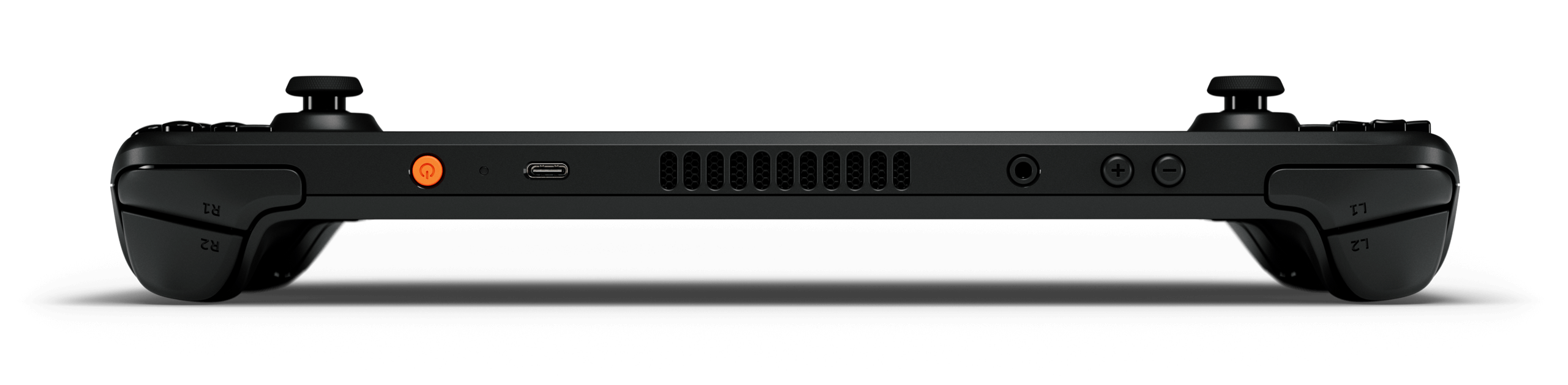
The OLED panel is the headline and it earns it. At 7.4 inches it is physically larger than the LCD’s 7 inches inside the same shell, thanks to slimmer bezels, and it hits 1000 nits peak in HDR, 600 nits in SDR, with 110% P3 coverage and true per-pixel blacks. The 90Hz refresh makes the whole interface feel quicker even before you launch a game. The 1TB model adds premium anti-glare etched glass that genuinely helps outdoors. Build-wise it is the familiar Deck chassis: full-size thumbsticks, two trackpads, gyro, and rear grip buttons, a control layout no Windows rival fully matches. Shaving 30g off makes a real difference across a long session, and the redesigned internals run noticeably cooler and quieter.
Software and setup
SteamOS 3 (Arch-based, KDE Plasma in desktop mode) is the reason to buy this over an Ally. Gaming Mode is fast, stable, and suspend/resume is reliable. For emulation, EmuDeck is the standard one-shot installer: it lays down RetroArch and standalone cores (Dolphin, PCSX2, RPCS3, Ryujinx, Cemu, PPSSPP), wires up Steam ROM Manager so emulated games appear as Steam library entries with box art, and configures controls sanely. You still supply your own BIOS files and legally dumped ROMs. Budget an evening for first setup, then it largely disappears.
Price, value and who it’s for
At its $549 (512GB) and $649 (1TB) launch pricing the OLED was an easy recommendation; note that Valve raised those to $789 and $949 in May 2026, which narrows the gap to faster Windows handhelds and changes the math. Even so, the value proposition is the same: the best handheld screen-plus-battery-plus-software package for someone who wants a console-like device, a massive Steam library, and a frictionless emulation box. Buy it if SteamOS and that OLED matter to you more than chasing the highest native frame rates. Skip it if you need maximum horsepower for new AAA PC releases, where an Ally X or Legion Go will simply run them faster.
📐 Size & Pocketability
⚖️ Weight vs Other Handhelds
🔋 Real-World Battery Estimator
⭐ Emulation Performance
📊 View How This Score is Calculated
The Hardware Power Score is an absolute metric. Perfect emulation of difficult, modern consoles awards significantly more points than standard retro consoles.
- 15× Multiplier: Modern PC
- 12× Multiplier: Switch, PS3, Xbox 360
- 10× Multiplier: Wii U
- 8× Multiplier: PS2, GameCube, Wii, Xbox
- 5× Multiplier: Saturn, Dreamcast, PSP
- 3× Multiplier: N64, PS1
- 1× Multiplier: SNES, GBA
Gen 8 & PC
Generation 7
Generation 6
Generation 5
Handhelds & Retro
⚡ Performance Benchmarks
Where Valve Steam Deck OLED AMD Radeon Steam Deck (8 RDNA 2 CUs) lands against the handhelds everyone knows. Every bar shares one scale, so longer genuinely means faster — add up to two rivals to compare.
CPU = Geekbench 6 multi-core · GPU = 3DMark Wild Life. Median real-world scores; every bar shares one scale — add up to two rivals to compare.
📋 Full Specifications
📺 Display
⚙️ Platform
💾 Memory
🕹️ Controls
📏 Body
🔋 Battery
⚖️ Verdict
✅ The Good
- Gorgeous 7.4" HDR OLED, 90Hz, 1000-nit peak with true blacks
- Bigger 50Whr battery plus the efficient 6nm APU means dramatically longer runtimes
- Lighter (~640g), cooler and quieter than the LCD in the same chassis
- SteamOS plus EmuDeck make it the most frictionless handheld for both Steam and emulation
❌ The Bad
- Same Zen 2 / RDNA 2 performance class as the LCD, so no real frame-rate gain
- Falls behind ROG Ally X and Legion Go on raw horsepower for native AAA PC games
- 2026 price hike to $789/$949 erodes the value edge it launched with
📰 Latest News & Guides
The Ultimate Guide to ARMSX3: Android’s New PS3 Emulator, Competitor Comparisons, and Setup Tutorial
18/08/2026Pokémon Gold, Silver, and Crystal (Gen 2) Recomp Lands on Android
17/08/2026How to Play the Pokémon Red, Blue, or Yellow Recomp on Your Android, Windows, and Linux Devices
16/08/2026🔍 Similar Handhelds
Other handhelds that emulate up to CURRENTGEN.