
🛒 Where to Buy
⚠️ Golden Rule of Retro Handhelds: Throw away the cheap MicroSD card that comes in the box — it will fail. And never use a high-wattage PD “Fast Charger” on these devices; it can damage the battery. Use a standard 5V/1.5A brick.
Device Overview: Anbernic RG ARC-S
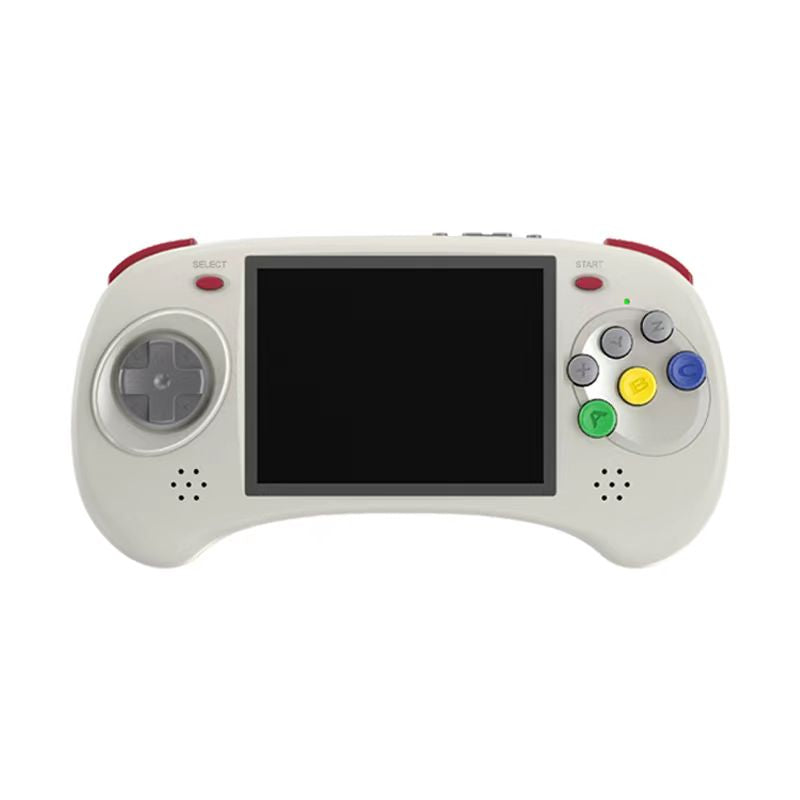
The Anbernic RG ARC-S is the retro-handheld world’s love letter to the SEGA Saturn controller, shrunk into a 191 x 80 x 22 mm slab you hold like a gamepad rather than a phone. Anbernic sells the ARC in two flavours: the ARC-D dual-boots Android and Linux, while this ARC-S is the single-system, Linux-only sibling. Both ride the same Rockchip RK3566 silicon, so the ARC-S is not a cheaper chip, just a leaner software load and a lower sticker price. Its defining trait is the face layout: a six-button A/B/C/X/Y/Z arc lifted straight from Saturn and Mega Drive fighting pads, and, crucially, no analog sticks at all. That one decision tells you exactly what this device is built for and what it will fumble.
Emulation performance, generation by generation
The RK3566 is a quad-core Cortex-A55 clocked to 1.8 GHz with a Mali-G52 2EE GPU and just 1 GB of LPDDR4. This is a known, middle-aged chip, the same one inside the Powkiddy RGB30 and Anbernic’s RG353 line, so its ceiling is well mapped. Everything through the fourth generation runs without drama: NES, SNES, Genesis, Master System, PC Engine, Game Boy through GBA and Neo Geo all hit full speed under RetroArch. Arcade is where this device shines, because CPS1/2/3, Neo Geo and most pre-3D boards map perfectly onto that six-button arc. PlayStation 1 is comfortable through DuckStation or PCSX-ReARMed, and Nintendo 64 is playable on Mupen64Plus for the lighter half of the library, with the usual per-game compatibility caveats.
Push past that and the compromises show. Dreamcast via Flycast runs 2D fighters and lighter 3D titles but is not a full-library machine. Saturn is the honest heartbreak: despite the Saturn-styled shell, Saturn emulation through Beetle Saturn or YabaSanshiro is punishing, and 1 GB of RAM on an A55 cluster means 2D Saturn games are the realistic target, not Burning Rangers. PSP through PPSSPP will boot, but two things fight it, the missing analog sticks and the thermal budget of a fanless RK3566, so treat 3D PSP as a bonus rather than a promise. This is a 2D-first machine that happens to peek into early 3D.
Screen, build and controls
The 4.0-inch IPS panel runs 640 x 480 at a native 4:3 ratio, roughly 200 PPI, bonded with OCA so there is no air gap between glass and pixels. That 4:3 shape is the right call for a machine built around 2D and arcade content: SNES, Genesis and CPS games fill the screen instead of floating between pillarbox bars. It is 60 Hz, non-touch and sharp for its size. The body weighs about 240 grams and stretches wide in the hand like a real controller, with a top-mounted D-pad and stacked L1/R1, L2/R2 shoulders. The star is that six-button face cluster, which is genuinely the best way to play Street Fighter, King of Fighters and Saturn-era 2D on a handheld. There is a 3.5mm headphone jack, stereo speakers, a rumble motor, WiFi 5 and Bluetooth 4.2, and the 3500 mAh battery holds up for roughly six hours of 2D emulation before the USB-C port earns its keep. The cost of the control layout, though, is total: with no sticks, anything that needs one, most N64, twin-stick shooters, dual-analog PS1 games, is played on the D-pad or not at all.
Software and setup
Out of the box the ARC-S runs Anbernic’s own Linux build with a stock front-end and a bundled microSD of ROMs. It boots straight to games and works, but like most stock Anbernic firmware it is the floor, not the ceiling. The RK3566 has a mature custom-firmware scene: ROCKNIX and ArkOS both support the ARC, and either gives you cleaner RetroArch integration, better scraping, per-core control mapping and more consistent performance. Installation is the familiar routine of flashing an image to a second microSD, and the device has dual card slots for exactly this. Note that muOS and OnionOS are not options here; those belong to Allwinner H700 and Miyoo hardware respectively, so ignore anyone pointing you toward them for this chip. If you own the ARC-D instead, GammaOS covers its Android side, but that does not apply to this Linux-only ARC-S.
Price, value and who it is for
Anbernic has listed the ARC-S from the high-$70s to high-$80s depending on sale and included microSD size, with the official store recently showing it near $88 before it sold out. At that price it is neither the fastest RK3566 handheld you can buy nor the cheapest; the value is entirely in the control layout. If your emulation life is arcade fighters, Neo Geo, Genesis, SNES and PS1 2D, the six-button Saturn arc makes this one of the most enjoyable ways to play those libraries, and the 4:3 screen backs that up. If you want N64, Dreamcast 3D, PSP or anything that leans on an analog stick, buy something with sticks instead. The ARC-S is a specialist, and it is refreshingly honest about being one.
📐 Size & Pocketability
⚖️ Weight vs Other Handhelds
🔋 Real-World Battery Estimator
⭐ Emulation Performance
📊 View How This Score is Calculated
The Hardware Power Score is an absolute metric. Perfect emulation of difficult, modern consoles awards significantly more points than standard retro consoles.
- 15× Multiplier: Modern PC
- 12× Multiplier: Switch, PS3, Xbox 360
- 10× Multiplier: Wii U
- 8× Multiplier: PS2, GameCube, Wii, Xbox
- 5× Multiplier: Saturn, Dreamcast, PSP
- 3× Multiplier: N64, PS1
- 1× Multiplier: SNES, GBA
Generation 6
Generation 5
Handhelds & Retro
⚡ Performance Benchmarks
Where Anbernic RG ARC-S ARM Mali-G52 MP2 (2EE) lands against the handhelds everyone knows. Every bar shares one scale, so longer genuinely means faster — add up to two rivals to compare.
CPU = Geekbench 6 multi-core · GPU = 3DMark Wild Life. Median real-world scores; every bar shares one scale — add up to two rivals to compare.
📋 Full Specifications
📺 Display
⚙️ Platform
💾 Memory
🕹️ Controls
📏 Body
🔋 Battery
⚖️ Verdict
✅ The Good
- Six-button A/B/C/X/Y/Z Saturn-style face layout is the best handheld option for CPS, Neo Geo and Saturn-era 2D fighters
- Native 4:3 640×480 IPS panel with OCA bonding fills the screen for SNES, Genesis and arcade without pillarboxing
- Mature RK3566 platform with ROCKNIX and ArkOS custom-firmware support plus dual microSD card slots
- Wide, controller-shaped body with a comfortable top-mounted D-pad and stacked L1/R1, L2/R2 shoulders
❌ The Bad
- No analog sticks at all, which rules out comfortable N64, Dreamcast 3D, PSP and dual-analog PS1 play
- Only 1 GB of RAM on a fanless Cortex-A55 chip caps Saturn to 2D titles and makes PSP/Dreamcast hit-or-miss
- Priced in the high-$80s despite mid-tier RK3566 silicon, so you pay for the layout, not the horsepower
📰 Latest News & Guides
The Ultimate Guide to ARMSX3: Android’s New PS3 Emulator, Competitor Comparisons, and Setup Tutorial
18/08/2026Pokémon Gold, Silver, and Crystal (Gen 2) Recomp Lands on Android
17/08/2026How to Play the Pokémon Red, Blue, or Yellow Recomp on Your Android, Windows, and Linux Devices
16/08/2026🔍 Similar Handhelds
Other handhelds that emulate up to PSP.