
🛒 Where to Buy
⚠️ Golden Rule of Retro Handhelds: Throw away the cheap MicroSD card that comes in the box — it will fail. And never use a high-wattage PD “Fast Charger” on these devices; it can damage the battery. Use a standard 5V/1.5A brick.
Device Overview: AYANEO 2S
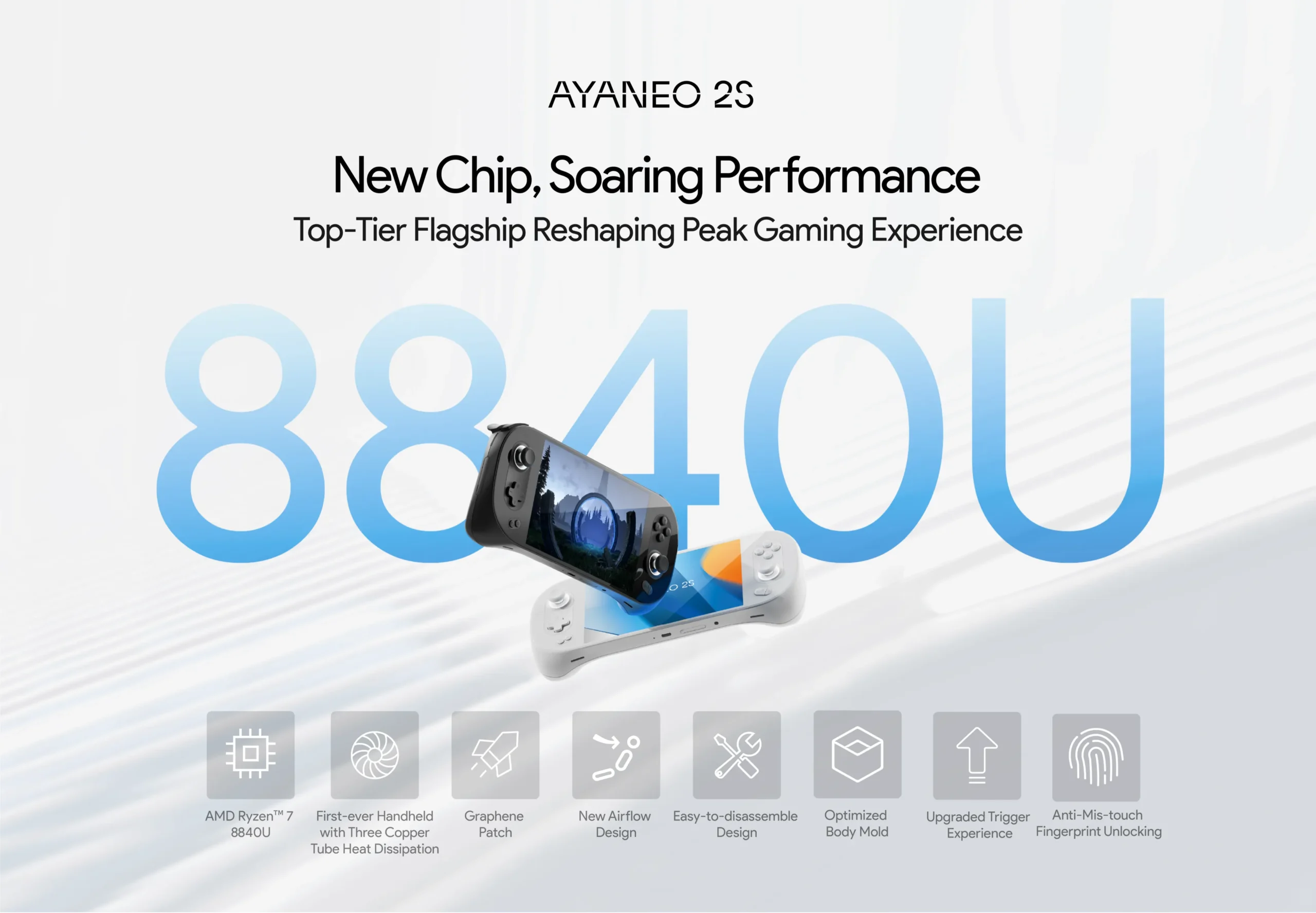
The AYANEO 2S is what happens when a boutique manufacturer decides the Steam Deck was a fine idea executed too cheaply. It takes the chassis of the original AYANEO 2 and drops in AMD’s Ryzen 7 7840U (Zen 4, eight cores, with the Radeon 780M handling graphics on twelve RDNA 3 compute units), the same Phoenix silicon that defined the 2023-2024 premium handheld class. Around that sits a 7-inch 1920×1200 IPS panel, a 50.25Wh battery, Hall-effect everything, and Windows 11. It is fast, it is heavy at 667 grams, and it costs more than most people will ever justify spending on a portable. AYANEO knows this and leans into it: aluminum, glass, RGB sticks, retail pricing that opened around $1,099-$1,139 and climbed past $1,800 for the 64GB/4TB configuration. This is a luxury object that happens to run Doom.
Emulation performance, generation by generation
The 7840U is one of the best emulation chips you can hold in two hands, and the 2S exploits it. PS2 through PCSX2 and GameCube/Wii through Dolphin are effortless — internal resolution multipliers cranked to 3x or 4x, full speed, fans barely audible. PSP (PPSSPP), Saturn, Dreamcast, and everything below run with zero thought. The interesting tier is Nintendo Switch: Ryujinx and the Yuzu forks push the bulk of the library to a locked or near-locked framerate, with the usual heavy hitters (Tears of the Kingdom, the demanding first-party stuff) needing patches and a tolerance for occasional shader-compilation stutter. PS3 via RPCS3 is genuinely playable here — not “every game,” but a large, real slice of the catalog runs well, which was unthinkable on handhelds a generation earlier. Wii U through Cemu is the comfortable surprise; it runs better than its source hardware ever did. The honest ceiling sits at Xbox 360: Xenia is improving but remains experimental, and on the 2S you’ll get some titles running and many fighting you. Treat 360 as a bonus, not a feature. PS4 and Switch 2 are not on the table.
Screen, build and controls
The 7-inch IPS display runs at 1920×1200 — a 16:10 panel rated around 450-500 nits with roughly 96-130% sRGB coverage depending on which figure AYANEO is quoting that week. It is sharp at 323 PPI and bright enough for indoor use, though it is a standard 60Hz LCD, not OLED and not high-refresh, which at this price stings. The build is where your money visibly goes: a dense, well-machined shell, 2.5D glass, and a hand-feel that shames plastic competitors. The controls are the headline. Hall-effect joysticks mean no drift, ever, with RGB rings around them; the triggers are linear Hall triggers with real analog travel, which matters for racing and shooters. Dual six-axis gyro and an HD linear-motor rumble round it out. At 667 grams it is noticeably heavier than a Steam Deck, and long sessions remind you of it.
Software and setup
This is a Windows 11 machine, and that is both the appeal and the tax. You get an open PC: Steam, Epic, Game Pass, EmuDeck for Windows, RetroArch, every standalone emulator, no walled garden. You also get Windows on a 7-inch touchscreen, which means driver updates, the occasional UAC prompt you can’t read, and a desktop that was never designed for thumbsticks. AYANEO’s answer is AYASpace, its overlay for TDP control (the 7840U scales from roughly 15W up to a 28-38W boost mode), fan curves, and a controller-friendly launcher. It is functional but not Valve-polished. Most owners pair it with Playnite as a unified front-end to make the thing feel like a console on boot. Budget an afternoon for first-time setup: BIOS, drivers, AYASpace, your emulation stack, and a front-end. The reward is a device that does literally everything; the cost is that nothing is done for you.
Price, value and who it’s for
At $1,099-plus, the 2S competes against the same 7840U in cheaper bodies. The AOKZOE A1 Pro offers an 8-inch screen and a bigger battery for less. The ASUS ROG Ally (Z1 Extreme, close cousin to the 7840U) undercuts it by hundreds of dollars with a 120Hz display and proper retail support, at the cost of build quality and Hall sticks. GPD’s WIN 4 and clamshells chase different form factors entirely. The 2S wins on materials, on its drift-proof Hall controls, and on a certain hardware fetishism — it is the best-built of the bunch and feels it. It loses on value, plainly. Buy it if you want the nicest possible 7840U handheld, you’ll tinker with Windows happily, and price is a secondary concern. Skip it if you want OLED, high refresh, or the most frames per dollar — the Ally or a Steam Deck OLED will serve you better and leave money for games.
📐 Size & Pocketability
⚖️ Weight vs Other Handhelds
🔋 Real-World Battery Estimator
⭐ Emulation Performance
📊 View How This Score is Calculated
The Hardware Power Score is an absolute metric. Perfect emulation of difficult, modern consoles awards significantly more points than standard retro consoles.
- 15× Multiplier: Modern PC
- 12× Multiplier: Switch, PS3, Xbox 360
- 10× Multiplier: Wii U
- 8× Multiplier: PS2, GameCube, Wii, Xbox
- 5× Multiplier: Saturn, Dreamcast, PSP
- 3× Multiplier: N64, PS1
- 1× Multiplier: SNES, GBA
Gen 8 & PC
Generation 7
Generation 6
Generation 5
Handhelds & Retro
⚡ Performance Benchmarks
Where AYANEO 2S AMD Radeon 780M lands against the handhelds everyone knows. Every bar shares one scale, so longer genuinely means faster — add up to two rivals to compare.
CPU = Geekbench 6 multi-core · GPU = 3DMark Wild Life. Median real-world scores; every bar shares one scale — add up to two rivals to compare.
📋 Full Specifications
📺 Display
⚙️ Platform
💾 Memory
🕹️ Controls
📏 Body
🔋 Battery
⚖️ Verdict
✅ The Good
- Hall-effect joysticks and linear Hall triggers: zero drift, genuine analog trigger travel
- Exceptional aluminum-and-glass build quality that outclasses every mainstream rival
- Ryzen 7 7840U / Radeon 780M chews through PS2, GameCube, Wii, Switch and a real slice of PS3 (RPCS3)
- Fully open Windows 11 PC: Steam, Game Pass, every emulator, no walled garden
❌ The Bad
- Brutally expensive, from ~$1,099 to over $1,800, against cheaper handhelds using the identical APU
- 60Hz IPS panel, not OLED and not high-refresh, at a flagship price
- Heavy at 667g and saddled with the usual Windows-on-a-touchscreen setup friction
📰 Latest News & Guides
The Ultimate Guide to ARMSX3: Android’s New PS3 Emulator, Competitor Comparisons, and Setup Tutorial
18/08/2026Pokémon Gold, Silver, and Crystal (Gen 2) Recomp Lands on Android
17/08/2026How to Play the Pokémon Red, Blue, or Yellow Recomp on Your Android, Windows, and Linux Devices
16/08/2026🔍 Similar Handhelds
Other handhelds that emulate up to CURRENTGEN.