
🛒 Where to Buy
⚠️ Golden Rule of Retro Handhelds: Throw away the cheap MicroSD card that comes in the box — it will fail. And never use a high-wattage PD “Fast Charger” on these devices; it can damage the battery. Use a standard 5V/1.5A brick.
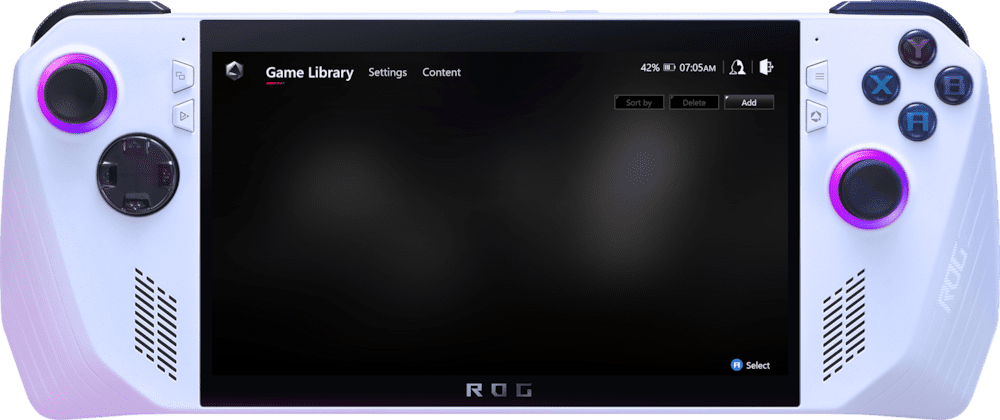
Device Overview: Asus ROG Ally
The 2023 ROG Ally is the handheld that made the Steam Deck nervous. Asus took a full Windows 11 PC, wrapped it in a 608g body roughly the footprint of a Switch OLED, and dropped in an AMD chip co-developed with AMD specifically for handhelds. The result is the mainstream Windows handheld: more raw power than the Steam Deck OLED, a sharper and far brighter screen, and the entire Windows games library — Steam, Game Pass, Epic, GOG, emulators, anything — with no compatibility layer in the way.
The model to buy is the Ryzen Z1 Extreme: 8 Zen 4 cores, 16 threads, and an RDNA 3 Radeon 780M iGPU with 12 compute units. There is a cheaper Ryzen Z1 (non-Extreme) at launch — 6 cores and only 4 RDNA 3 CUs — and it is genuinely not worth the $100 saving; the GPU deficit is brutal, so skip it. Both ship with 16GB LPDDR5-6400 and a 512GB PCIe 4.0 NVMe SSD (a real 2230 stick you can swap). Against the field, the Ally undercuts the Legion Go on size and weight, beats the Steam Deck OLED on brightness and peak frame rates, and was later superseded by the ROG Ally X (same chip, bigger 80Wh battery, 24GB RAM, better ergonomics) — but the original launched at $699 and now sells well below it.
Emulation performance, generation by generation
This is where the Z1 Extreme earns its keep, helped by AVX-512 support that a lot of x86 handhelds lack. Everything up to the sixth generation is effortless: PS2 (PCSX2), GameCube and Wii (Dolphin) run at 1080p 60fps with headroom and modest power draw — Dolphin hitting 1080p60 around 7W is the kind of efficiency the Steam Deck can’t match here. The seventh generation is realistic but demands tuning: PS3 (RPCS3) runs many titles at 1080p 60fps on a Performance profile, and Switch (historically Yuzu/Ryujinx, now community successors) reaches 1080p in plenty of games, though both PS3 and Switch are per-title gambles, not blanket guarantees. Wii U (Cemu) sits in the same comfortable bracket. Xbox 360 (Xenia) is the rough edge — Xenia’s canary builds run standouts like Forza Horizon 2 at high frame rates, but the emulator’s compatibility is patchy and many games stutter, crash, or simply don’t boot. Treat 360 as a “some games” platform, not a library you can rely on.
Screen, build and controls
The 7-inch 1920×1080 120Hz IPS panel is the Ally’s headline feature and remains one of the best on any handheld: 500 nits, 100% sRGB, FreeSync Premium, and Gorilla Glass Victus. After the Steam Deck LCD it looks like a different decade; only the Deck OLED’s contrast claws anything back. The body is light at 608g and comfortable, with Hall Effect analog triggers, two full-size sticks, a 6-axis gyro, and HD haptics. Note the nuance: the triggers are Hall Effect, but the sticks are conventional potentiometer units, so the original Ally is not immune to stick drift the way fully Hall-sensor handhelds are. The real black mark is the microSD slot: it sits directly over an exhaust vent, and under sustained load the heat could kill cards outright. Asus acknowledged it, pushed fan-curve firmware to mitigate it, and offered RMAs — but it was a genuine hardware design flaw, and the safer move is to put your library on the swappable internal SSD.
Software and setup
You get Windows 11 Home and Armoury Crate SE as the controller-friendly launcher and fan/TDP control center. The power knob is great — you can dial 10W/15W/25W (and a 30W plugged-in Turbo) to trade frame rate for battery. The catch is the Windows tax. Out of the box this is a desktop OS bolted onto a 7-inch touchscreen: tiny menus, update nags, a Start menu that wasn’t built for thumbsticks, and Armoury Crate that was buggy at launch. Budget an afternoon. The community fix is to layer Playnite as a unified big-picture front end and run EmuDeck for Windows to auto-configure your emulators and ROM folders. Once tamed it’s the most flexible handheld going; untamed it’s fiddlier than a Steam Deck.
Price, value and who it’s for
At its $699 launch the Ally was a tougher sell against a $549 Steam Deck OLED, but on discount — and it discounts hard — it becomes the obvious pick for anyone who wants Windows, Game Pass, and serious emulation in one device. The 40Wh battery is the honest weakness: an hour to ninety minutes in a demanding game, which is why the Ally X exists. Buy the Z1 Extreme if you want maximum compatibility and the best handheld screen and you’ll happily tinker. Buy a Steam Deck OLED instead if you want SteamOS to “just work” and battery life over peak power.
📐 Size & Pocketability
⚖️ Weight vs Other Handhelds
🔋 Real-World Battery Estimator
⭐ Emulation Performance
📊 View How This Score is Calculated
The Hardware Power Score is an absolute metric. Perfect emulation of difficult, modern consoles awards significantly more points than standard retro consoles.
- 15× Multiplier: Modern PC
- 12× Multiplier: Switch, PS3, Xbox 360
- 10× Multiplier: Wii U
- 8× Multiplier: PS2, GameCube, Wii, Xbox
- 5× Multiplier: Saturn, Dreamcast, PSP
- 3× Multiplier: N64, PS1
- 1× Multiplier: SNES, GBA
Gen 8 & PC
Generation 7
Generation 6
Generation 5
Handhelds & Retro
📋 Full Specifications
📺 Display
⚙️ Platform
💾 Memory
🕹️ Controls
📏 Body
🔋 Battery
⚖️ Verdict
✅ The Good
- Excellent 7-inch 1080p 120Hz IPS panel — bright (500 nits), sharp, FreeSync, best-in-class for its generation
- Ryzen Z1 Extreme (RDNA 3 780M) is a strong emulation chip; AVX-512 helps PS3/Xbox 360 emulators
- Full Windows 11: entire PC library, Game Pass, every storefront and emulator, no compatibility layer
- Light (608g), comfortable, with Hall Effect triggers and a user-swappable 2230 NVMe SSD
❌ The Bad
- microSD slot sits over an exhaust vent and can overheat and kill cards (mitigated by firmware, not fully fixed)
- Small 40Wh battery — roughly 1 to 1.5 hours in demanding games
- Windows-on-a-handheld is fiddly out of the box (tiny UI, buggy launch-era Armoury Crate, manual setup)
📰 Latest News & Guides
The Ultimate Guide to ARMSX3: Android’s New PS3 Emulator, Competitor Comparisons, and Setup Tutorial
18/08/2026Pokémon Gold, Silver, and Crystal (Gen 2) Recomp Lands on Android
17/08/2026How to Play the Pokémon Red, Blue, or Yellow Recomp on Your Android, Windows, and Linux Devices
16/08/2026🔍 Similar Handhelds
Other handhelds that emulate up to CURRENTGEN.