
🛒 Where to Buy
⚠️ Golden Rule of Retro Handhelds: Throw away the cheap MicroSD card that comes in the box — it will fail. And never use a high-wattage PD “Fast Charger” on these devices; it can damage the battery. Use a standard 5V/1.5A brick.
Device Overview: AYN Loki
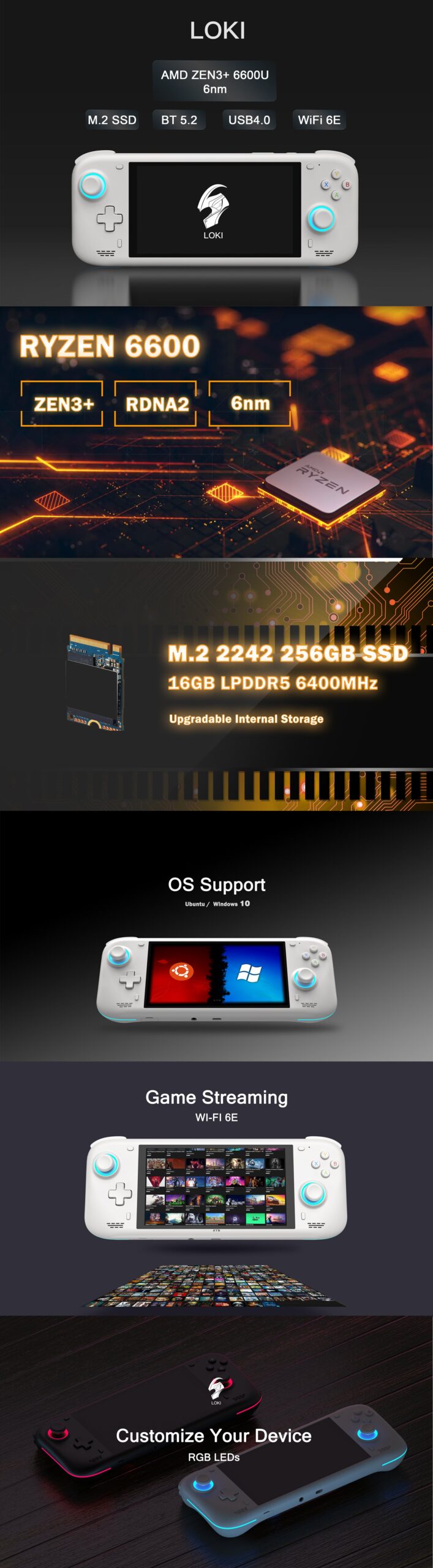
First, a name that trips up almost everyone: “AYN Loki” is not one device but a family, and the model AYN literally sells as the Loki is not the weak one. That confusion matters because the Loki line spans four very different machines. The Loki Zero runs an ancient AMD Athlon Silver 3050e and a 720p screen. The Loki Mini and Loki Mini Pro use AMD’s low-power Mendocino (Zen 2, two RDNA 2 compute units) or an Intel Pentium/Celeron. The Loki Max sits at the top with a Ryzen 7 6800U and Radeon 680M. The plain Loki reviewed here sits one rung below the Max, running an AMD Ryzen 5 6600U (Zen 3+, 6 cores / 12 threads, up to 4.5 GHz) with Radeon 660M graphics. So if you read elsewhere that “the base Loki” is a feeble Mendocino tablet, that writer was describing the Zero or the Mini, not this one.
That distinction sets the positioning. The Loki is AYN’s affordable real Windows handheld, undercutting the Max while keeping a genuine Ryzen 6000 APU rather than dropping to Mendocino. Against a Steam Deck, the comparison is close: the 660M is in the same neighborhood as the Deck’s RDNA 2 GPU, the Loki adds a sharper native 1080p panel and Windows flexibility, and it gives that up in exchange for SteamOS’s tuned, suspend-anywhere convenience. The gap to the Loki Max is real but narrower than the price difference suggests: the 6800U’s 680M has more compute units and clocks higher, so the Max pulls ahead at high TDP, but the 660M is a capable part, not a Mendocino afterthought.
Emulation performance, generation by generation
The 660M is strong enough that the honest dividing line falls between PS3/Wii U and Switch, not earlier. Everything through PlayStation, N64, Dreamcast, PSP and Saturn runs at high internal resolutions with headroom to spare. PS2 and GameCube are comfortable, frequently at 2x-3x render scale. Wii is solid. PSP titles upscale cleanly to 2x and beyond.
PS3 via RPCS3 is where the Loki genuinely impresses for a chip this size: reviewers ran God of War, X-Men and Ragnarok Odyssey at 2x at roughly 10-15W. It is not blanket “PS3 works,” though. RPCS3 remains a per-title affair, the heavier first-party games still demand patience, and you will lean on community config tweaks. Switch emulation is the real ceiling. Lighter and mid-tier titles are playable, but the demanding 3D games are case-by-case and often need resolution and frame compromises. This is not a 6800U, and it is emphatically not the place to expect locked Switch performance. If flawless Switch and the toughest PS3 games are your priority, the Loki Max’s 680M is the chip to buy.
Screen, build and controls
The display is a 6-inch 1080p IPS LCD with touch, 16:9, 60 Hz. At 6 inches, 1080p is genuinely sharp (around 367 ppi), and the native panel renders modern Windows games and PS3/Switch upscales crisply. The 16:9 shape does mean letterboxing on 4:3 retro content, an unavoidable trade for a widescreen panel.
The body is plastic with contoured grips, about 248 x 98 mm and roughly 568-573 g, so it is lighter than a Steam Deck but chunkier than a phone-thin Mendocino unit. Controls are the strong suit: Hall-effect analog sticks (drift-resistant), analog L2/R2 triggers, a stacked shoulder layout, a dome-style D-pad, gyro, rumble, and two programmable rear buttons. Connectivity is current: USB 4.0, Wi-Fi 6E, Bluetooth 5.2, a microSD slot and a 3.5 mm jack. Battery is around 40.5 Wh (the Loki Max steps up to 46.2 Wh), so expect modest runtime under load and the usual handheld-PC habit of capping TDP to stretch it.
Software and setup
The Loki ships with Windows 11, and that is both its freedom and its tax. You get the full PC: Steam, Epic, Game Pass, every emulator front-end, and no walled garden. You also inherit Windows on a 15W-class chip, which means desktop overhead, driver and update interruptions, and a touch-and-gamepad interface that Windows still handles awkwardly. Plan on installing a handheld launcher overlay, dialing in per-game TDP, and doing the initial setup work yourself. A 6600U has less thermal and power budget to absorb that overhead than the Max, so leaving Windows untuned costs you more here proportionally. Budget an afternoon before it feels like a console.
Price, value and who it’s for
Pricing is the other place the “base” framing misleads. The genuinely cheap Loki tiers are the Zero and Mini, which start near $199-299. The Ryzen 5 6600U Loki is not in that band: it launched around $449-499 depending on storage (256 GB or 512 GB), with 16 GB LPDDR5 on the higher configs. That puts it against the Steam Deck and below the Loki Max rather than against budget tablets. It earns the position if you want native 1080p, Windows openness and Hall-effect sticks, and you accept doing the software legwork. Buy the Loki if PS2/GC/Wii/PSP perfection and solid case-by-case PS3 are your target. Step up to the Loki Max only if locked Switch and the heaviest PS3 titles are non-negotiable, and drop to the Zero or Mini only if your real budget is sub-$300 and you understand you are getting a far weaker machine.
📐 Size & Pocketability
⚖️ Weight vs Other Handhelds
🔋 Real-World Battery Estimator
⭐ Emulation Performance
📊 View How This Score is Calculated
The Hardware Power Score is an absolute metric. Perfect emulation of difficult, modern consoles awards significantly more points than standard retro consoles.
- 15× Multiplier: Modern PC
- 12× Multiplier: Switch, PS3, Xbox 360
- 10× Multiplier: Wii U
- 8× Multiplier: PS2, GameCube, Wii, Xbox
- 5× Multiplier: Saturn, Dreamcast, PSP
- 3× Multiplier: N64, PS1
- 1× Multiplier: SNES, GBA
Gen 8 & PC
Generation 7
Generation 6
Generation 5
Handhelds & Retro
⚡ Performance Benchmarks
Where AYN Loki AMD Radeon 660M lands against the handhelds everyone knows. Every bar shares one scale, so longer genuinely means faster — add up to two rivals to compare.
CPU = Geekbench 6 multi-core · GPU = 3DMark Wild Life. Median real-world scores; every bar shares one scale — add up to two rivals to compare.
📋 Full Specifications
📺 Display
⚙️ Platform
💾 Memory
🕹️ Controls
📏 Body
🔋 Battery
⚖️ Verdict
✅ The Good
- Real Ryzen 5 6600U / Radeon 660M, not a weak Mendocino chip — comfortably handles PS2, GameCube, Wii, PSP and capable case-by-case PS3
- Sharp native 6-inch 1080p IPS touchscreen, crisp at ~367 ppi for modern and upscaled games
- Hall-effect analog sticks plus gyro, rumble, analog triggers and two programmable back buttons
- Modern, open connectivity and platform: USB 4.0, Wi-Fi 6E, Bluetooth 5.2, microSD, and full Windows 11 with every storefront and emulator
❌ The Bad
- Switch emulation and the heaviest PS3 titles are a real ceiling — clearly behind the Loki Max's 6800U/680M, not a substitute for it
- Windows 11 overhead on a ~15W chip means setup work, update interruptions and a clunky touch UI before it feels console-like
- Smaller ~40.5 Wh battery and plastic build, with modest runtime under load and 16:9 letterboxing on 4:3 retro content
📰 Latest News & Guides
The Ultimate Guide to ARMSX3: Android’s New PS3 Emulator, Competitor Comparisons, and Setup Tutorial
18/08/2026Pokémon Gold, Silver, and Crystal (Gen 2) Recomp Lands on Android
17/08/2026How to Play the Pokémon Red, Blue, or Yellow Recomp on Your Android, Windows, and Linux Devices
16/08/2026🔍 Similar Handhelds
Other handhelds that emulate up to CURRENTGEN.