
🛒 Where to Buy
⚠️ Golden Rule of Retro Handhelds: Throw away the cheap MicroSD card that comes in the box — it will fail. And never use a high-wattage PD “Fast Charger” on these devices; it can damage the battery. Use a standard 5V/1.5A brick.
Device Overview: MagicX XU10
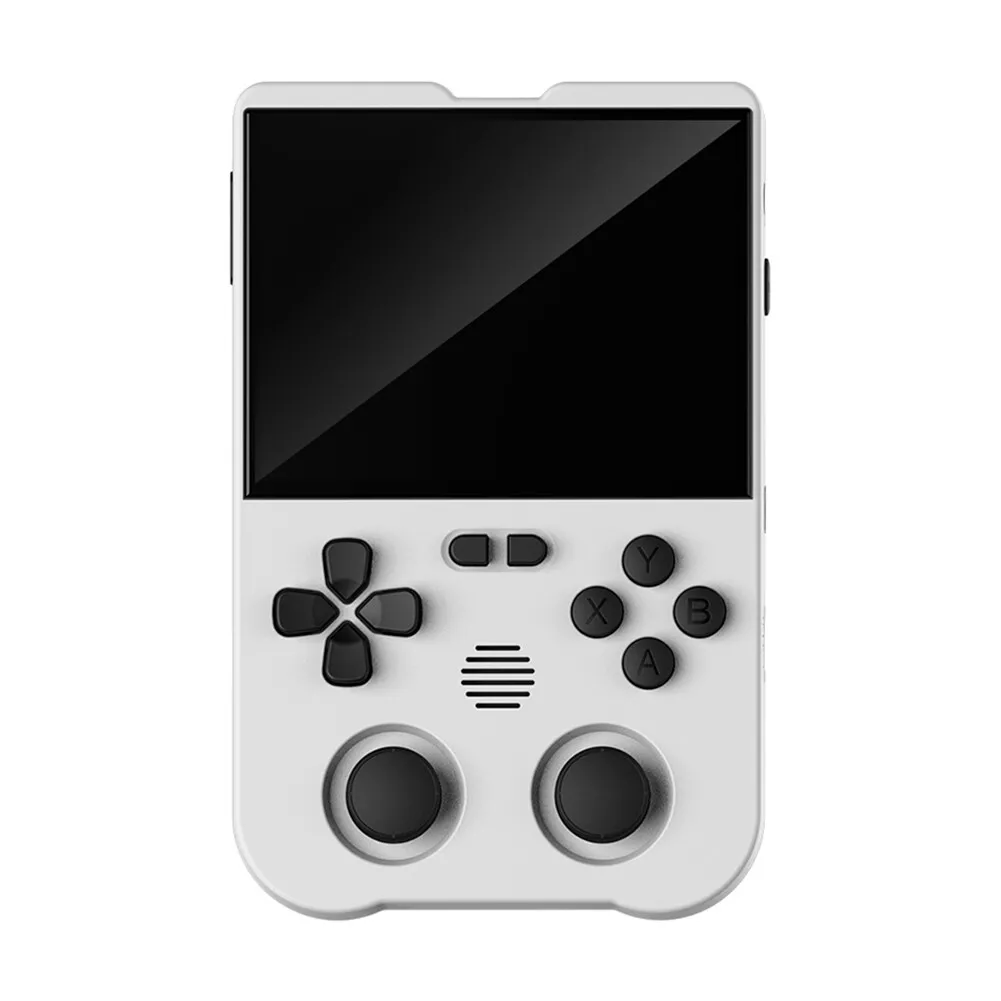
The MagicX XU10 is a compact horizontal handheld built around the Rockchip RK3326, the same six-year-old budget SoC that powered the Anbernic RG351 family and a dozen other sub-$80 Linux emulators. That single fact tells you most of what you need to know: this is not a Snapdragon Android powerhouse but a cheap, self-contained retro player aimed squarely at 8- and 16-bit libraries with a helping of PlayStation 1 on top. MagicX marketed early units as carrying the “RK3326S,” and buyers quickly found that many shipped with the plain RK3326 instead. In practice the difference is trivial, since both are quad Cortex-A35 parts, but it was a bad look for a brand already fighting a reputation for muddled spec sheets. The XU10 launched in late 2023 around $65-70 and has since been cleared out closer to $35-45.
Emulation performance, generation by generation
Set your expectations by the chip, not the marketing. Four Cortex-A35 cores top out near 1.3-1.5 GHz alongside a Mali-G31 MP2 GPU and just 1 GB of RAM, so this is firmly a retro-first device. Running RetroArch, everything up to the 16-bit era is flawless: NES, SNES, Master System, Genesis/Mega Drive, PC Engine, Neo Geo, and Game Boy through Game Boy Advance (gpSP or mGBA) all hit full speed with headroom left over. PlayStation 1 through PCSX ReARMed is the real sweet spot, with the vast majority of the library running at full frame rate. Above that line, performance gets ragged fast. Nintendo 64 through Mupen64Plus is a lottery: Super Mario 64 and lighter titles are playable, but demanding games stutter or break. Dreamcast via Flycast handles 2D fighters and simpler 3D titles yet chokes on anything heavy. PSP through PPSSPP is technically present, and MagicX pushed firmware tuning that reportedly lifted it 15-20 percent, but realistically you get 2D and light 3D games at reduced resolution, not God of War at full speed. Sega Saturn and anything newer are out of reach. Read “up to Dreamcast” as a headline, not a guarantee.
Screen, build and controls
The 3.5-inch IPS panel runs 640×480 at a native 4:3 aspect, and that is genuinely the right call. Retro consoles output 4:3, so pixel art and PS1 games fill the glass without the black bars a 16:9 handheld forces on them. At roughly 228 PPI it looks sharp, and the 60 Hz IPS gives respectable color and viewing angles for the price. The shell is plastic, about 190 g, with a contoured grip, a vibration motor, and a small fan for cooling. The control layout is unusual: a separated d-pad and face buttons sit up top, while dual clickable analog sticks live low on the face. Nothing in the specs mentions Hall-effect sensors, so assume standard potentiometer sticks that may drift over time. You get L1/R1 and L2/R2 on a horizontal shoulder shelf. Audio comes from a single mono front speaker, a real step down from stereo rivals, though the headphone jack is present. Two microSD slots let you keep firmware and ROMs on separate cards.
Software and setup
Out of the box it runs a MagicX-customized Linux front-end that works but feels rough, and the stock firmware has historically needed patching to fix game-specific errors. The real value lives in the community. Because it is an RK3326 board, the XU10 inherits one of the most mature custom-firmware ecosystems in the hobby: ROCKNIX, AmberELEC, and UnofficialOS all support it or run with minimal fiddling. Those images are faster, better organized, and far better maintained than the stock OS, with proper RetroArch integration and per-system overrides. Setup is the familiar routine of flashing a CFW image to a microSD with balenaEtcher, loading ROMs onto the second card, and booting. One caveat looms over all of it: there is no WiFi or Bluetooth. That means no online box-art scraping, no wireless controllers, and no over-the-air updates. Everything moves by SD card, which some people prefer for its simplicity and others will find archaic in 2026.
Price, value and who it is for
At clearance pricing the XU10 is a sensible buy for anyone who wants a pocketable, 4:3, self-contained machine for GBA, SNES, Genesis, and PS1, and nothing heavier. At its original ~$70 it was a much harder sell, because the RK3326 platform was already aging and Anbernic’s RG35XX line offered similar or better value with cleaner firmware. The mono speaker, the total lack of wireless, and MagicX’s loose relationship with its own spec sheet are the genuine knocks against it. Buy it if you specifically want the tall 4:3 display and dual sticks on a budget RK3326 body and you are comfortable flashing ROCKNIX on day one. If you actually need N64, Dreamcast, or PSP to run well, put the money toward an Android or Allwinner H700-class device instead, and treat the XU10 as the pure retro sidekick it really is.
📐 Size & Pocketability
⚖️ Weight vs Other Handhelds
🔋 Real-World Battery Estimator
⭐ Emulation Performance
📊 View How This Score is Calculated
The Hardware Power Score is an absolute metric. Perfect emulation of difficult, modern consoles awards significantly more points than standard retro consoles.
- 15× Multiplier: Modern PC
- 12× Multiplier: Switch, PS3, Xbox 360
- 10× Multiplier: Wii U
- 8× Multiplier: PS2, GameCube, Wii, Xbox
- 5× Multiplier: Saturn, Dreamcast, PSP
- 3× Multiplier: N64, PS1
- 1× Multiplier: SNES, GBA
Generation 6
Generation 5
Handhelds & Retro
⚡ Performance Benchmarks
Where MagicX XU10 Mali-G31 MP2 lands against the handhelds everyone knows. Every bar shares one scale, so longer genuinely means faster — add up to two rivals to compare.
CPU = Geekbench 6 multi-core · GPU = 3DMark Wild Life. Median real-world scores; every bar shares one scale — add up to two rivals to compare.
📋 Full Specifications
📺 Display
⚙️ Platform
💾 Memory
🕹️ Controls
📏 Body
🔋 Battery
⚖️ Verdict
✅ The Good
- Native 4:3 640×480 IPS screen fills the frame for retro and PS1 games with no letterboxing
- Excellent custom-firmware support (ROCKNIX, AmberELEC, UnofficialOS) thanks to the well-worn RK3326 platform
- Dual clickable analog sticks and full L1/R1/L2/R2 on a sub-$70 body, plus two microSD slots
- Cheap, especially at clearance prices, for flawless 8/16-bit and PS1 emulation
❌ The Bad
- Mono speaker and no WiFi or Bluetooth, so no wireless controllers, scraping, or OTA updates
- Aging RK3326 chip and 1 GB RAM cap it at PS1; N64, Dreamcast, and PSP are unreliable
- MagicX advertised an "RK3326S" but shipped plain RK3326 units, and stock firmware needed patching
📰 Latest News & Guides
The Ultimate Guide to ARMSX3: Android’s New PS3 Emulator, Competitor Comparisons, and Setup Tutorial
18/08/2026Pokémon Gold, Silver, and Crystal (Gen 2) Recomp Lands on Android
17/08/2026How to Play the Pokémon Red, Blue, or Yellow Recomp on Your Android, Windows, and Linux Devices
16/08/2026🔍 Similar Handhelds
Other handhelds that emulate up to Dreamcast.