
🛒 Where to Buy
⚠️ Golden Rule of Retro Handhelds: Throw away the cheap MicroSD card that comes in the box — it will fail. And never use a high-wattage PD “Fast Charger” on these devices; it can damage the battery. Use a standard 5V/1.5A brick.
Device Overview: SJGAM M21
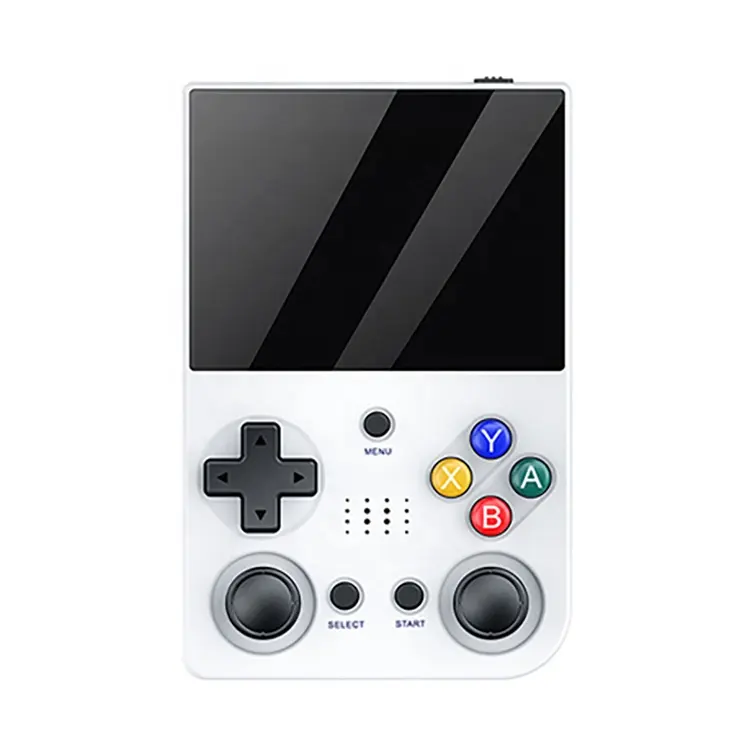
The SJGAM M21 is a sub-$40 vertical-slab emulation handheld that makes no secret of what it copies. Set it next to a Game Console R36S or a Powkiddy RGB20S and the resemblance is not a coincidence: it is the same 3.5-inch 4:3 body language, the same top-mounted d-pad, the same twin sticks bolted low on the face. Reviewers have called it a clone of a clone, and that is fair. What SJGAM adds on top of a well-worn template is a genuinely good set of triggers, skittle-shaped face buttons that feel better than the price suggests, and a quirky pair of volume buttons on the back. This is a device you buy when you want a cheap Linux handheld for 8- and 16-bit libraries and you already understand that the polish will come from the community, not the box.
Emulation performance, generation by generation
The M21 runs on a chip SJGAM markets as the “N909,” which the enthusiast community pegs as an Allwinner H133 or a close relative: a low-power ARM Cortex-A7 design clocked somewhere in the 1.2 to 1.8 GHz range with a small Mali-400-class GPU. Core count is reported inconsistently, dual-core in most write-ups and the handhelds wiki, and that low-power reality is the single most important fact about this handheld. Do not picture a Windows machine or even an RK3566 device; this is a chip built for cheap set-top boxes, and it emulates accordingly. Through NES, SNES, Genesis, Game Boy and Game Boy Advance it is comfortable, and its 640×480 panel gives those 4:3 systems clean integer-ish scaling. PlayStation 1 is the honest ceiling: most PS1 titles run well, which is where the “up to PS1” marketing lands. N64 is a coin toss, with lighter games playable and demanding ones stuttering. Dreamcast, PSP and Saturn are aspirational rather than dependable, and anything past that generation is out of reach. This is a retro machine for the eras before 3D got heavy, and it is honest to treat it that way.
Screen, build and controls
The screen is a 3.5-inch 4:3 panel at 640×480, roughly 228 ppi, sharp enough for the systems the chip can actually run. Note a spec discrepancy worth flagging: some retailer listings, including Geekbuying, advertise a 4.3-inch 2GB/64GB configuration, while hands-on reviews and the community wiki consistently describe a 3.5-inch, 1GB unit, so confirm exactly which variant a seller is shipping. The shell is solid plastic that hands-on testers described as bordering on feeling cheap, but the controls are where the M21 earns goodwill. The triggers are quiet and satisfying, needing enough pressure to avoid false inputs without fighting you. The face buttons are a highlight. The rear-mounted volume rocker is a clever touch you can reach mid-game. The weak points are the analog sticks, which are standard budget potentiometer units with short travel and no Hall-effect sensors, and a d-pad that sits recessed and tight, fine for platformers but fiddly for fighting games. Power comes from a 3,000 mAh battery, and connectivity is bare-bones: USB-C for charging, a micro/mini HDMI out for TV play, a headphone jack and a microSD slot, with wireless essentially absent or unreliable.
Software and setup
Out of the box the M21 boots a locked, custom EmuELEC-based image, and that word “locked” is the catch. Reviewers found the stock interface janky and, more seriously, reported that you cannot reliably add your own ROMs to the bundled SD card, for reasons SJGAM never explained. On an open device you would simply drop your games onto a card and go; here the stock experience fights you. The saving grace is the hardware lineage. Because it shares its silicon family with the RK3326/H133 clone ecosystem, the M21’s long-term value depends on whether the community ports a proper front end to it. Reviewers explicitly recommended a wait-and-see stance pending ArkOS, MinUI, muOS or Knulli support; if a mature image lands, this becomes a much nicer handheld, and if it does not, you are stuck with the stock firmware’s quirks. Treat community firmware as the real product here and the stock OS as a placeholder.
Price, value and who it is for
At roughly $30 to $40 the M21 is priced as an impulse buy, and at that number the calculus is simple. If you want the cheapest possible way to play 8- and 16-bit and PS1 games on a 4:3 screen, and you are comfortable tinkering, the buttons and triggers make it a pleasant little thing to hold. If you want a device that just works, that takes your ROMs without a fight, and that has a guaranteed custom-firmware path, spend a little more on an Anbernic RG35XX H or a known R36S revision with proven ArkOS support. The M21 is for the hobbyist who enjoys the ecosystem as much as the games, not for someone who wants a finished product. As an obscure brand with thin documentation, it also carries the usual small-maker risk: spec listings conflict, support is minimal, and its future rests almost entirely on community goodwill.
📐 Size & Pocketability
⚖️ Weight vs Other Handhelds
🔋 Real-World Battery Estimator
⭐ Emulation Performance
📊 View How This Score is Calculated
The Hardware Power Score is an absolute metric. Perfect emulation of difficult, modern consoles awards significantly more points than standard retro consoles.
- 15× Multiplier: Modern PC
- 12× Multiplier: Switch, PS3, Xbox 360
- 10× Multiplier: Wii U
- 8× Multiplier: PS2, GameCube, Wii, Xbox
- 5× Multiplier: Saturn, Dreamcast, PSP
- 3× Multiplier: N64, PS1
- 1× Multiplier: SNES, GBA
Generation 6
Generation 5
Handhelds & Retro
📋 Full Specifications
📺 Display
⚙️ Platform
💾 Memory
🕹️ Controls
📏 Body
🔋 Battery
⚖️ Verdict
✅ The Good
- Excellent triggers and satisfying skittle-style face buttons that punch above the sub-$40 price
- Clean 640×480 3.5-inch 4:3 screen well matched to 8-bit, 16-bit and PS1 libraries
- Handy rear volume rocker plus HDMI-out for playing on a TV
- Cheap enough to be a low-risk impulse buy for tinkerers
❌ The Bad
- Locked stock EmuELEC image reportedly blocks adding your own ROMs to the bundled card, and future value hinges on unproven community firmware
- Low-power dual-core Cortex-A7 chip caps emulation around PS1, with N64/Dreamcast/PSP unreliable
- Obscure brand with conflicting spec listings (3.5in/1GB vs advertised 4.3in/2GB), cheap-feeling shell, short-travel non-Hall sticks and no reliable wireless
📰 Latest News & Guides
The Ultimate Guide to ARMSX3: Android’s New PS3 Emulator, Competitor Comparisons, and Setup Tutorial
18/08/2026Pokémon Gold, Silver, and Crystal (Gen 2) Recomp Lands on Android
17/08/2026How to Play the Pokémon Red, Blue, or Yellow Recomp on Your Android, Windows, and Linux Devices
16/08/2026🔍 Similar Handhelds
Other handhelds that emulate up to PS1.