
🛒 Where to Buy
⚠️ Golden Rule of Retro Handhelds: Throw away the cheap MicroSD card that comes in the box — it will fail. And never use a high-wattage PD “Fast Charger” on these devices; it can damage the battery. Use a standard 5V/1.5A brick.
Device Overview: AYN Odin 2 Mini
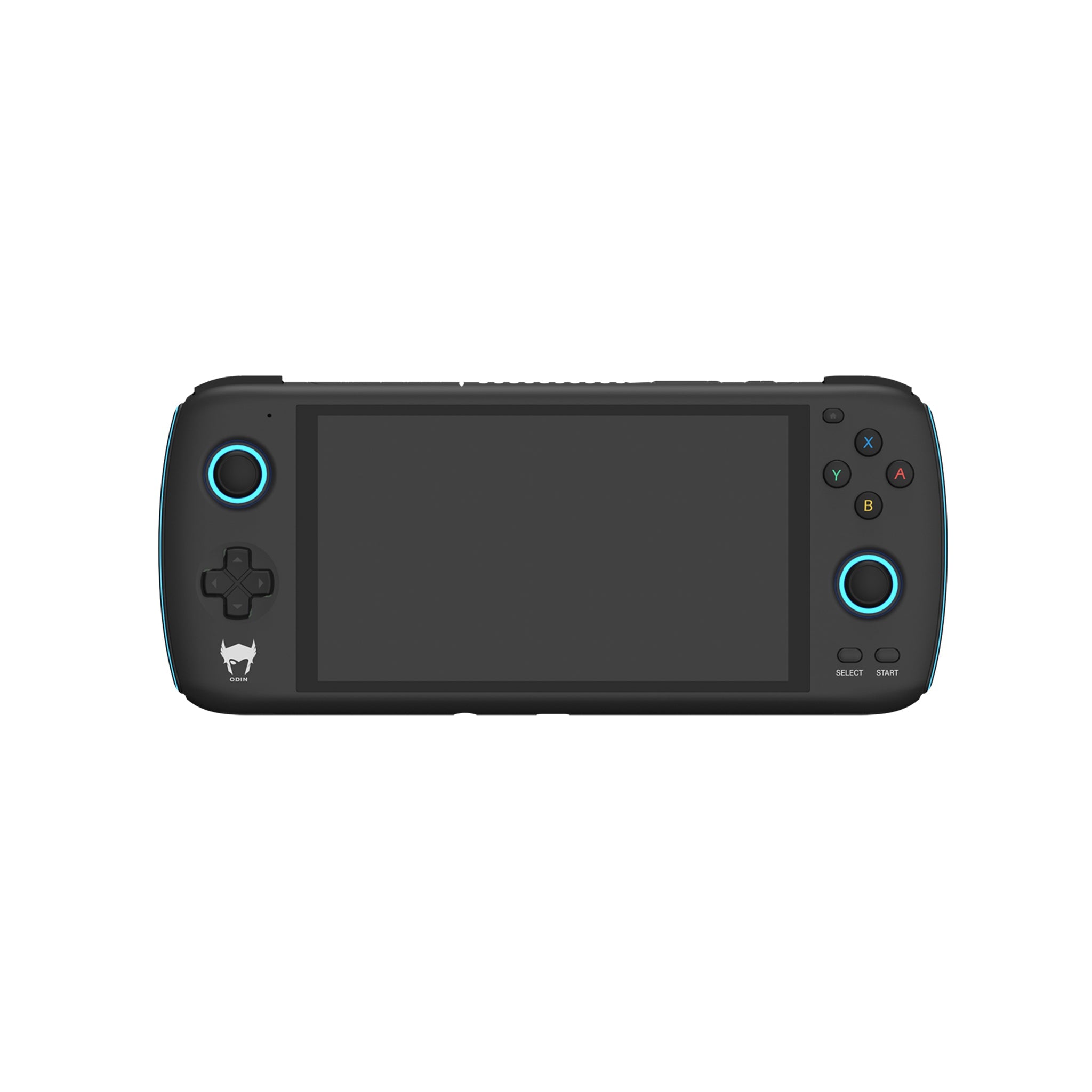
AYN built the Odin 2 Mini around a simple bet: take the Qualcomm Snapdragon 8 Gen 2 that made the full-size Odin 2 the fastest Android emulation handheld of its generation, and cram it into a 320-gram body shaped like a PS Vita. The result is a 5-inch horizontal slab with no chin, no grips, and no downgrade on the silicon. Where most “mini” handhelds swap in a weaker chip to hit the smaller size, the Odin 2 Mini keeps the flagship 2023 SoC and its Adreno 740 GPU intact, then pairs it with 8GB or 12GB of LPDDR5X and UFS 4.0 storage. Against the full-size Odin 2’s 6-inch screen and larger cell, the Mini trades away display area and runtime but keeps every ounce of the compute. It is, functionally, an Odin 2 that fits in a jacket pocket, and that framing explains almost every decision AYN made here.
Emulation performance, generation by generation
This is an ARM Android device, not a Windows x86 machine, so set expectations accordingly: there is no native Steam library and no Windows desktop, but for retro emulation the Snapdragon 8 Gen 2 sits near the ceiling of what handheld ARM can do in 2025. Everything through the fifth generation, meaning NES, SNES, Genesis, PS1 and N64, runs at high internal resolutions inside RetroArch with power to spare, often at 3x or 4x upscaling. PSP is effortless in PPSSPP at 3x native. Dreamcast (Flycast), Saturn (Beetle/Kronos) and GameCube plus Wii (Dolphin) all run the bulk of their libraries at full speed, with GameCube frequently pushed to 2x or 3x resolution. PS2 is where the Mini earns its keep: AetherSX2 and the NetherSX2 fork handle most of the catalog at native or 2x, though a handful of demanding titles still stutter, and that is an emulator limitation rather than a chip one. Nintendo 3DS runs well through Citra descendants such as Azahar. Switch emulation via the various Yuzu forks (Eden, Citron) is genuinely playable on lighter games but inconsistent on heavy ones, and its legal footing is murky. Windows games are possible through Winlator’s translation layer, but treat that as a bonus, not a promise.
Screen, build and controls
The 5-inch panel is a 1920×1080 Mini LED, marketed by AYN as a QLED-style backlit LCD rather than OLED, running at 60Hz with touch. At roughly 441 ppi it is razor-sharp, and the Mini LED backlight gets genuinely bright, with reviewers consistently calling it one of the punchiest LCDs on a handheld, though you will notice mild corner vignetting and it lacks OLED’s perfect blacks. Controls are the highlight: dual Hall effect analog sticks that will never develop drift, Hall effect analog triggers, and a proper d-pad, all wrapped in a build with stacked, dual-tier shoulder buttons AYN added after feedback on the original Odin 2. The 5000mAh battery is modest for the power on tap, so expect roughly 5 to 8 hours on lighter systems and considerably less once you push PS2 or GameCube, but 65W Quick Charge 5.0 refills it in about 90 minutes. Around the frame you get a USB 3.1 Type-C port, a Micro HDMI output for docked play on a TV, and a microSD slot for expanding past the built-in UFS 4.0 storage.
Software and setup
The Odin 2 Mini ships on Android 13 with AYN’s own launcher over the top. Because it is Android, none of the Linux custom-firmware images that define cheaper handhelds, meaning muOS, Knulli, ArkOS, ROCKNIX or OnionOS, apply here; there is no Batocera build to flash onto it. Your “setup” is instead picking a front-end and configuring emulators individually. Most owners layer on Daijisho or ES-DE (EmulationStation DE) for a console-style library, sideload RetroArch cores and standalone emulators, and point them at a microSD stuffed with ROMs. It is more hands-on than a plug-and-play Linux device out of the box, but far more flexible, and you also get the full Google Play Store for streaming apps, native Android titles, and Moonlight or Steam Link remote play from a real PC.
Price, value and who it is for
The base model, with 8GB of RAM, 128GB of storage and a black finish, launches at $339, while the Pro (12GB, 256GB, and the white option) sits at $399, both bundled with a carry case and screen protector. That price undercuts nothing on raw specs: you are paying flagship-phone money for flagship-phone silicon in a games-first shell. The Mini makes the most sense for someone who wants Vita-class ergonomics with far more horsepower, who is comfortable living in Android, and who is willing to spend an evening dialing in emulators. If you want plug-and-play simplicity, a cheap Linux handheld is the smarter buy; if you want a native PC library, a Windows device is. But if you specifically want the fastest thing this size that runs PS2 and GameCube in your palm, this is the one to get.
📐 Size & Pocketability
⚖️ Weight vs Other Handhelds
🔋 Real-World Battery Estimator
⭐ Emulation Performance
📊 View How This Score is Calculated
The Hardware Power Score is an absolute metric. Perfect emulation of difficult, modern consoles awards significantly more points than standard retro consoles.
- 15× Multiplier: Modern PC
- 12× Multiplier: Switch, PS3, Xbox 360
- 10× Multiplier: Wii U
- 8× Multiplier: PS2, GameCube, Wii, Xbox
- 5× Multiplier: Saturn, Dreamcast, PSP
- 3× Multiplier: N64, PS1
- 1× Multiplier: SNES, GBA
Gen 8 & PC
Generation 7
Generation 6
Generation 5
Handhelds & Retro
⚡ Performance Benchmarks
Where AYN Odin 2 Mini Adreno 740 lands against the handhelds everyone knows. Every bar shares one scale, so longer genuinely means faster — add up to two rivals to compare.
CPU = Geekbench 6 multi-core · GPU = 3DMark Wild Life. Median real-world scores; every bar shares one scale — add up to two rivals to compare.
📋 Full Specifications
📺 Display
⚙️ Platform
💾 Memory
🕹️ Controls
📏 Body
🔋 Battery
⚖️ Verdict
✅ The Good
- Flagship Snapdragon 8 Gen 2 and Adreno 740 in a pocketable 320g body: runs PS2, GameCube and Wii that cheaper minis cannot touch
- Dual Hall effect sticks and Hall effect analog triggers mean no stick drift and precise, durable inputs
- Bright, razor-sharp 5-inch 1080p Mini LED panel that is among the punchiest LCDs on any handheld
- 65W Quick Charge 5.0 refills the 5000mAh cell in about 90 minutes, plus Wi-Fi 7, Android 13 and full Play Store access
❌ The Bad
- Mini LED, not OLED, so expect mild corner vignetting, no true blacks, and only a 60Hz refresh rate
- The 5000mAh battery is small for the silicon and drains quickly under PS2 and GameCube loads
- Android-only means no Linux custom firmware (muOS, Knulli, ArkOS) and hands-on per-emulator setup, with no native PC or Steam library
📰 Latest News & Guides
The Ultimate Guide to ARMSX3: Android’s New PS3 Emulator, Competitor Comparisons, and Setup Tutorial
18/08/2026Pokémon Gold, Silver, and Crystal (Gen 2) Recomp Lands on Android
17/08/2026How to Play the Pokémon Red, Blue, or Yellow Recomp on Your Android, Windows, and Linux Devices
16/08/2026🔍 Similar Handhelds
Other handhelds that emulate up to CURRENTGEN.