
🛒 Where to Buy
⚠️ Golden Rule of Retro Handhelds: Throw away the cheap MicroSD card that comes in the box — it will fail. And never use a high-wattage PD “Fast Charger” on these devices; it can damage the battery. Use a standard 5V/1.5A brick.
Device Overview: GAMEMT E5
The GAMEMT E5 is a sub-$50 preloaded handheld that leans on a gimmick almost no rival bothers with: it is also a 17W power bank. The dual USB-C ports on the top edge let it charge your phone from its 5,000 mAh cell, and when you are bored you flip it over and play one of the roughly 1,200 games baked into storage. That framing matters, because it tells you what the E5 is not. It is not an RK3566 device you fill with your own ROM collection and a custom OS. It is a closed, fixed-menu appliance built around a V.R. Technology VT569B, the same budget “plug-and-play” chip family that powers the countless anonymous retro bricks on AliExpress. GAMEMT wraps it in a nicer shell and a real IPS panel, but the silicon underneath is firmly entry-level, and pretending otherwise would set you up for disappointment.
Emulation performance, generation by generation
The VT569B pairs a single Cortex-A7 core clocked around 810 MHz with a modest Vivante 3D GPU and just 64 MB of DDR2 RAM. Read that RAM figure again — 64 megabytes, not gigabytes — and the ceiling comes into focus. Eight- and 16-bit systems are the comfort zone: NES, SNES, Genesis/Mega Drive, Game Boy through Game Boy Advance, Master System and Neo Geo all run at or near full speed, which covers the bulk of what most buyers actually want from a device this small. Push into 32-bit and the picture gets ragged. PlayStation 1 is the advertised headline, and lighter 2D PS1 titles are playable, but 3D-heavy games stutter and emulation stability varies enough that “up to PS1” is better read as “some PS1” than “all PS1.” Anything past that — N64, PSP, Dreamcast, GameCube — is out of reach here regardless of what a marketplace listing implies. Those systems need the Unisoc T620- and Rockchip RK3566-class chips found in the E5 Ultra and E5 Plus, which are entirely different machines despite the shared name. Do not confuse the three when you shop.
Screen, build and controls
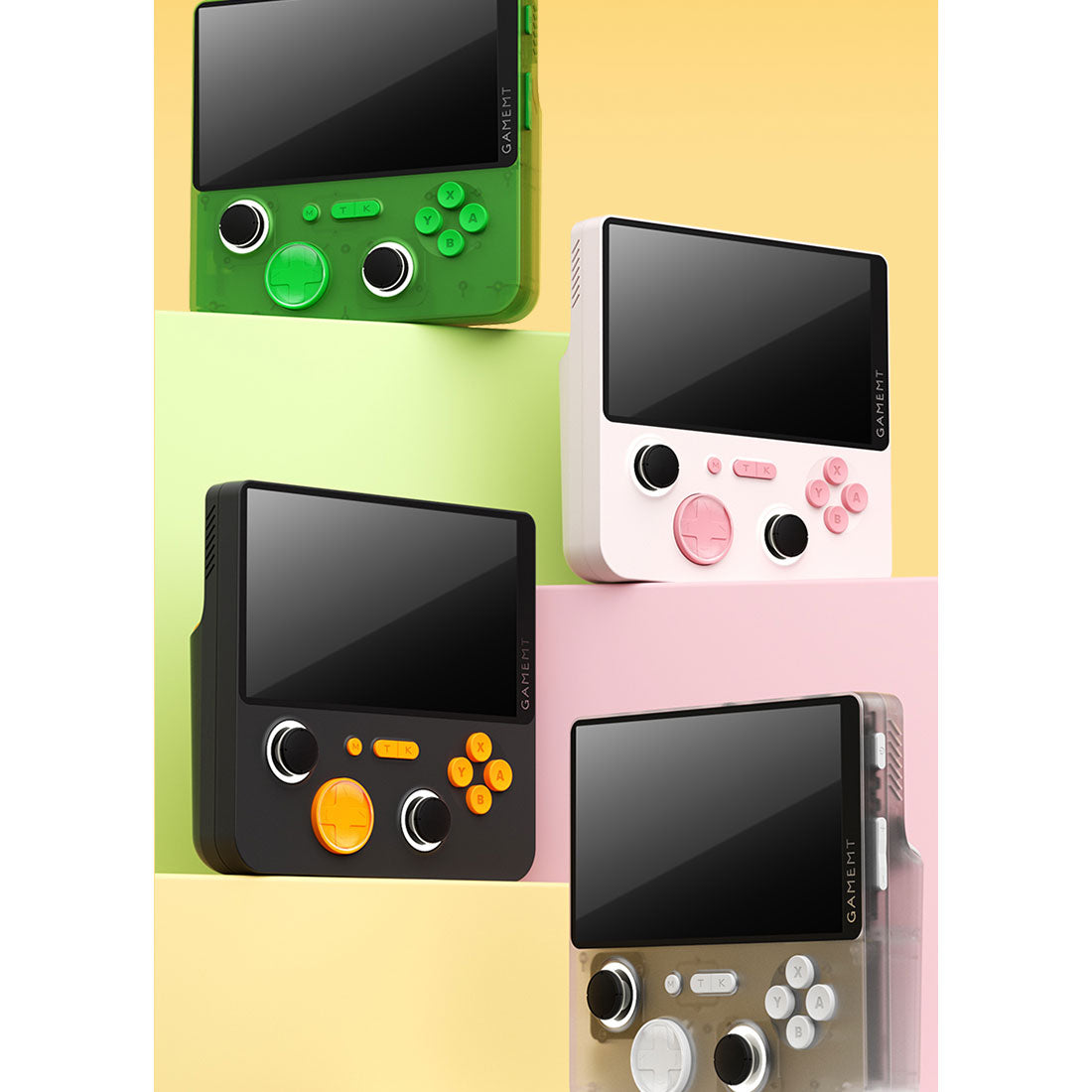
The 5-inch IPS screen is the E5’s strongest single component. Independent spec databases measure it at 960×544 — the same resolution the PS Vita used — at roughly 220 ppi and 60 Hz, giving clean, evenly lit output that punches above the price. Some listings advertise 1280×720; treat that as unconfirmed marketing. The body is plastic and ships in cheerful colorways including transparent green, transparent smoke, pink and black-with-orange, each wearing a “GAMEMT” logo beside the display. Controls follow an asymmetric layout with twin analog sticks flanking a d-pad, four A/B/X/Y face buttons, an M/T/K function cluster and L1/R1/L2/R2 shoulder buttons. The sticks are conventional potentiometer units — there is no Hall-effect sensing here, so budget for the usual long-term drift risk, and there is no rumble motor. GAMEMT publishes no weight or dimensions, so plan to judge the ergonomics in hand rather than on paper.
Software and setup
This is where honesty matters most. The E5 runs a closed-source Linux front-end with the games already installed: power on, pick a system, pick a title, play. There is no custom-firmware scene to graduate into. You will not be flashing muOS, Knulli, ArkOS, ROCKNIX, OnionOS or Batocera onto this — those projects target Allwinner and Rockchip hardware, and the VT569B simply is not supported by any of them. Worse, the device was reportedly marketed at one point as using an RK3326, only for teardowns to reveal the VT chip, which extinguished any lingering homebrew hope. Practically, that means you cannot choose your own RetroArch cores or drop in a standalone emulator such as DuckStation or PPSSPP. You can usually add your own ROMs to the microSD card for the systems the built-in menu already understands, but you are living inside GAMEMT’s front-end, not Linux proper.
Price, value and who it is for
At roughly $40, the E5 is priced as an impulse buy, and judged on those terms it is a reasonable one. The panel is genuinely good, the power-bank trick is legitimately handy on a trip, and for NES-through-GBA play it does the job without fuss. But the tiny RAM pool, single-core chip and locked software mean it will never grow with you, and its PS1 billing oversells what the hardware delivers. Buy it as a cheap, cheerful retro-plus-charger novelty for a kid, a commute or a backpack — not as your gateway into serious emulation or custom firmware. Anyone who wants a device to tinker with, or one that reaches N64 and PSP, should skip straight to an RK3566-class handheld (including GAMEMT’s own E5 Plus and Ultra) and spend the extra money. Documentation on the base E5 is thin and inconsistent across sellers, so confirm the exact chip and battery capacity on the specific listing before you pay.
📐 Size & Pocketability
🔋 Real-World Battery Estimator
⭐ Emulation Performance
📊 View How This Score is Calculated
The Hardware Power Score is an absolute metric. Perfect emulation of difficult, modern consoles awards significantly more points than standard retro consoles.
- 15× Multiplier: Modern PC
- 12× Multiplier: Switch, PS3, Xbox 360
- 10× Multiplier: Wii U
- 8× Multiplier: PS2, GameCube, Wii, Xbox
- 5× Multiplier: Saturn, Dreamcast, PSP
- 3× Multiplier: N64, PS1
- 1× Multiplier: SNES, GBA
Generation 5
Handhelds & Retro
📋 Full Specifications
📺 Display
⚙️ Platform
💾 Memory
🕹️ Controls
📏 Body
🔋 Battery
⚖️ Verdict
✅ The Good
- Excellent-for-the-price 5-inch IPS panel (960×544, 60Hz) with clean, bright, evenly-lit output
- Doubles as a 17W USB-C power bank from its 5,000 mAh cell, a genuinely useful two-in-one on the go
- Runs 8- and 16-bit libraries (NES, SNES, Genesis, GBA, Neo Geo) at full speed, with around 1,200 games preloaded
- Cheap ~$40 impulse price and fun transparent colorways
❌ The Bad
- Weak VT569B (single Cortex-A7 ~810MHz, Vivante GPU, only 64MB RAM) makes PS1 unstable and puts N64/PSP/Dreamcast out of reach despite marketing
- Closed Linux front-end with zero custom-firmware support (no muOS/Knulli/ArkOS), reportedly mis-marketed as RK3326, plus non-Hall potentiometer sticks that can drift
- Thin, inconsistent documentation: GAMEMT lists no weight or dimensions and specs (resolution, battery) vary by seller, so verify before buying
📰 Latest News & Guides
The Ultimate Guide to ARMSX3: Android’s New PS3 Emulator, Competitor Comparisons, and Setup Tutorial
18/08/2026Pokémon Gold, Silver, and Crystal (Gen 2) Recomp Lands on Android
17/08/2026How to Play the Pokémon Red, Blue, or Yellow Recomp on Your Android, Windows, and Linux Devices
16/08/2026🔍 Similar Handhelds
Other handhelds that emulate up to PS1.