
🛒 Where to Buy
⚠️ Golden Rule of Retro Handhelds: Throw away the cheap MicroSD card that comes in the box — it will fail. And never use a high-wattage PD “Fast Charger” on these devices; it can damage the battery. Use a standard 5V/1.5A brick.
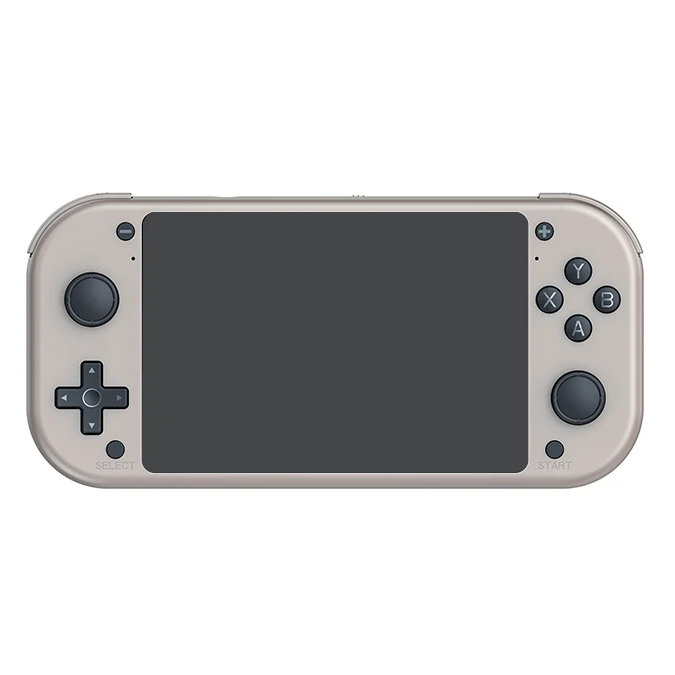
Device Overview: SJGAM M17
The SJGAM M17 is a sub-$35 Linux handheld that surfaces on AliExpress under a dozen seller names, almost always padded with promises of “10,000 games” and a “2GB” spec line. Strip the marketing away and it is a very specific, very cheap machine: a Rockchip RK3126C, a chip that first turned up in budget tablets and set-top boxes around 2016, driving a 4.3-inch 16:9 screen. It launched in September 2023, years after the silicon inside it stopped being interesting, and its entire reason to exist is the price. Judge it against a Miyoo Mini Plus or an R36S rather than against anything with a modern Cortex-A55, and its limits start to make sense.
Emulation performance, generation by generation
The RK3126C is a quad-core Cortex-A7 clocked around 1.2 GHz, paired with a Mali-400 MP2 GPU and just 256 MB of RAM. Listings that advertise 2 GB are simply wrong; 256 MB is what the board actually carries, and that number is the ceiling for everything below. Eight- and 16-bit systems are where it lives: NES, Master System, Genesis/Mega Drive, PC Engine, Game Boy, Game Boy Color and Game Boy Advance all run at full speed through the usual libretro cores such as Genesis Plus GX and gpSP. SNES is fine across most of the library on Snes9x-2005/2010; the SuperFX and SA-1 titles like Star Fox and Yoshi’s Island are the ones that stutter. 2D arcade — CPS1, CPS2, most pre-3D Neo Geo — is generally playable with a matched romset.
PlayStation is the fault line. Sprite-based PS1 games — fighters, JRPGs, 2D shooters — are enjoyable on PCSX ReARMed, but anything that leans on the 3D hardware drops frames, and the 256 MB ceiling means you live with frameskip. Above that line there is nothing worth taking seriously. N64 runs, and the stock menu advertises it, but at single-digit-to-teens frame rates it is a tech demo rather than a way to play. PSP through PPSSPP is technically present and practically pointless; Nintendo DS via a DraStic-style core is the same story. Treat the M17 as a machine that tops out at 2D PS1 and you will not be let down.
Screen, build and controls
The panel is a 4.3-inch IPS at 480×272 — the exact resolution the original PSP used — 16:9, roughly 128 PPI, at 60 Hz. Colours are punchy and bright scenes look good, but shadow detail muddies badly in a lit room or outdoors, and the backlight is not strong enough to beat sunlight. That 480×272 count is generous for widescreen 16-bit content and an awkward fit for square 4:3 systems, which end up letterboxed or stretched. Physically it is a plastic slab of about 170 x 80 x 29 mm, with a stacked shoulder layout (L1/R1 over L2/R2), a d-pad low on the face and two asymmetric analog sticks. The sticks are ordinary potentiometer units — no Hall-effect sensors at this price — and close to decorative, since almost nothing in the emulator range needs them. Buttons and d-pad are acceptable for platformers. A single back-mounted speaker handles audio, with a 3.5 mm jack for headphones.
Software and setup
Out of the box the M17 boots a locked-down Linux frontend from a bundled microSD, pre-loaded with thousands of ROMs of dubious provenance. The stock build is where the notorious bugs live: audio that cuts out mid-session and returns only on its own, and a cheap included card that tends to corrupt. The community answer is to reflash. Early hardware revisions of the M17 are supported by MinUI, the minimalist libretro launcher, and by forks such as MyMinUI; a fresh, cleanly dumped card fixes the flaky-storage problem and the interface is far better than stock. The important caveat: SJGAM quietly changed the internals on later batches, and those units may not take MinUI, so which firmware you can run depends on the board you happen to receive. There is no Wi-Fi, no Bluetooth and no video out, so every change is made by pulling the card and editing it on a PC — no wireless scraping, no Bluetooth pads, no TV mode.
Price, value and who it is for
At roughly $30–35 the M17 is priced as an impulse buy, and that is the only frame in which it makes sense. Battery capacity is quoted inconsistently across sources — some spec sheets say 1,500 mAh, others 2,000 mAh — but in practice it lasts a few hours on 2D content at moderate brightness and drains quickly the moment you push it into 3D. For the money you get a genuine IPS screen, a full button set and a device that plays the entire pre-32-bit catalogue without complaint. What you do not get is polish, support, or a chip that ages well: the Miyoo Mini Plus costs a little more and runs nicer firmware, and the RK3326-class R36S handles PS1 and light N64 far better for a few dollars on top. Buy the M17 if you want the cheapest possible way to carry a Game Boy and a Genesis in your pocket, you are comfortable flashing an SD card, and you can accept a lottery on which revision turns up. Anyone who needs PS1 to run reliably, or who does not want to tinker, should spend the extra elsewhere.
📐 Size & Pocketability
🔋 Real-World Battery Estimator
⭐ Emulation Performance
📊 View How This Score is Calculated
The Hardware Power Score is an absolute metric. Perfect emulation of difficult, modern consoles awards significantly more points than standard retro consoles.
- 15× Multiplier: Modern PC
- 12× Multiplier: Switch, PS3, Xbox 360
- 10× Multiplier: Wii U
- 8× Multiplier: PS2, GameCube, Wii, Xbox
- 5× Multiplier: Saturn, Dreamcast, PSP
- 3× Multiplier: N64, PS1
- 1× Multiplier: SNES, GBA
Generation 5
Handhelds & Retro
📋 Full Specifications
📺 Display
⚙️ Platform
💾 Memory
🕹️ Controls
📏 Body
🔋 Battery
⚖️ Verdict
✅ The Good
- Genuinely cheap ($30–35) way into 8- and 16-bit emulation, and it uses a real IPS panel rather than a washed-out TN screen.
- Runs NES, SNES, Genesis, the Game Boy line and 2D arcade at full speed, plus playable sprite-based PlayStation.
- Standard controls for the class: d-pad, four shoulder buttons, dual analog sticks and a 3.5 mm headphone jack.
- Early hardware revisions are supported by MinUI and community forks, which cure the stock software's worst habits.
❌ The Bad
- Stock firmware has well-documented flaws — audio that randomly cuts out and an unreliable bundled SD card.
- The RK3126C and 256 MB of RAM cap it at 2D PS1; N64, PSP and DS appear in the menus but are not realistically playable.
- Obscure, thinly supported brand with inconsistent listings — later revisions changed the internals and may not run MinUI, and even basics like battery capacity are stated differently from source to source.
📰 Latest News & Guides
The Ultimate Guide to ARMSX3: Android’s New PS3 Emulator, Competitor Comparisons, and Setup Tutorial
18/08/2026Pokémon Gold, Silver, and Crystal (Gen 2) Recomp Lands on Android
17/08/2026How to Play the Pokémon Red, Blue, or Yellow Recomp on Your Android, Windows, and Linux Devices
16/08/2026🔍 Similar Handhelds
Other handhelds that emulate up to PS1.