
🛒 Where to Buy
⚠️ Golden Rule of Retro Handhelds: Throw away the cheap MicroSD card that comes in the box — it will fail. And never use a high-wattage PD “Fast Charger” on these devices; it can damage the battery. Use a standard 5V/1.5A brick.
Device Overview: Funny Playing Retro Pixel Pocket
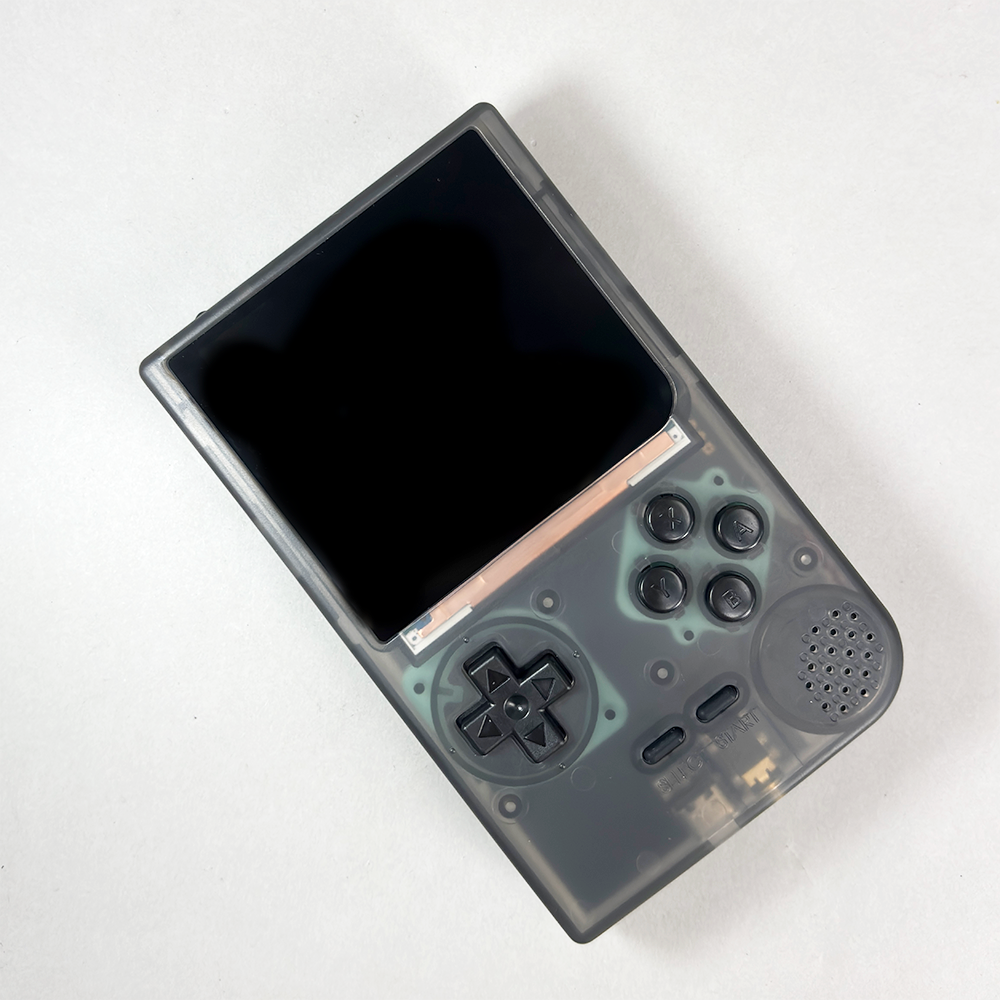
FunnyPlaying built its reputation in the Game Boy modding world: laminated IPS retrofit kits, replacement shells, and parts that turned dusty DMG and Pocket units into sharp-screened daily players. The Retro Pixel Pocket is the company’s attempt to sell a whole handheld instead of a kit, and it leans hard on that heritage. Crucially, this is an emulation device, not an FPGA console. There is no field-programmable logic recreating original silicon here, and no cartridge slot. It is an ARM system-on-chip running a Linux-based RetroArch frontend, dressed in a Game Boy Pocket body. If you want FunnyPlaying’s FPGA work, that is a separate product (their FPGBC Game Boy Color clone) and should not be confused with this.
Two versions exist, and the distinction matters. The original 2023 unit used an Allwinner A64 SoC running a stripped Android 7.1 build and sold for around $80-$100. In September 2025 FunnyPlaying revised it to a Rockchip RK3326 chip running a custom EmuELEC image and cut the price to roughly $50. Everything below describes that current revision. Positioned against the $200-plus Analogue Pocket, this is a different animal entirely: the Pocket is a hardware-accurate FPGA flagship, while this is a budget emulator. Against a Miyoo Mini Plus it is closer in spirit and price, but the Retro Pixel Pocket trades the Miyoo’s stick-friendly shape for a strict Game Boy Pocket silhouette and a square 1:1 screen.
Performance and compatibility, generation by generation
Be realistic: the RK3326 is a modest quad-core Cortex-A35-class chip with 1GB of RAM, the same silicon family that powered the Anbernic RG351 line years ago. This is comfortable 8- and 16-bit hardware. Game Boy, Game Boy Color, Game Boy Advance, NES, SNES, Sega Master System, Genesis/Mega Drive, Game Gear, PC Engine, and Neo Geo Pocket all run well, and the square panel flatters the original Game Boy library’s near-square aspect. PlayStation 1 is the realistic ceiling, and even there expect the chip to labor on heavier 3D titles rather than sail through them. Nintendo 64, Dreamcast, PSP, and DS are effectively off the table; treat any claim otherwise with suspicion. The earlier A64 model also topped out at PS1 but was hamstrung by its sluggish Android OS. The RK3326 swap to EmuELEC is the meaningful fix, giving a faster, more game-focused experience.
Screen, build and controls
The screen is the reason to look at this device. FunnyPlaying fits a 3-inch (listed as 3.0-3.1″) 720×720 fully laminated IPS panel — the same caliber of display the company sells in its premium GB mod kits, with the glass bonded directly to the panel so there is no air gap and no parallax. For pixel art at 1:1 it looks excellent. The body is a faithful Game Boy Pocket homage at 75 x 130 x 24 mm, light and pocketable, with a 3000mAh battery and USB-C charging. Controls are where the device shows its budget roots. There are physical L1/R1 shoulder buttons, with the volume dials doubling as L2/R2 when pressed. Reviewers consistently praise the feel of the buttons — “light and clacky” face buttons, an improved d-pad — but flag inconsistent input registration and false diagonals, with some users applying a tape mod to the d-pad. The original also drew complaints about a tinny speaker and a finicky USB port; how thoroughly the revision addresses build quality beyond the chip swap is not fully confirmed.
Software and setup
The current model boots a custom EmuELEC image (a Linux/RetroArch distribution; some review firmware is described as an AmberELEC-style build derived from RG351MP support). Setup is standard for this class: flash or use the bundled microSD, drop ROMs into per-system folders, and rely on the built-in scraper for box art. Wi-Fi is on board for box-art scraping and RetroArch’s RetroAchievements. FunnyPlaying’s guidance is to stick to official firmware images rather than third-party builds to avoid compatibility headaches. There is no touchscreen, so menu navigation is entirely button-driven.
Price, value and who it’s for
At about $50 plus shipping, the Retro Pixel Pocket is priced as a budget single-purpose toy, and that is the honest frame for it. You are paying for a genuinely good laminated IPS screen and an authentic Game Boy Pocket form factor, accepting a modest SoC and imperfect d-pad behavior in return. It is for the buyer who specifically wants a square-screen, vertical Game Boy-shaped emulator for 8/16-bit and the occasional PS1 title — and ideally one who appreciates Pico-8 and handheld-era libraries. It is not for anyone chasing N64, PSP, or DS, and it is not an alternative to the Analogue Pocket’s hardware accuracy. Some reviewers still call it “slightly overpriced” against newer budget rivals, so judge it on the screen and the shape, which are its real strengths.
📺 Device in Action
📐 Size & Pocketability
🔋 Real-World Battery Estimator
⭐ Emulation Performance
📊 View How This Score is Calculated
The Hardware Power Score is an absolute metric. Perfect emulation of difficult, modern consoles awards significantly more points than standard retro consoles.
- 15× Multiplier: Modern PC
- 12× Multiplier: Switch, PS3, Xbox 360
- 10× Multiplier: Wii U
- 8× Multiplier: PS2, GameCube, Wii, Xbox
- 5× Multiplier: Saturn, Dreamcast, PSP
- 3× Multiplier: N64, PS1
- 1× Multiplier: SNES, GBA
Generation 6
Generation 5
Handhelds & Retro
📋 Full Specifications
📺 Display
⚙️ Platform
💾 Memory
🕹️ Controls
📏 Body
🔋 Battery
⚖️ Verdict
✅ The Good
- Excellent fully laminated 720×720 IPS screen, true to FunnyPlaying's mod-kit pedigree
- Authentic, pocketable Game Boy Pocket form factor with a 1:1 panel ideal for GB-era pixel art
- RK3326 revision with EmuELEC fixes the original's sluggish Android OS at half the price (~$50)
- Solid 8/16-bit and PS1-capable emulation with USB-C, Wi-Fi scraping, and RetroAchievements
❌ The Bad
- Inconsistent d-pad input with reported false diagonals (some buyers resort to a tape mod)
- Modest RK3326 SoC caps it at PS1 — no N64, DS, PSP, or Dreamcast
- Only L1/R1 are real buttons; L2/R2 are pressable volume dials, and there's no touchscreen
📰 Latest News & Guides
The Ultimate Guide to ARMSX3: Android’s New PS3 Emulator, Competitor Comparisons, and Setup Tutorial
18/08/2026Pokémon Gold, Silver, and Crystal (Gen 2) Recomp Lands on Android
17/08/2026How to Play the Pokémon Red, Blue, or Yellow Recomp on Your Android, Windows, and Linux Devices
16/08/2026🔍 Similar Handhelds
Other handhelds that emulate up to PS1.