
🛒 Where to Buy
⚠️ Golden Rule of Retro Handhelds: Throw away the cheap MicroSD card that comes in the box — it will fail. And never use a high-wattage PD “Fast Charger” on these devices; it can damage the battery. Use a standard 5V/1.5A brick.
Device Overview: Retroid Pocket 4 Pro
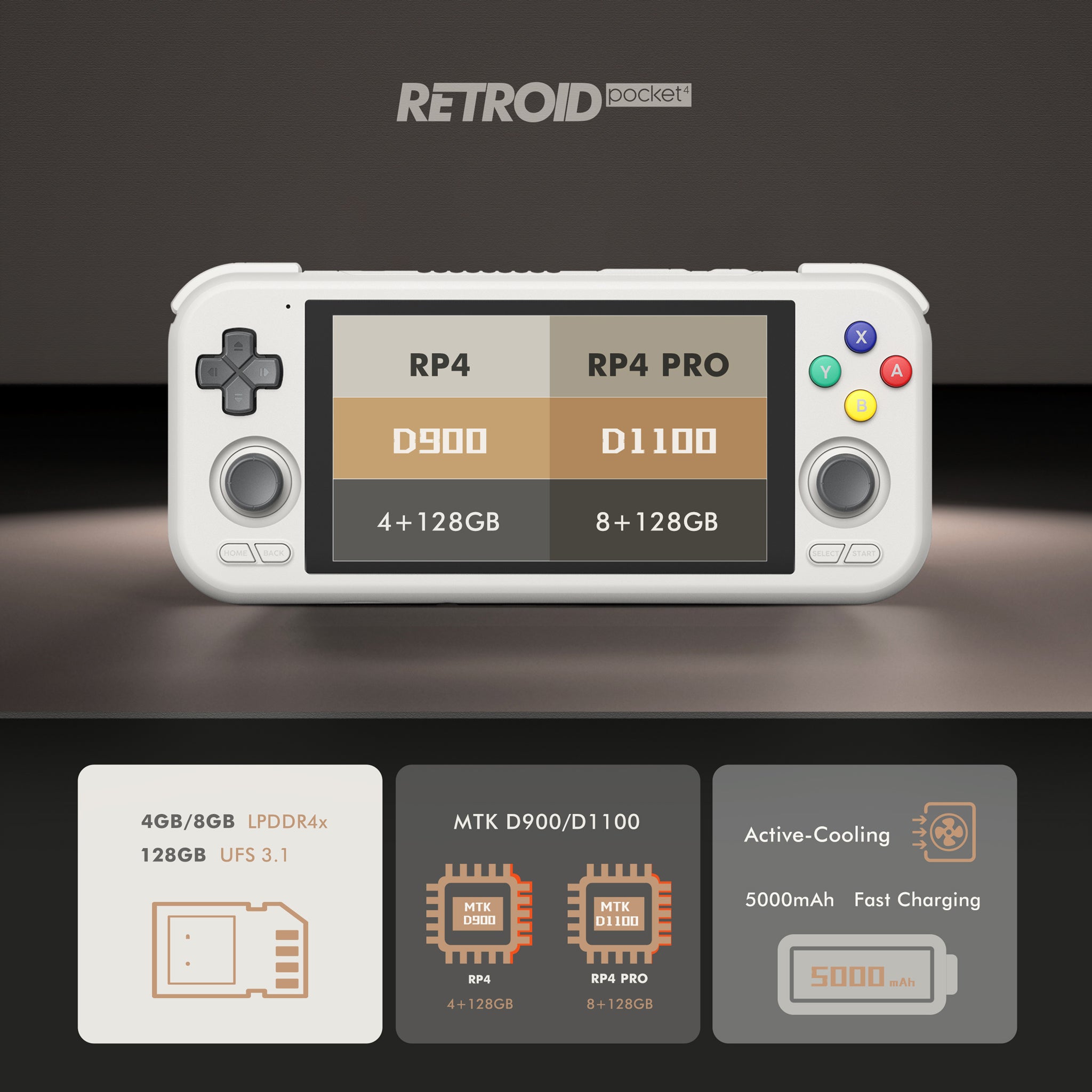
The Retroid Pocket 4 Pro is the handheld I hand to people who want serious emulation without spending serious money. It runs Android 13 on a MediaTek Dimensity 1100, pairs that with 8GB of LPDDR4x RAM and 128GB of UFS 3.1 storage, and asks roughly $199 at MSRP (it frequently sells closer to $159). That combination lands it in a very specific spot: more capable than the cheap Anbernic-style ARM boxes below it, but a clear step under the brute-force tier.
Positioning matters here because Retroid’s own lineup competes with itself. The newer Pocket 5 moves to a sharper 5.5-inch AMOLED and a stronger Snapdragon, and the Pocket Mini shrinks that AMOLED into a smaller shell at a higher price. The AYN Odin 2, on a Snapdragon 8 Gen 2, roughly triples this chip in raw benchmarks and actually runs Nintendo Switch, but it costs nearly double and weighs noticeably more. The 4 Pro’s argument is dollars-per-playable-system: it covers the libraries most people actually emulate and stops, deliberately, before the expensive frontier.
Emulation performance, generation by generation
Everything up through 32-bit is trivial. NES, SNES, Genesis, GBA, PS1, and N64 run full speed with headroom to spare via RetroArch cores. PSP through PPSSPP is excellent, including upscaling to 2x or 3x. Dreamcast on Flycast or Redream is effortless.
The Dimensity 1100 earns its keep at the sixth generation. PS2 through AetherSX2/NetherSX2 is where this handheld lives: most of the library is playable at native or 2x resolution, though demanding titles like Gran Turismo 4 want you to drop resolution or switch the renderer between OpenGL and Vulkan. GameCube and Wii on Dolphin are strong, with the bulk of both catalogs running well once you tune per-game settings. The 3DS via Citra is comfortable.
The ceiling is real and worth stating plainly. Nintendo Switch (Yuzu forks, Sudachi/Eden) is case-by-case: lighter 2D titles like Super Mario Bros. Wonder run, but demanding 3D games stutter or simply will not boot. PS3 via RPCS3 is marginal at best and not the reason to buy this device. If Switch and PS3 are your priority, this is the wrong tier.
Screen, build and controls
The display is a 4.7-inch IPS panel at 750×1334, 60Hz, and 500 nits. It is a 4:3-friendly shape, which suits retro content well, and it is sharp enough for handheld viewing, but it is IPS, not OLED, so blacks are gray and contrast is ordinary next to the Pocket 5. Outdoors, 500 nits is usable but not bright.
The controls are the standout. Both analog sticks are 3D Hall-effect units, so there is no potentiometer drift to develop over time, and they sit in an offset layout that mimics an Xbox pad. Face buttons and triggers feel firm. The shell is comfortable for its size and lighter to hold for long sessions than the bigger Odin 2.
Software and setup
This is full Android 13, not a locked retro launcher, which is the source of both its power and its homework. Out of the box you get Retroid’s own launcher front-end over Android, plus the Play Store. You will still install and configure emulators yourself: AetherSX2/NetherSX2 for PS2, Dolphin for GameCube and Wii, PPSSPP for PSP, RetroArch for the rest. Frontends like Daijisho or ES-DE tie it together into a clean game-grid. Expect an evening of setup before it feels finished. If you want plug-and-play, Android is a tax, not a feature.
Price, value and who it’s for
At around $199, and often less on sale, the 4 Pro is the value emulation pick for someone whose target library tops out at PS2, GameCube, and Wii with PSP and Dreamcast along the way. Buy it if that describes you and you are comfortable tinkering in Android. Skip it for an OLED screen (Pocket 5 or Mini) or for reliable Switch and PS3 (Odin 2). It does not pretend to be the most powerful handheld; it is the one that covers the most-played systems for the least money.
📐 Size & Pocketability
⚖️ Weight vs Other Handhelds
🔋 Real-World Battery Estimator
⭐ Emulation Performance
📊 View How This Score is Calculated
The Hardware Power Score is an absolute metric. Perfect emulation of difficult, modern consoles awards significantly more points than standard retro consoles.
- 15× Multiplier: Modern PC
- 12× Multiplier: Switch, PS3, Xbox 360
- 10× Multiplier: Wii U
- 8× Multiplier: PS2, GameCube, Wii, Xbox
- 5× Multiplier: Saturn, Dreamcast, PSP
- 3× Multiplier: N64, PS1
- 1× Multiplier: SNES, GBA
Gen 8 & PC
Generation 7
Generation 6
Generation 5
Handhelds & Retro
⚡ Performance Benchmarks
Where Retroid Pocket 4 Pro Mali-G77 MC9 lands against the handhelds everyone knows. Every bar shares one scale, so longer genuinely means faster — add up to two rivals to compare.
CPU = Geekbench 6 multi-core · GPU = 3DMark Wild Life. Median real-world scores; every bar shares one scale — add up to two rivals to compare.
📋 Full Specifications
📺 Display
⚙️ Platform
💾 Memory
🕹️ Controls
📏 Body
🔋 Battery
⚖️ Verdict
✅ The Good
- Hall-effect sticks on both analog inputs mean no drift over the device's lifetime
- Strong PS2, GameCube and Wii performance at a sub-$200 price
- 8GB RAM, 128GB UFS 3.1 storage and a microSD slot give real headroom for ROM libraries
- Compact, comfortable shell that is lighter to hold for long sessions than rivals like the Odin 2
❌ The Bad
- IPS panel at 750p with gray blacks looks ordinary next to OLED siblings like the Pocket 5
- Switch is hit-or-miss and PS3 is effectively out of reach on the Dimensity 1100
- Full Android means real setup work; emulator install and per-game tuning is on you
📰 Latest News & Guides
The Ultimate Guide to ARMSX3: Android’s New PS3 Emulator, Competitor Comparisons, and Setup Tutorial
18/08/2026Pokémon Gold, Silver, and Crystal (Gen 2) Recomp Lands on Android
17/08/2026How to Play the Pokémon Red, Blue, or Yellow Recomp on Your Android, Windows, and Linux Devices
16/08/2026🔍 Similar Handhelds
Other handhelds that emulate up to PS2.