
🛒 Where to Buy
⚠️ Golden Rule of Retro Handhelds: Throw away the cheap MicroSD card that comes in the box — it will fail. And never use a high-wattage PD “Fast Charger” on these devices; it can damage the battery. Use a standard 5V/1.5A brick.
Device Overview: Anbernic RG-556
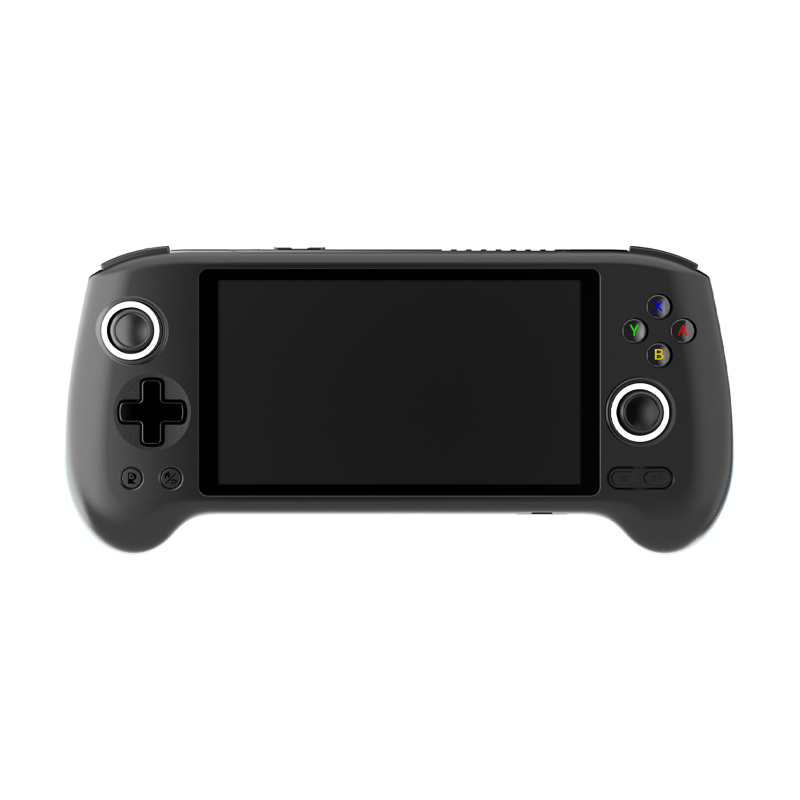
The Anbernic RG-556 is Anbernic’s first handheld built around a 5.48-inch 1080p AMOLED panel, and that screen is the whole reason it exists. Announced in early 2024 at roughly $175 and now selling around $180, it sits on the Android side of Anbernic’s range rather than in the cheaper Linux-based RG35XX family. Inside is the Unisoc T820, the same chip Anbernic reused across the RG406V, RG406H and RG-Cube, so the RG-556 is best understood as the big-screen 16:9 member of that family rather than a bespoke design. If you want an OLED and are willing to run Android instead of a stripped-down retro OS, this is the pitch, and the closest internal comparison is the vertical RG406V, which shares the silicon but trades the widescreen panel for a 4:3 one.
Emulation performance, generation by generation
The T820 is a 6nm octa-core ARM part: one Cortex-A76 at 2.7GHz, three more A76 at 2.3GHz, four A55 at 2.1GHz, and a Mali-G57 MC4 GPU. That is a capable phone-class chip, not a Windows gaming PC, and it should be judged as such. Everything through the fifth generation is trivial. NES, SNES, Genesis, GBA, PS1 (DuckStation) and most N64 (M64Plus FZ) run at full speed without fiddling. PSP via PPSSPP and Dreamcast via Flycast or Redream are effectively solved, frequently upscaled. The interesting line is PS2 and GameCube. AetherSX2 or its NetherSX2 fork handles a large slice of the PS2 library at 30fps or better, though heavier 3D games need per-title tweaking and a few never behave. Dolphin runs many GameCube games well at native or 2x, but demanding titles chug; F-Zero GX is the usual cautionary example. Saturn through Beetle or YabaSanshiro is playable but remains the fussiest of the older systems, and arcade sets under FinalBurn Neo or MAME are limited only by ROM version rather than horsepower. Wii is hit-and-miss and often wants native resolution. Switch emulation technically boots via forks, but treat it as a novelty rather than a feature.
Screen, build and controls
The AMOLED is the headline and it earns it: 5.48 inches, 1920×1080, fully laminated, with the deep blacks and saturation you simply cannot get from the LCDs on rivals. Out of the box it ships with a heavy blue tint, so budget a few minutes in the display settings before judging its colour. It is a standard 60Hz panel, not a high-refresh one. The body is plastic and, at around 331g, this is a heavy handheld, closer to a Steam Deck in the hand than a Game Boy. Controls are the modern Anbernic set: Hall-effect analog sticks ringed with RGB, plus Hall-effect analog triggers, though the L2/R2 only report as analog once you enable “Xbox Mode” in settings. The D-pad is decent for 2D but slightly loose, which can throw false diagonals in fighters. Two front speakers, a 128GB UFS 2.2 base drive, USB-C with DisplayPort video output, dual-band Wi-Fi 5 and Bluetooth 5.0 round it out, and the 5500mAh cell tops up over roughly three and a half hours on a 5V/2A charger.
Software and setup
Stock, the RG-556 runs Android 13 under Anbernic’s own RG Launcher, and that launcher is the weak point: cluttered, slow, and not somewhere you will want to live. Most owners install a proper front-end such as Daijisho or ES-DE over RetroArch and standalone emulators, which is the real setup work. Because this is an Android T820 device and not a Rockchip Linux board, the muOS, Knulli, ArkOS, ROCKNIX and Batocera scene does not apply here; those target other Anbernics. The custom-firmware path that does exist is GammaOS Next, TheGammaSqueeze’s LineageOS 21 (Android 14) build for the whole T820 lineup, which debloats the stock ROM and adds universal button remapping, HDMI docking behaviour and performance modes. It ships in a Full edition with Google Play and a Lite edition without. If you dislike stock Anbernic Android, GammaOS is the fix rather than a Linux reflash.
Price, value and who it is for
At roughly $180 for the 8GB/128GB model, with 256GB and 512GB storage tiers above it and microSD expansion to 2TB, the RG-556 lands in a crowded mid-range. What you are paying the premium for is the OLED and the 8GB of LPDDR4X RAM; what you give up against a Retroid Pocket is a slightly cleaner software experience and a lighter body. Buy it if an AMOLED screen and 16:9 games up to the PS2 and GameCube era are the priority and you are comfortable doing Android emulator setup yourself. Skip it if you want a pick-up-and-play Linux retro OS, if weight matters to you, or if Switch and Wii performance sit on your must-have list. For PS1-through-PSP libraries on a genuinely gorgeous panel it is one of the easier recommendations in its bracket, with the honest asterisk that the T820 is now a well-worn chip rather than the newest silicon available.
📐 Size & Pocketability
⚖️ Weight vs Other Handhelds
🔋 Real-World Battery Estimator
⭐ Emulation Performance
📊 View How This Score is Calculated
The Hardware Power Score is an absolute metric. Perfect emulation of difficult, modern consoles awards significantly more points than standard retro consoles.
- 15× Multiplier: Modern PC
- 12× Multiplier: Switch, PS3, Xbox 360
- 10× Multiplier: Wii U
- 8× Multiplier: PS2, GameCube, Wii, Xbox
- 5× Multiplier: Saturn, Dreamcast, PSP
- 3× Multiplier: N64, PS1
- 1× Multiplier: SNES, GBA
Gen 8 & PC
Generation 7
Generation 6
Generation 5
Handhelds & Retro
⚡ Performance Benchmarks
Where Anbernic RG-556 Mali-G57 MP4 lands against the handhelds everyone knows. Every bar shares one scale, so longer genuinely means faster — add up to two rivals to compare.
CPU = Geekbench 6 multi-core · GPU = 3DMark Wild Life. Median real-world scores; every bar shares one scale — add up to two rivals to compare.
📋 Full Specifications
📺 Display
⚙️ Platform
💾 Memory
🕹️ Controls
📏 Body
🔋 Battery
⚖️ Verdict
✅ The Good
- 5.48-inch 1080p AMOLED is the standout: fully laminated, with deep blacks and saturation no LCD rival matches near this price.
- Hall-effect sticks and Hall-effect analog triggers resist drift and give real analog braking once Xbox Mode is enabled.
- 8GB LPDDR4X and a 5500mAh battery deliver roughly 8 hours plus enough headroom for PS2 and GameCube-era emulation.
- Active custom-firmware support via GammaOS Next (LineageOS 21) fixes the weak stock launcher and adds remapping and HDMI docking.
❌ The Bad
- Heavy at about 331g and all-plastic, so long sessions tire the hands more than lighter handhelds do.
- Stock RG Launcher is cluttered and the panel ships with a blue tint, so it needs setup before it feels right.
- The Unisoc T820 is a well-worn chip: Wii and Switch emulation stay unreliable, and this is not a Linux-CFW device.
📰 Latest News & Guides
The Ultimate Guide to ARMSX3: Android’s New PS3 Emulator, Competitor Comparisons, and Setup Tutorial
18/08/2026Pokémon Gold, Silver, and Crystal (Gen 2) Recomp Lands on Android
17/08/2026How to Play the Pokémon Red, Blue, or Yellow Recomp on Your Android, Windows, and Linux Devices
16/08/2026🔍 Similar Handhelds
Other handhelds that emulate up to PS2.