
🛒 Where to Buy
⚠️ Golden Rule of Retro Handhelds: Throw away the cheap MicroSD card that comes in the box — it will fail. And never use a high-wattage PD “Fast Charger” on these devices; it can damage the battery. Use a standard 5V/1.5A brick.
Device Overview: Pimax Portal
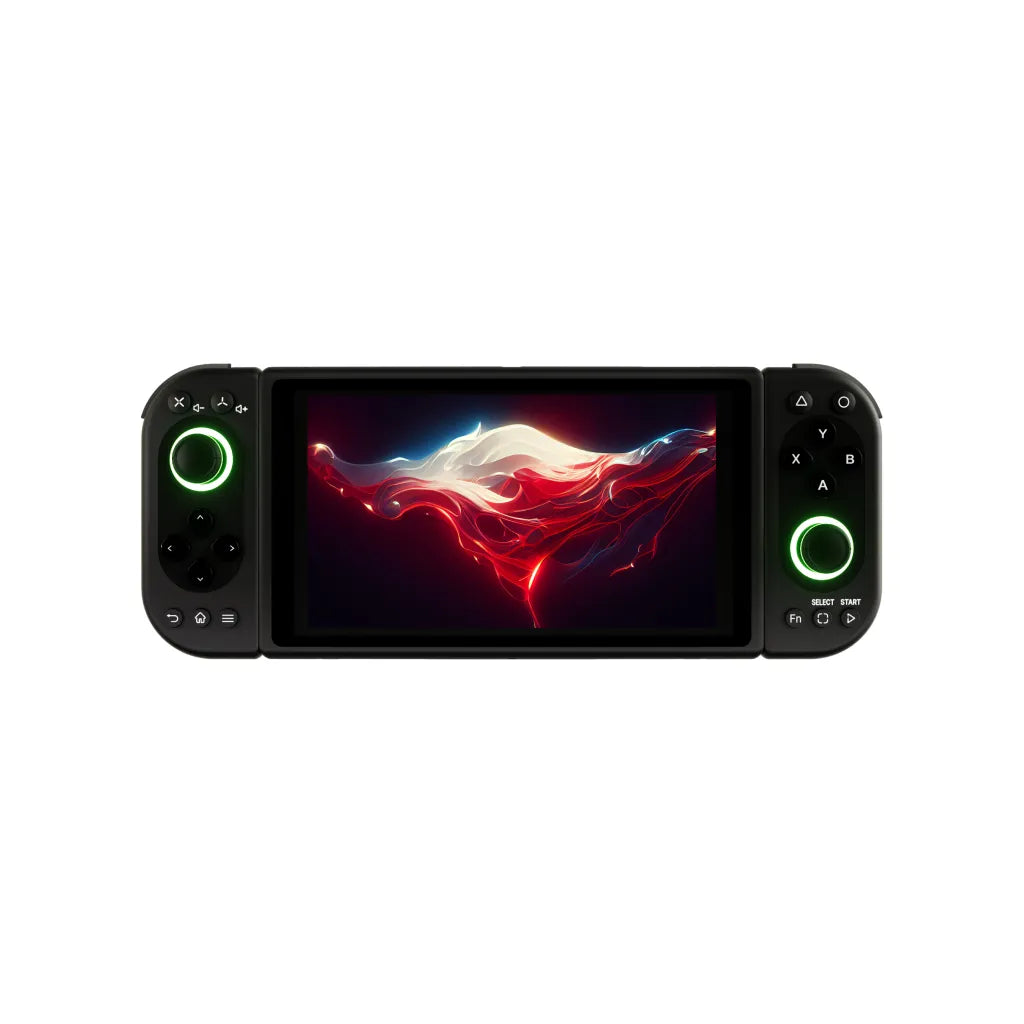
The Pimax Portal is what happens when a VR headset company decides to build a handheld and refuses to make a normal one. Pimax is best known for ultra-wide PC VR headsets, and the Portal carries that DNA: it is a 5.5-inch Android handheld with magnetically detachable Joy-Con-style controllers that can also be clipped into an optional headset shell and used as standalone VR. The headline trick, though, is the screen. The Portal ships with a 4K panel — 3840 x 2160 pixels crammed into roughly 5.46 inches at 144Hz — which is an absurd, almost provocative pixel density for a device running on Quest 2-era silicon. That tension between a phone-flagship screen and a mid-tier mobile chip defines the whole product.
Positioned against the obvious rivals, the Portal is the oddball. The Retroid Pocket 5 gives you a similar Snapdragon-865-class experience with a cleaner 1080p AMOLED and far better software polish for less money. The AYN Odin 2 runs a Snapdragon 8 Gen 2 and simply outclasses the Portal on raw emulation horsepower. The Pimax does not win on either front. What it has instead is the detachable controllers, the genuinely dazzling display, and the VR side-quest that nobody else in this class offers. Whether that adds up depends entirely on how much you value the gimmicks over the fundamentals.
Emulation performance, generation by generation
The chip here is the Qualcomm Snapdragon XR2 with an Adreno 650 GPU and 8GB of RAM — effectively the same platform as the Meta Quest 2. In handheld terms that lands it around the Snapdragon 865 tier, so calibrate expectations accordingly. Everything up to and including PSP, Dreamcast, GameCube and Wii runs well: GameCube titles like Pikmin 2 and Luigi’s Mansion play cleanly, and Dolphin handles most of the library at reasonable internal resolutions. PS2 via AetherSX2/NetherSX2 is solid for the bulk of games, with the usual heavy hitters needing settings tweaks. PSP through PPSSPP is effectively flawless and can be pushed to high render scales.
Where it gets honest is the modern stuff. Switch emulation is possible — reviewers got Breath of the Wild and Cuphead booting through Android Switch emulators — but it is inconsistent, with frame dips on demanding titles and the general fragility you expect from XR2-class hardware. This is not an Odin 2; do not buy it expecting clean Switch performance. And here is the screen tax: that 4K panel means the GPU is feeding far more pixels than the games need, so most people run emulators at a fraction of native resolution anyway. The display is wasted on PS2 and routinely a liability on anything 3D and demanding. Native Android gaming is the rougher patch — Genshin Impact and similar run, but the Portal’s controllers are frequently not recognized by Android games, forcing manual key-mapping that ranges from fiddly to broken.
Screen, build and controls
The panel is the reason this device exists. The top model uses a 4K QLED with a mini-LED backlight, and it is genuinely striking — sharp, bright, with proper local dimming on the higher-end variant. The base unit uses a 4K LCD instead, still 3840 x 2160 at 144Hz. Either way, text and 2D sprite art look immaculate, and video playback is excellent. Build is plastic, Switch-styled, pitch black, and the whole package weighs around 300g.
The controllers detach magnetically like Joy-Cons and use Hall effect analog sticks, which is the right call for drift resistance. The triggers are a GameCube-style long-throw analog design with a distinct click at the bottom. The serious flaw is the d-pad: it is not a unified cross but four separate directional buttons, which makes fighting games and precise 2D platforming genuinely unpleasant. For a retro-focused handheld that is a real miss. There is also no dedicated volume rocker, an odd omission given the empty real estate.
Software and setup
The Portal launched on Android 10, with the QLED model later moving toward newer Android builds. Out of the box you get a fairly stock Android experience with a Pimax launcher layered on top, and that launcher is the weak link — it has historically felt half-finished, and much of the device’s potential is unlocked only by ignoring it and installing your own front end. Most owners go straight to Daijisho or ES-DE plus standalone emulators and treat the Portal as a raw Android slate. The VR functionality requires the separate headset accessory and controller sleeves, which were not even ready at many reviews’ launch and remain a niche, lightly-supported curiosity rather than a real reason to buy.
Price, value and who it’s for
Pricing starts around $299 for the 4K LCD handheld and climbs to roughly $399, with QLED configurations listed as high as $549 at full price. Against a Retroid Pocket 5 or an Odin 2 at similar money, the Portal is a harder sell on pure gaming value — both rivals offer better software and, in the Odin’s case, more power. Buy the Portal if the 4K QLED screen and detachable VR-capable controllers are the specific things you want, and if you are comfortable bypassing Pimax’s software to set it up yourself. Skip it if you want a no-fuss emulation handheld that just works, if you care about d-pad-heavy retro genres, or if you were hoping the VR mode would be a polished, central feature rather than an experimental add-on.
📐 Size & Pocketability
🔋 Real-World Battery Estimator
⭐ Emulation Performance
📊 View How This Score is Calculated
The Hardware Power Score is an absolute metric. Perfect emulation of difficult, modern consoles awards significantly more points than standard retro consoles.
- 15× Multiplier: Modern PC
- 12× Multiplier: Switch, PS3, Xbox 360
- 10× Multiplier: Wii U
- 8× Multiplier: PS2, GameCube, Wii, Xbox
- 5× Multiplier: Saturn, Dreamcast, PSP
- 3× Multiplier: N64, PS1
- 1× Multiplier: SNES, GBA
Gen 8 & PC
Generation 7
Generation 6
Generation 5
Handhelds & Retro
⚡ Performance Benchmarks
Where Pimax Portal Adreno 650 lands against the handhelds everyone knows. Every bar shares one scale, so longer genuinely means faster — add up to two rivals to compare.
CPU = Geekbench 6 multi-core · GPU = 3DMark Wild Life. Median real-world scores; every bar shares one scale — add up to two rivals to compare.
📋 Full Specifications
📺 Display
⚙️ Platform
💾 Memory
🕹️ Controls
📏 Body
🔋 Battery
⚖️ Verdict
✅ The Good
- Stunning 4K QLED/mini-LED 144Hz display, far sharper than anything else in its class
- Detachable magnetic controllers with drift-resistant Hall effect sticks
- Strong emulation up through GameCube, Wii, PS2 and PSP
- Unique optional VR headset mode no rival handheld offers
❌ The Bad
- Four-button "d-pad" instead of a real cross hurts retro and fighting games
- XR2/Adreno 650 chip is mid-tier; Switch and demanding 3D titles struggle
- Half-baked Pimax launcher and Android-game controller recognition issues
📰 Latest News & Guides
The Ultimate Guide to ARMSX3: Android’s New PS3 Emulator, Competitor Comparisons, and Setup Tutorial
18/08/2026Pokémon Gold, Silver, and Crystal (Gen 2) Recomp Lands on Android
17/08/2026How to Play the Pokémon Red, Blue, or Yellow Recomp on Your Android, Windows, and Linux Devices
16/08/2026🔍 Similar Handhelds
Other handhelds that emulate up to PS2.