
🛒 Where to Buy
⚠️ Golden Rule of Retro Handhelds: Throw away the cheap MicroSD card that comes in the box — it will fail. And never use a high-wattage PD “Fast Charger” on these devices; it can damage the battery. Use a standard 5V/1.5A brick.
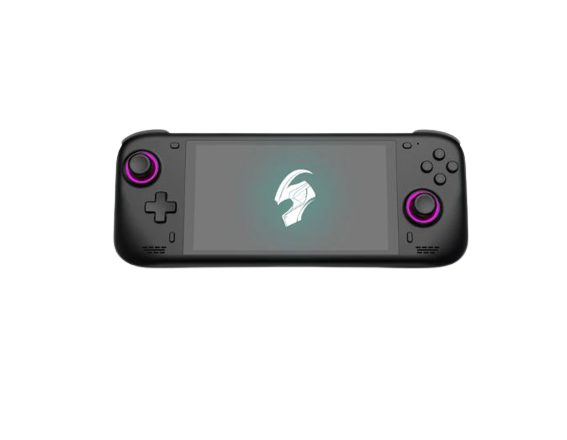
Device Overview: AYN Loki Zero
The AYN Loki Zero was AYN’s attempt to build the cheapest real x86 Windows handheld on the market, and in 2023 it succeeded on price at the cost of almost everything else. Where the rest of the Loki family shipped Ryzen 5 and Ryzen 7 chips aimed at Steam Deck buyers, the Zero sits at the bottom of the ladder with an AMD Athlon Silver 3050e, a two-core, four-thread laptop APU rated at roughly 6W and paired with a three-compute-unit Radeon Vega 3 integrated GPU. Announced in July 2022 at a $199 pre-order price and finally shipping in August 2023 at $249, it is not a Deck rival. It is a pocket Windows PC for retro emulation and light native games, and it should be judged as exactly that.
Emulation performance, generation by generation
Because the Zero runs full Windows, it can install any emulator you like: RetroArch, DuckStation, PPSSPP, Flycast, PCSX2, Dolphin, the lot. What it cannot do is brute-force its way through the demanding ones. The 3050e’s two Zen cores are the ceiling here, and emulators that lean on single-thread performance feel it. Everything up to and including the PlayStation 1, N64, and Sega Saturn runs comfortably. PSP through PPSSPP is a strong showing and probably the Zero’s sweet spot, with most of the library holding full speed at native or 2x resolution. Dreamcast via Flycast is reliable, and arcade libraries through MAME and FinalBurn Neo cover the CPS-1, CPS-2 and Neo Geo era without complaint. GameCube and Wii on Dolphin are the fault line: lighter first-party titles are playable, but anything CPU-heavy dips below full speed, and you will spend real time tuning settings per game. PS2 on PCSX2 is a genuine coin-flip, where 2D and simpler 3D games are fine and heavier ones stutter. Treat 3DS (Citra), Wii U (Cemu), PS3 (RPCS3), and Switch as out of reach. This is a sixth-generation machine that occasionally reaches into the seventh, not the other way around.
Screen, build and controls
The display is a 6-inch 1280×720 IPS panel at 60Hz with touch, and that is 720p, not the 1080p that some spec aggregators wrongly list for it. At this size 720p is sharp enough and, frankly, the right call for a GPU that has no business rendering 1080p. The controls are the Zero’s genuine highlight: Hall-effect analog sticks in an asymmetric layout that resist the stick drift plaguing cheaper handhelds, analog triggers, and two programmable back buttons. The device measures 248 x 98 x 20-23.7mm and weighs about 573g, which is hefty for the class and noticeable in long sessions. Connectivity is dated even for 2023, with Wi-Fi 5 and Bluetooth 4.2 rather than Wi-Fi 6, alongside a USB-C port with video out, a microSD slot, and a 3.5mm jack. The 40.5Wh battery is reasonable on paper, but Windows overhead and the weak-but-thirsty APU mean real runtime is modest.
Software and setup
The Zero ships with Windows 11, and that is both its strength and its tax. You get a real desktop, Steam, GOG, and any launcher you want, but you also get Windows update nags, driver housekeeping, and an OS that was never designed for a 6-inch touchscreen and a gamepad. Plan to install a frontend such as Playnite or EmulationStation to make it usable from the couch. Note that the popular ARM-Linux custom firmwares, meaning muOS, Knulli, ArkOS, ROCKNIX, and OnionOS, do not run on this device; those target Rockchip and Allwinner handhelds, and the Loki Zero is x86. What does apply is the x86 side of the ecosystem: Batocera ships an x86-64 build that installs cleanly, EmuDeck runs on both the stock Windows and on a Linux install, and enthusiasts have put Bazzite or ChimeraOS on it for a more console-like experience. Because it is a standard PC, you can dual-boot Windows and a Linux emulation distro from separate partitions or a second M.2 drive and pick your environment at power-on. Whichever route you choose, expect to do the setup work yourself.
Price, value and who it is for
At $249 the Loki Zero’s pitch is simple: it is one of the least expensive ways to own a true x86 Windows handheld with Hall-effect sticks. That is a real niche. But the value math is tight, because ARM-based Rockchip handhelds around the same money, or less, will out-emulate it up to the PS2 tier while running cooler and lasting longer, and a used Steam Deck is a completely different league of performance for not much more. Buy the Zero if you specifically want Windows in your pocket, value the drift-resistant sticks and the upgrade slots you are effectively paying for, and keep your library in the PS1-through-PSP range. Skip it if you were hoping for GameCube, PS2, or modern PC gaming at anything above the lightest indie titles, because the 3050e simply is not that chip.
📐 Size & Pocketability
🔋 Real-World Battery Estimator
⭐ Emulation Performance
📊 View How This Score is Calculated
The Hardware Power Score is an absolute metric. Perfect emulation of difficult, modern consoles awards significantly more points than standard retro consoles.
- 15× Multiplier: Modern PC
- 12× Multiplier: Switch, PS3, Xbox 360
- 10× Multiplier: Wii U
- 8× Multiplier: PS2, GameCube, Wii, Xbox
- 5× Multiplier: Saturn, Dreamcast, PSP
- 3× Multiplier: N64, PS1
- 1× Multiplier: SNES, GBA
Gen 8 & PC
Generation 7
Generation 6
Generation 5
Handhelds & Retro
⚡ Performance Benchmarks
Where AYN Loki Zero AMD Radeon RX Vega 3 (3 CUs @ 1000 MHz) lands against the handhelds everyone knows. Every bar shares one scale, so longer genuinely means faster — add up to two rivals to compare.
CPU = Geekbench 6 multi-core · GPU = 3DMark Wild Life. Median real-world scores; every bar shares one scale — add up to two rivals to compare.
📋 Full Specifications
📺 Display
⚙️ Platform
💾 Memory
🕹️ Controls
📏 Body
🔋 Battery
⚖️ Verdict
✅ The Good
- Genuine x86 Windows 11 handheld at a low $249 entry price, so any emulator or PC launcher runs without ARM-firmware workarounds
- Hall-effect analog sticks resist the drift common on budget handhelds, backed by analog triggers and two programmable back buttons
- Excellent through the PS1, N64, Dreamcast and PSP tier, with PPSSPP running most of the PSP library at full speed
- User-serviceable internals: a DDR4 SO-DIMM RAM slot and M.2 2230 storage let you upgrade memory and the drive yourself
❌ The Bad
- The dual-core Athlon Silver 3050e with Vega 3 is one of the weakest x86 handheld chips, so GameCube, PS2 and modern PC games are unreliable to impossible
- Heavy at roughly 573g with dated Wi-Fi 5 and Bluetooth 4.2, plus only modest real-world battery life under Windows
- Windows 11 on a 6-inch screen needs manual setup and upkeep, and the popular ARM custom firmwares like muOS, ArkOS and ROCKNIX do not apply to this x86 device
📰 Latest News & Guides
The Ultimate Guide to ARMSX3: Android’s New PS3 Emulator, Competitor Comparisons, and Setup Tutorial
18/08/2026Pokémon Gold, Silver, and Crystal (Gen 2) Recomp Lands on Android
17/08/2026How to Play the Pokémon Red, Blue, or Yellow Recomp on Your Android, Windows, and Linux Devices
16/08/2026🔍 Similar Handhelds
Other handhelds that emulate up to PS2.