
🛒 Where to Buy
⚠️ Golden Rule of Retro Handhelds: Throw away the cheap MicroSD card that comes in the box — it will fail. And never use a high-wattage PD “Fast Charger” on these devices; it can damage the battery. Use a standard 5V/1.5A brick.
Device Overview: AYANEO Pocket Air
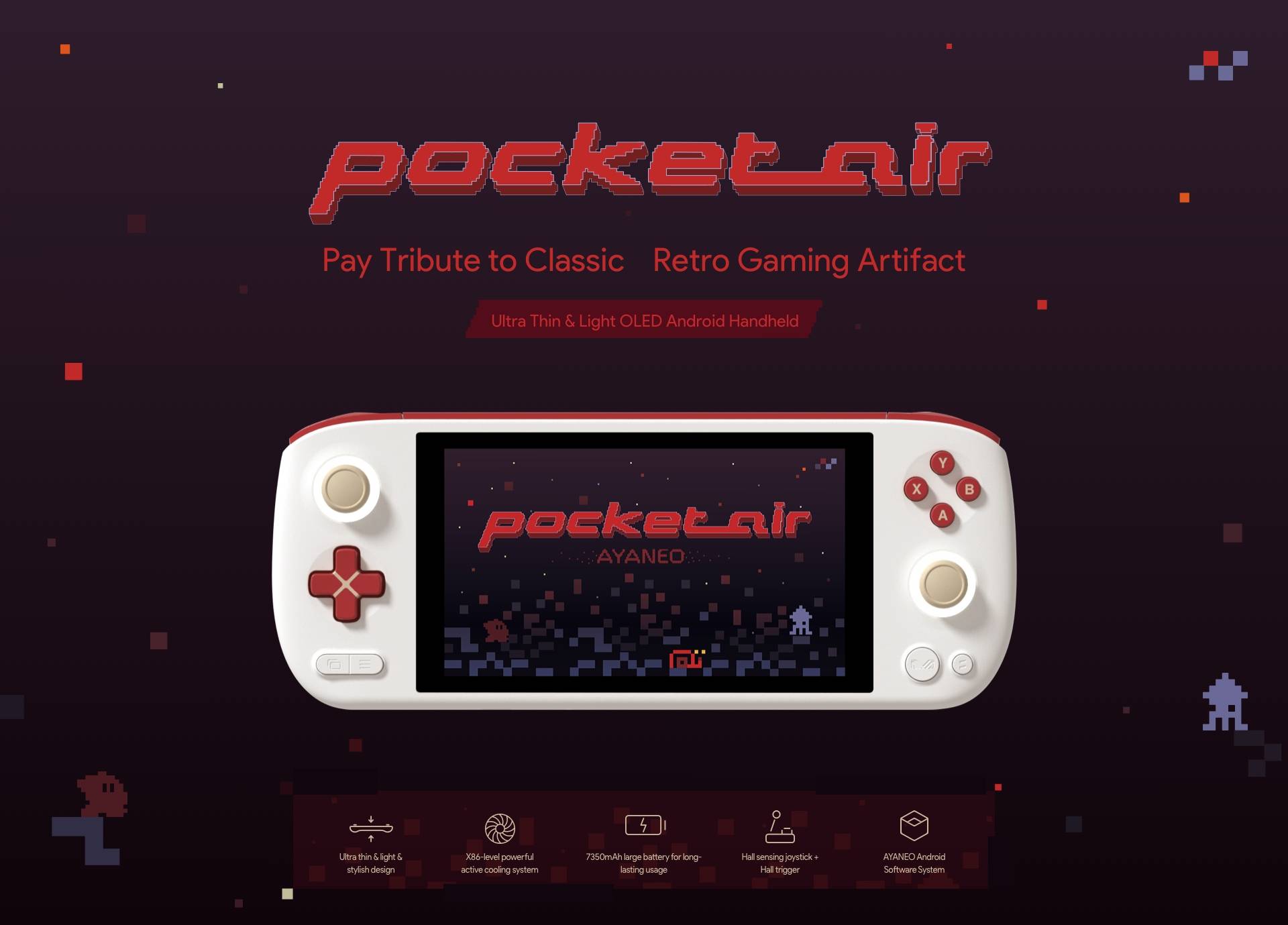
The AYANEO Pocket Air is the company’s compact Android emulation handheld, crowdfunded on Indiegogo in late 2022 as a deliberate break from AYANEO’s x86 Windows machines. Instead of an AMD APU it runs a MediaTek Dimensity 1200, the same 6 nm phone silicon that shipped in mid-2021 flagships, wrapped in a 5.5-inch chassis with real analog sticks. The pitch is straightforward: take a capable phone SoC, bolt on physical controls and active cooling, and pair it with a screen that outclasses almost everything else in the category. It competes less with a Steam Deck than with the Retroid Pocket line and AYANEO’s own cheaper Pocket Air Mini, and its central argument over those rivals is that AMOLED panel. Memory is LPDDR4X and storage is UFS 3.1, and it arrived as one of the first Android handhelds to lead with an OLED screen rather than a budget LCD, which is exactly how AYANEO justifies the price.
Emulation performance, generation by generation
Read this as an ARM Android device, not a pocket PC. The Dimensity 1200 pairs four Cortex-A78 cores (up to 3.0 GHz) with four A55 cores and a Mali-G77 MC9 GPU, which is competent but a full generation behind the Snapdragon 8 Gen 2 chips later Android handhelds adopted. Everything through the sixth generation is trivial: NES, SNES, Genesis, Game Boy Advance, PS1 (DuckStation), Nintendo 64 and Dreamcast (Flycast) run at full speed with headroom for upscaling. PSP via PPSSPP is comfortable at 2x or 3x native. The interesting tier is PS2 and GameCube. AetherSX2 handles a large slice of the PS2 library at 2x resolution, and Dolphin pushes many GameCube games to 2-3x, though demanding titles and the usual driver-level graphical glitches persist. Citra upscales 3DS cleanly at roughly 2-3x, and Sega Saturn is playable through Yaba Sanshiro with the usual per-game caveats. Wii is hit-and-miss and depends heavily on the title, and Switch emulation is effectively off the table on this chip. Sustained PS2 and GameCube sessions also draw hard on the 7,350 mAh cell, so expect roughly three to four hours of heavy emulation versus much longer for 8- and 16-bit systems. Do not expect the Yuzu or Ryujinx results people got from Snapdragon flagships. Native Android games from the Play Store run flawlessly, which matters more here than on a Linux handheld.
Screen, build and controls
The 5.5-inch 1920×1080 AMOLED is the reason to buy this device. At 404 ppi with true blacks, roughly 100% sRGB and near-full DCI-P3 coverage, it makes 2D sprite work and upscaled 3D look genuinely rich in a way LCD rivals cannot touch. It is a 60 Hz panel rather than high-refresh, and 1080p is arguably overkill for retro content, but it remains a real differentiator. The controls back it up: Hall-effect analog sticks that resist drift, linear analog triggers and a competent d-pad. The trade-off is size and weight. At roughly 380 g (AYANEO’s own listing says 391 g) and 224 mm wide, the Pocket Air is heavier and larger than the “pocket” name implies, closer to a small tablet in the hand. AYANEO fitted an active fan to hold the Dimensity’s clocks, so it throttles less than a passively cooled phone, at the cost of audible noise under load.
Software and setup
It ships with Android 12, and that shapes the entire ownership experience. The Linux custom-firmware ecosystem people associate with retro handhelds, muOS, Knulli, ArkOS, ROCKNIX and Batocera, does not apply here, because those target Allwinner and Rockchip Linux boards rather than a MediaTek Android device. Setup instead means installing standalone emulators or RetroArch from the Play Store and wrapping them in a front-end such as Daijisho or ES-DE for a console-style library. AYANEO’s own AYASpace and AYAHome launcher is serviceable but not essential. A rooting and custom-ROM community exists, yet for most owners the sane path is stock Android plus a curated stack of DuckStation, PPSSPP, Dolphin, AetherSX2 and Citra. Budget an afternoon to load games, sort them and map controls; nothing is turnkey the way an Anbernic Linux unit is.
Price, value and who it is for
Crowdfunding opened at $279 for 6 GB/128 GB and climbed to $459 for the 12 GB/512 GB tier, with retail landing higher. That is a lot to ask for a 2021-class phone chip, and it is the Pocket Air’s weakest point: a Retroid Pocket delivers comparable or better emulation for far less, just without the OLED. You are paying a premium for the panel, the Hall sticks and the build quality. It makes sense for someone who wants the best-looking screen on an Android emulation handheld, who values AMOLED for sprite-based and PSP-era games, and who does not need Switch or reliable Wii support. Bargain hunters and anyone chasing raw performance per dollar should look elsewhere; buyers who will notice the display every single time they power it on are the real audience.
📐 Size & Pocketability
⚖️ Weight vs Other Handhelds
🔋 Real-World Battery Estimator
⭐ Emulation Performance
📊 View How This Score is Calculated
The Hardware Power Score is an absolute metric. Perfect emulation of difficult, modern consoles awards significantly more points than standard retro consoles.
- 15× Multiplier: Modern PC
- 12× Multiplier: Switch, PS3, Xbox 360
- 10× Multiplier: Wii U
- 8× Multiplier: PS2, GameCube, Wii, Xbox
- 5× Multiplier: Saturn, Dreamcast, PSP
- 3× Multiplier: N64, PS1
- 1× Multiplier: SNES, GBA
Gen 8 & PC
Generation 7
Generation 6
Generation 5
Handhelds & Retro
⚡ Performance Benchmarks
Where AYANEO Pocket Air Mali-G77 MC9 lands against the handhelds everyone knows. Every bar shares one scale, so longer genuinely means faster — add up to two rivals to compare.
CPU = Geekbench 6 multi-core · GPU = 3DMark Wild Life. Median real-world scores; every bar shares one scale — add up to two rivals to compare.
📋 Full Specifications
📺 Display
⚙️ Platform
💾 Memory
🕹️ Controls
📏 Body
🔋 Battery
⚖️ Verdict
✅ The Good
- Class-leading 5.5-inch 1080p AMOLED (404 ppi, true blacks, wide gamut) that outshines every LCD rival in the category
- Hall-effect analog sticks, linear analog triggers and an active fan that holds clocks under sustained load
- Runs everything up to PS2, GameCube and 3DS at 2-3x upscaling, plus flawless native Android games
- Large 7,350 mAh battery with full Android 12: Play Store, Wi-Fi 6, Bluetooth 5.2 and optional 4G LTE
❌ The Bad
- Expensive at $279-$459 for a 2021 Dimensity 1200; Retroid handhelds match its emulation for much less
- Heavy and wide at ~380-391 g and 224 mm, not genuinely pocketable, and the panel is only 60 Hz
- Switch emulation is effectively a no-go and Wii is inconsistent; as an Android device it gets no muOS/ArkOS-style firmware, so all setup is DIY
📰 Latest News & Guides
The Ultimate Guide to ARMSX3: Android’s New PS3 Emulator, Competitor Comparisons, and Setup Tutorial
18/08/2026Pokémon Gold, Silver, and Crystal (Gen 2) Recomp Lands on Android
17/08/2026How to Play the Pokémon Red, Blue, or Yellow Recomp on Your Android, Windows, and Linux Devices
16/08/2026🔍 Similar Handhelds
Other handhelds that emulate up to PS2.