
🛒 Where to Buy
⚠️ Golden Rule of Retro Handhelds: Throw away the cheap MicroSD card that comes in the box — it will fail. And never use a high-wattage PD “Fast Charger” on these devices; it can damage the battery. Use a standard 5V/1.5A brick.
Device Overview: Anbernic RG-35XX H
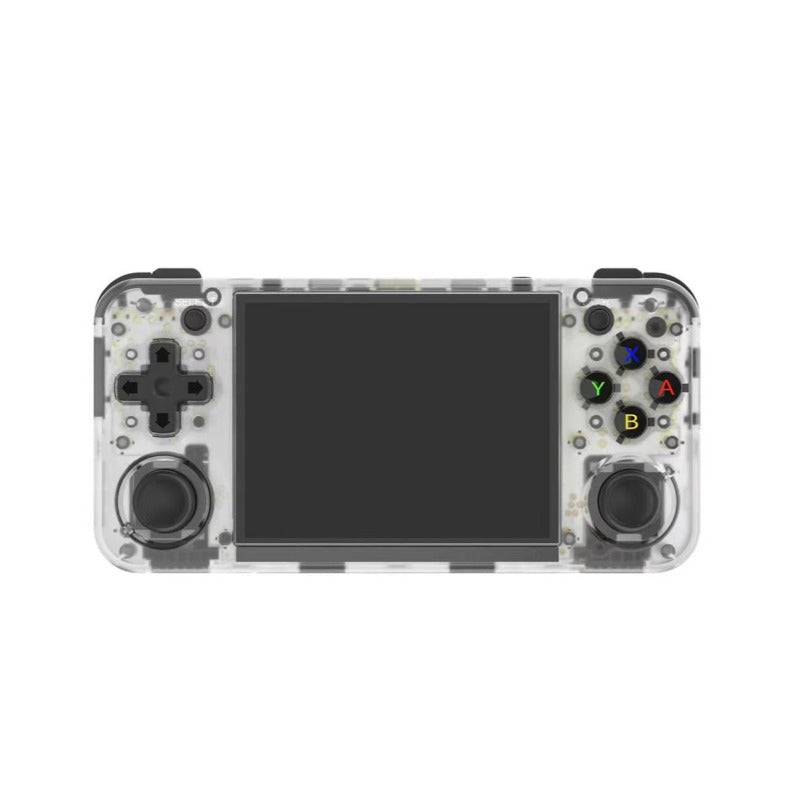
The Anbernic RG-35XX H is the horizontal, dual-stick reworking of Anbernic’s popular 3.5-inch line, aimed at anyone who wants a pocketable retro machine that also handles the fifth-generation systems the original vertical RG35XX left out. The “H” stands for the landscape body: instead of the Game Boy-style upright shell, you get a wider chassis with two offset analog sticks tucked below the d-pad and face buttons, and that is exactly what makes PlayStation and Nintendo 64 emulation usable here. It runs on the Allwinner H700, the same quad-core chip Anbernic put in the RG35XX Plus, so treat this as a sibling of that device in a different shape rather than a genuine step up in power.
Emulation performance, generation by generation
The H700 is a quad-core ARM Cortex-A53 clocked at 1.5GHz with a dual-core Mali-G31 GPU and 1GB of LPDDR4 RAM. That is a low-power mobile SoC, not a handheld PC, and the emulation ceiling reflects it. Everything up to and including the 16-bit era is trivial: NES, SNES, Genesis, Game Boy, Game Boy Color, Game Boy Advance, PC Engine and Neo Geo all run at full speed through RetroArch with room to spare for shaders and run-ahead. PlayStation 1 is the comfort zone, and most of the library runs cleanly on the Beetle and PCSX cores. Nintendo 64 is where the honesty starts: through Mupen64Plus, Super Mario 64, Ocarina of Time and Mario Kart 64 are playable, but heavier titles such as Perfect Dark, Conker and the Rare-engine games stutter, and per-game tweaking is part of the deal. PSP via PPSSPP is genuinely possible but selective, with 2D and lighter 3D games holding up while the demanding stuff needs frameskip and resolution cuts. Dreamcast on Flycast is a coin toss; plenty of games run, others drop frames. Nintendo DS through DraStic works but the single screen is awkward. Saturn and the heaviest PSP and N64 titles are the practical wall, and GameCube, Wii and Switch are simply out of reach for this chip.
Screen, build and controls
The 3.5-inch IPS panel runs 640×480 at a 4:3 aspect, OCA-laminated so the image sits right under the glass, and it is bright and genuinely sharp for the money. That native 4:3 shape is a deliberate choice: it fills the screen with old console output instead of letterboxing it, which most sub-$70 widescreen handhelds cannot. The shell measures 14.5 x 6.9 x 1.6cm and weighs 180g, so it slips into a jacket pocket without a case. The trade-off is ergonomics; it is a small, flat body, and long sessions get cramped, a complaint reviewers raise consistently. The two analog sticks are conventional potentiometer units, not Hall effect, so drift is a long-term risk even if review samples start clean. The shoulder buttons are digital L1/R1/L2/R2 rather than analog triggers, there is a rumble motor, and the face buttons and d-pad are clicky and responsive.
Software and setup
Out of the box the RG-35XX H ships with Anbernic’s own 64-bit Linux build on a bundled microSD, which works but is not why most people buy it. The H700 has a mature custom-firmware scene, and swapping the OS is the single biggest upgrade you can make. muOS is the popular default for its clean interface and strong controller and save management; Knulli, the Batocera-derived successor to the older 35XX firmware, is excellent for box art scraping and RetroAchievements; Batocera and ROCKNIX are both available too if you prefer their ecosystems. The dual microSD slots help here: keep the stock card in one slot and your custom firmware plus ROMs in the other, so you can revert at any time. One caveat worth stating plainly is that GarlicOS, the firmware many associate with the original RG35XX, does not target this H700 hardware, so muOS and Knulli are the equivalents to reach for.
Price, value and who it is for
Anbernic lists it around $57.99 to $67.99 direct, though third-party sellers on Amazon push it toward $90, so buy from the source if you can. At the direct price it is one of the cheapest ways to get dual sticks, dual-band WiFi, Bluetooth 4.2 and HDMI-out in a package that plays everything from the NES up through most of the PS1 catalog and dabbles credibly in N64 and PSP. It is a good fit for someone who mainly wants 8-bit, 16-bit and PS1 games with the occasional N64 session and who values pocketability over grip comfort. If your priority is smooth N64, PSP and Dreamcast across the board, or Hall effect sticks, spend more on an RG406-class device; if you never touch analog games at all, the cheaper vertical RG35XX or the clamshell 35XXSP saves money. As a compact, honest all-rounder for retro gaming up to the 32-bit era, the RG-35XX H is one of the easiest budget recommendations in Anbernic’s range.
📐 Size & Pocketability
⚖️ Weight vs Other Handhelds
🔋 Real-World Battery Estimator
⭐ Emulation Performance
📊 View How This Score is Calculated
The Hardware Power Score is an absolute metric. Perfect emulation of difficult, modern consoles awards significantly more points than standard retro consoles.
- 15× Multiplier: Modern PC
- 12× Multiplier: Switch, PS3, Xbox 360
- 10× Multiplier: Wii U
- 8× Multiplier: PS2, GameCube, Wii, Xbox
- 5× Multiplier: Saturn, Dreamcast, PSP
- 3× Multiplier: N64, PS1
- 1× Multiplier: SNES, GBA
Generation 6
Generation 5
Handhelds & Retro
⚡ Performance Benchmarks
Where Anbernic RG-35XX H ARM Mali-G31 MP2 lands against the handhelds everyone knows. Every bar shares one scale, so longer genuinely means faster — add up to two rivals to compare.
CPU = Geekbench 6 multi-core · GPU = 3DMark Wild Life. Median real-world scores; every bar shares one scale — add up to two rivals to compare.
📋 Full Specifications
📺 Display
⚙️ Platform
💾 Memory
🕹️ Controls
📏 Body
🔋 Battery
⚖️ Verdict
✅ The Good
- Native 4:3 640×480 laminated IPS screen fills the display with old-console output instead of letterboxing it, and it stays bright and sharp
- Horizontal dual-stick body adds HDMI-out, dual-band WiFi and Bluetooth 4.2 for well under $70 direct
- Mature custom-firmware support (muOS, Knulli, Batocera, ROCKNIX) plus dual microSD slots make swapping the OS painless and reversible
- Genuinely pocketable at 180g with clicky, responsive face buttons and d-pad
❌ The Bad
- Conventional potentiometer sticks, not Hall effect, so long-term stick drift is a real possibility
- Small, flat shell gets cramped over long sessions, and the shoulder buttons are digital with no analog triggers
- The H700 runs out of headroom at N64, PSP and Dreamcast, where many titles need per-game tuning and never hit full speed
📰 Latest News & Guides
The Ultimate Guide to ARMSX3: Android’s New PS3 Emulator, Competitor Comparisons, and Setup Tutorial
18/08/2026Pokémon Gold, Silver, and Crystal (Gen 2) Recomp Lands on Android
17/08/2026How to Play the Pokémon Red, Blue, or Yellow Recomp on Your Android, Windows, and Linux Devices
16/08/2026🔍 Similar Handhelds
Other handhelds that emulate up to Dreamcast.