
🛒 Where to Buy
⚠️ Golden Rule of Retro Handhelds: Throw away the cheap MicroSD card that comes in the box — it will fail. And never use a high-wattage PD “Fast Charger” on these devices; it can damage the battery. Use a standard 5V/1.5A brick.
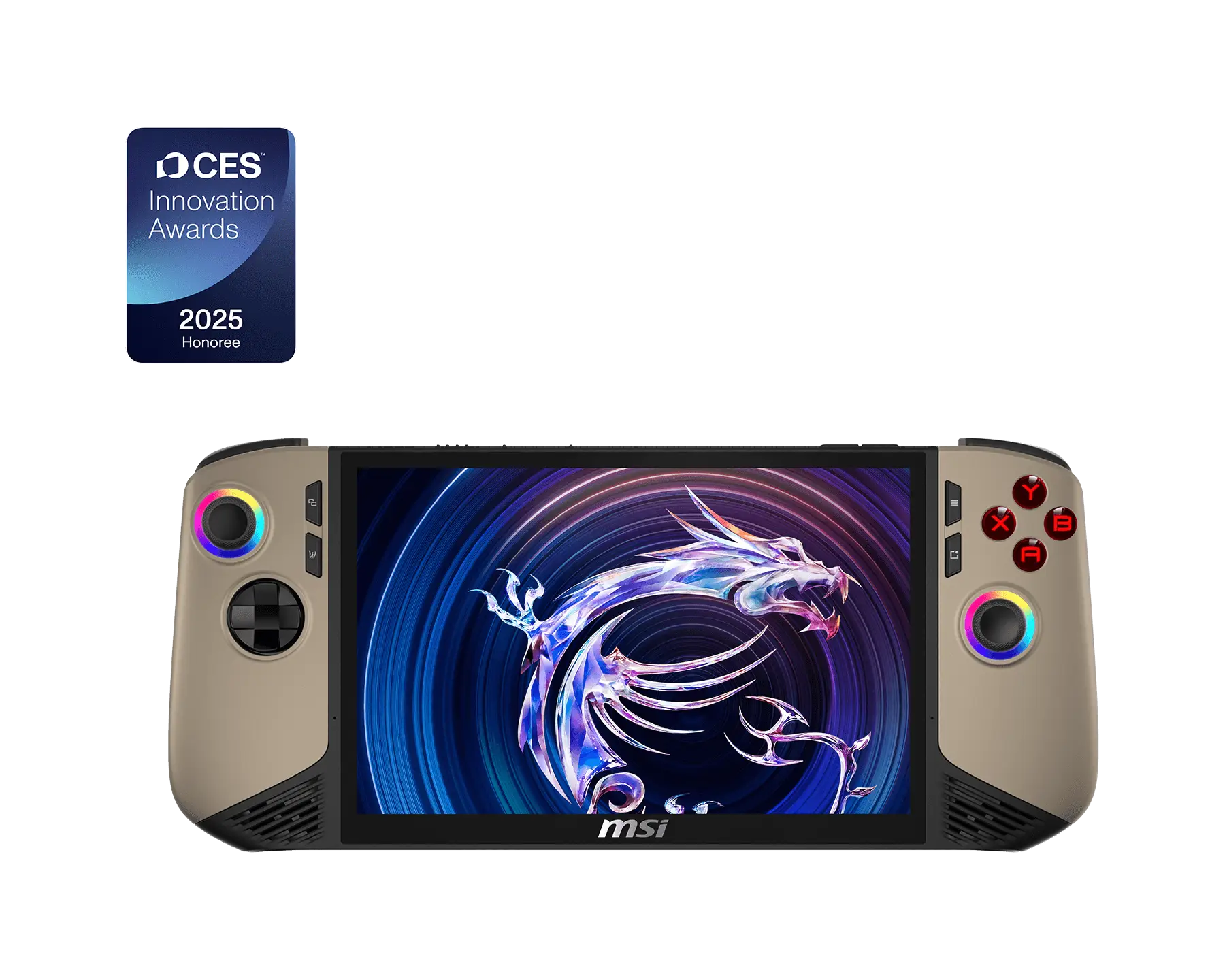
Device Overview: MSI Claw 8 AI+
The first MSI Claw was a cautionary tale. Its Meteor Lake chip drank power, ran hot, and lost benchmarks to AMD handhelds that cost less. The Claw 8 AI+ is MSI conceding none of that and fixing all of it. The Intel Core Ultra 7 258V inside is a Lunar Lake part: four performance cores and four low-power efficiency cores, 8 threads total, paired with on-package LPDDR5X-8533 memory and an Arc 140V integrated GPU built on eight Xe2 cores clocking to roughly 1.95 GHz. The review configuration ships with 32GB of that memory and a 1TB PCIe 4.0 NVMe SSD.
What makes it interesting is efficiency. The Arc 140V is the rare iGPU that gets stronger, relative to AMD, as you starve it of watts. At 12-17W it outperforms the Radeon 780M in the ROG Ally X, and MSI quotes a 20% average FPS lead under identical power. Push both to 30W and the gap narrows, but handhelds live in the 15-25W band, and that is exactly where Lunar Lake is happiest. Against the Ally X it trades blows on raw frames while winning on idle draw; against the Lenovo Legion Go it counters with a saner 8-inch form factor instead of detachable-controller ambition.
Emulation performance, generation by generation
This is where Intel’s reputation has historically been a liability, and the honest answer is that the Claw 8 AI+ is excellent up to a point and frustrating past it. PS2 through PCSX2 runs at 2-3x internal resolution without drama. GameCube and Wii through Dolphin are effortless, holding full speed at upscaled resolutions across the library. Wii U via Cemu is largely full-speed too, provided you run the Vulkan backend rather than OpenGL, where Intel’s driver is weaker.
Above that tier, results turn per-game. Nintendo Switch emulation through the Yuzu successors (Eden, Citron) handles lighter titles cleanly but stumbles on demanding ones, and the failures are usually Intel GPU driver compatibility, not a lack of horsepower. PS3 through RPCS3 is the rough spot: many lightweight games run smoothly, but plenty show graphical glitches the equivalent AMD chip renders correctly, and RPCS3’s affinity for AVX-512 (which the Ryzen Z1 Extreme’s Zen 4 cores expose and Lunar Lake does not) costs you on the heaviest titles. Xbox 360 through Xenia is experimental on any handheld and stays that way here, working title-by-title at best.
The caveat worth internalizing: Intel iGPUs were long the wrong pick for emulation, and you will still find forum advice that says so. Lunar Lake genuinely narrowed that gap, and Dolphin/PCSX2/Cemu are now non-issues. But if your library leans Switch, PS3, or 360, AMD remains the safer compatibility bet.
Screen, build and controls
The 8-inch IPS panel is a 1920×1200 16:10 display at 120Hz with VRR, around 500 nits, and full sRGB coverage. It is genuinely good, with strong contrast for IPS, though out of the box the color temperature runs cool with a blue cast you will want to correct. The chassis is plastic but rigid, with no creak under pressure, and it weighs roughly 795 grams, which is a lot to hold but normal for an 8-inch device. The 80Wh battery is the headline: it is among the largest in any handheld, and combined with Lunar Lake’s frugality it delivers the longest runtimes in the category. The Hall effect sticks and triggers won’t develop drift, and the triggers carry slightly more resistance than the competition, which suits shooters.
Software and setup
You are buying a Windows 11 Home PC shaped like a console, and the Windows tax is real. MSI Center M is the launcher and TDP/fan-curve hub, and it works, but it is occasionally laggy and its feature set trails Asus’s Armoury Crate. Expect to disable startup bloat, fight Windows scaling at 1200p, and lean on a third-party front end if you want a couch experience. The flip side is total openness: any storefront, any emulator, any mod tool, no walled garden.
Price, value and who it’s for
MSRP is $899.99, though US tariffs have pushed street pricing toward $1,000. That is flagship money, and it buys you the best battery life in the class, the most efficient chip, a top-tier screen, and effortless retro-to-PS2/Wii U emulation. It is the right handheld for someone who plays native PC games at low wattage on long sessions and dabbles in emulation up through Dolphin and Cemu. It is the wrong handheld for an emulation purist whose endgame is flawless Switch and PS3, where the Intel driver situation still trails AMD. Buy it for what Lunar Lake is genuinely best at, not for the generations Intel still can’t fully tame.
📐 Size & Pocketability
⚖️ Weight vs Other Handhelds
🔋 Real-World Battery Estimator
⭐ Emulation Performance
📊 View How This Score is Calculated
The Hardware Power Score is an absolute metric. Perfect emulation of difficult, modern consoles awards significantly more points than standard retro consoles.
- 15× Multiplier: Modern PC
- 12× Multiplier: Switch, PS3, Xbox 360
- 10× Multiplier: Wii U
- 8× Multiplier: PS2, GameCube, Wii, Xbox
- 5× Multiplier: Saturn, Dreamcast, PSP
- 3× Multiplier: N64, PS1
- 1× Multiplier: SNES, GBA
Gen 8 & PC
Generation 7
Generation 6
Generation 5
Handhelds & Retro
⚡ Performance Benchmarks
Where MSI Claw 8 AI+ Intel Arc Graphics 140V (Xe2, 8 Xe cores) lands against the handhelds everyone knows. Every bar shares one scale, so longer genuinely means faster — add up to two rivals to compare.
CPU = Geekbench 6 multi-core · GPU = 3DMark Wild Life. Median real-world scores; every bar shares one scale — add up to two rivals to compare.
📋 Full Specifications
📺 Display
⚙️ Platform
💾 Memory
🕹️ Controls
📏 Body
🔋 Battery
⚖️ Verdict
✅ The Good
- Best-in-class battery life: 80Wh paired with Lunar Lake's efficiency, the longest runtimes in the category
- Arc 140V leads the Radeon 780M at 12-17W, the wattage band handhelds actually run in
- Excellent 8-inch 1920×1200 120Hz IPS screen with VRR, ~500 nits and full sRGB
- Hall effect sticks and triggers (no drift), rigid creak-free chassis, dual Thunderbolt 4
❌ The Bad
- Intel GPU drivers still hurt Switch (Eden/Citron) and PS3 (RPCS3) emulation versus AMD; Xbox 360 stays experimental
- $900 MSRP climbing toward $1,000 with US tariffs, plus the usual Windows handheld friction (scaling, bloat, laggy MSI Center M)
- Heavy at ~795g, and factory color calibration runs cool with a blue cast
📰 Latest News & Guides
The Ultimate Guide to ARMSX3: Android’s New PS3 Emulator, Competitor Comparisons, and Setup Tutorial
18/08/2026Pokémon Gold, Silver, and Crystal (Gen 2) Recomp Lands on Android
17/08/2026How to Play the Pokémon Red, Blue, or Yellow Recomp on Your Android, Windows, and Linux Devices
16/08/2026🔍 Similar Handhelds
Other handhelds that emulate up to CURRENTGEN.