
🛒 Where to Buy
⚠️ Golden Rule of Retro Handhelds: Throw away the cheap MicroSD card that comes in the box — it will fail. And never use a high-wattage PD “Fast Charger” on these devices; it can damage the battery. Use a standard 5V/1.5A brick.
Device Overview: MSI Claw 7 AI+
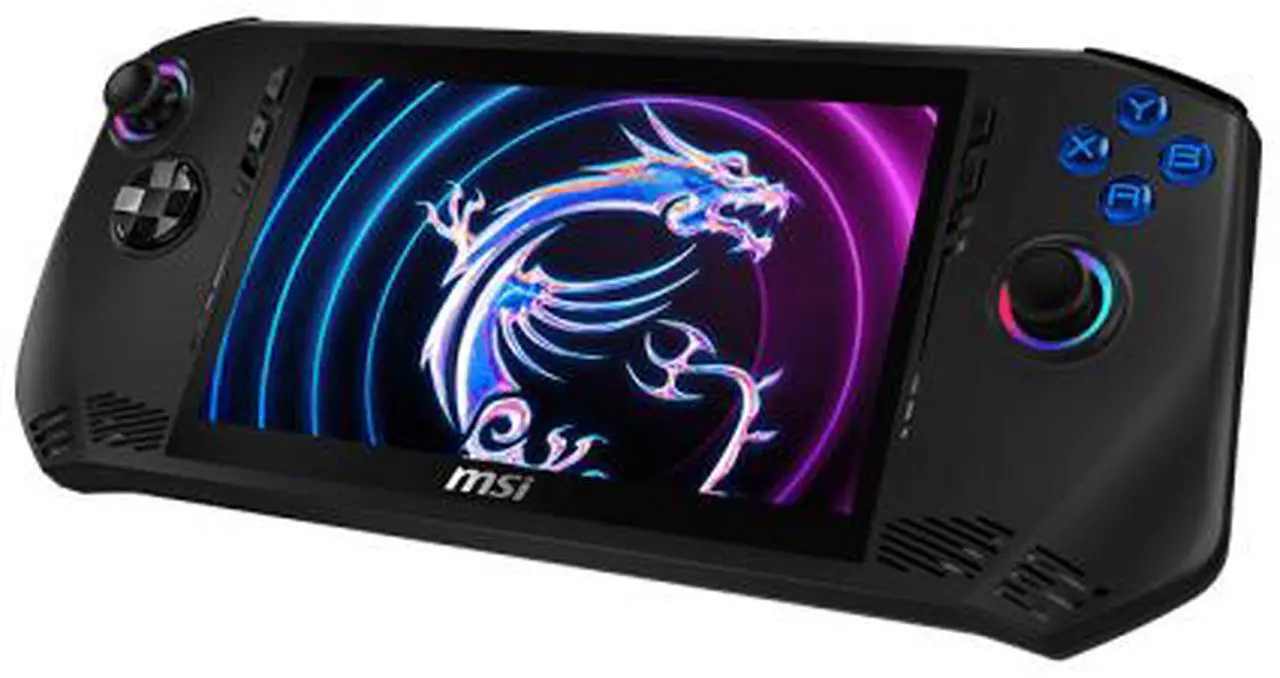
The MSI Claw 7 AI+ is a full Windows 11 gaming PC folded into a 7-inch handheld, and that framing matters more than any spec sheet line. Unlike the ARM-based Anbernic and Retroid units that dominate the emulation hobby, this is an x86 machine built around Intel’s Lunar Lake platform: a Core Ultra 7 258V with four performance cores and four low-power efficiency cores (eight cores, eight threads, no hyper-threading), paired with an Intel Arc 140V integrated GPU that carries eight Xe2 cores clocked near 1.95 GHz and draws its VRAM from the shared on-package memory. It is the smaller sibling to the Claw 8 AI+, trading screen real estate and a little battery for a lighter 675 g chassis. The “AI+” tag refers to the chip’s roughly 47-TOPS NPU, which does effectively nothing for gaming or emulation; ignore the branding and judge it as a compact Windows portable.
Emulation performance, generation by generation
Because it runs desktop Windows, the Claw 7 AI+ reaches emulation targets no handheld Linux box in its size class can touch. Everything up to the sixth generation is trivial: PS1 (DuckStation), N64, Dreamcast, PSP (PPSSPP), NDS and 3DS (Azahar, the post-Citra fork) all run at full speed with heavy internal upscaling and frame doubling. GameCube and Wii through Dolphin are essentially solved, and Wii U via Cemu is one of this chip’s real strengths thanks to strong single-thread throughput. PS2 (PCSX2) clears its harder titles comfortably. PS3 through RPCS3 is where it earns its price: a large slice of the library is genuinely playable, though the heaviest games still dip and per-title tuning is part of the deal. Switch emulation is the honest caveat: yuzu and Ryujinx were both shut down in 2024, and the surviving forks (Sudachi, Citron, Eden) are less polished, so results depend on which build you chase. The Arc 140V handles them well where they run at all. PS4 via shadPS4 is early and experimental. The one asterisk on all of this is Intel’s GPU drivers, which have matured but still occasionally trail AMD’s Radeon stack on specific titles and shader compilation.
Screen, build and controls
The 7-inch panel is a 1920 x 1080 IPS display at 120 Hz with VRR, 500 nits, and full sRGB coverage, roughly 314 ppi and touch-enabled. It is a sensible native resolution for emulation, where you can render 2x or 4x internally and still hit high frame rates. The controls are the biggest upgrade over the original 2024 Claw: Hall-effect thumbsticks in an asymmetric layout that resist drift, Hall-effect analog triggers, and a proper d-pad. At 675 g it is lighter than the 8-inch model and most Ryzen rivals, which helps on long sessions, though it is still a two-handed slab, not a pocket device. Cooling is active, and under a 30 W load the fans are audible.
Software and setup
This ships with stock Windows 11, which is both the appeal and the friction. You get Steam, Game Pass, Epic, GOG and every standalone emulator with no sideloading gymnastics, but you also inherit Windows’ handheld ergonomics problems: small touch targets, driver updates, and background bloat. MSI Center M is the built-in overlay for TDP, fan curves and button remaps, and it is serviceable rather than great. Most owners smooth the experience with third-party front ends: EmuDeck installs and configures the emulator stack in one pass, and Playnite or a similar launcher unifies your libraries behind a controller-friendly interface. The Linux custom-firmware ecosystem that defines ARM handhelds, muOS, Knulli, ROCKNIX, Batocera, is not the native path here, though Bazzite exists as a SteamOS-style Linux alternative if you want to leave Windows behind. For pure retro use, a debloated Windows plus EmuDeck is the pragmatic route.
Price, value and who it is for
Launch pricing sits around 799 USD for the 32 GB / 1 TB configuration, with a 512 GB variant available. That is a lot next to a 150-dollar Anbernic, and the value question is genuine: if your ceiling is PSP and Dreamcast, you are massively overpaying. The Claw 7 AI+ makes sense only if you want the top of the emulation stack, PS3, Wii U, the Switch forks, alongside a real Steam and Game Pass library on the same machine. Battery is the practical limiter; the 53 Wh pack stretches past 15 hours for video but collapses to roughly 1.5 to 2 hours in demanding native games at higher TDP, with emulation landing somewhere in between depending on wattage. Note that the 32 GB LPDDR5X-8533 is on-package and soldered, so it is not upgradeable, though the M.2 2230 SSD is. Buy it if you specifically want a Windows handheld that doubles as your most capable emulator; skip it if you only play 8- and 16-bit libraries, where a fraction of the money and none of the Windows overhead will serve you better.
📐 Size & Pocketability
⚖️ Weight vs Other Handhelds
🔋 Real-World Battery Estimator
⭐ Emulation Performance
📊 View How This Score is Calculated
The Hardware Power Score is an absolute metric. Perfect emulation of difficult, modern consoles awards significantly more points than standard retro consoles.
- 15× Multiplier: Modern PC
- 12× Multiplier: Switch, PS3, Xbox 360
- 10× Multiplier: Wii U
- 8× Multiplier: PS2, GameCube, Wii, Xbox
- 5× Multiplier: Saturn, Dreamcast, PSP
- 3× Multiplier: N64, PS1
- 1× Multiplier: SNES, GBA
Gen 8 & PC
Generation 7
Generation 6
Generation 5
Handhelds & Retro
⚡ Performance Benchmarks
Where MSI Claw 7 AI+ Intel Arc Graphics 140V (Xe2, 8 Xe cores) lands against the handhelds everyone knows. Every bar shares one scale, so longer genuinely means faster — add up to two rivals to compare.
CPU = Geekbench 6 multi-core · GPU = 3DMark Wild Life. Median real-world scores; every bar shares one scale — add up to two rivals to compare.
📋 Full Specifications
📺 Display
⚙️ Platform
💾 Memory
🕹️ Controls
📏 Body
🔋 Battery
⚖️ Verdict
✅ The Good
- Full Windows 11 x86 platform reaches PS3, Wii U and Switch-fork emulation that ARM handhelds in this size class cannot
- 7-inch 1920×1080 120Hz IPS panel with VRR, 500 nits and full sRGB, ideal for internal upscaling
- Hall-effect sticks and triggers plus a proper d-pad, a real fix for the original Claw's control complaints
- Light for its class at 675 g, with dual Thunderbolt 4, Wi-Fi 7 and a replaceable M.2 2230 SSD
❌ The Bad
- Around 799 USD launch price is hard to justify unless you actually need the top of the emulation ladder
- Battery drops to roughly 1.5 to 2 hours in demanding games, and Windows handheld ergonomics add friction
- Intel Arc drivers still occasionally trail AMD on specific titles, and the soldered 32 GB RAM is not upgradeable
📰 Latest News & Guides
The Ultimate Guide to ARMSX3: Android’s New PS3 Emulator, Competitor Comparisons, and Setup Tutorial
18/08/2026Pokémon Gold, Silver, and Crystal (Gen 2) Recomp Lands on Android
17/08/2026How to Play the Pokémon Red, Blue, or Yellow Recomp on Your Android, Windows, and Linux Devices
16/08/2026🔍 Similar Handhelds
Other handhelds that emulate up to CURRENTGEN.