
🛒 Where to Buy
⚠️ Golden Rule of Retro Handhelds: Throw away the cheap MicroSD card that comes in the box — it will fail. And never use a high-wattage PD “Fast Charger” on these devices; it can damage the battery. Use a standard 5V/1.5A brick.
Device Overview: Game Kiddy GKD Pixel 2
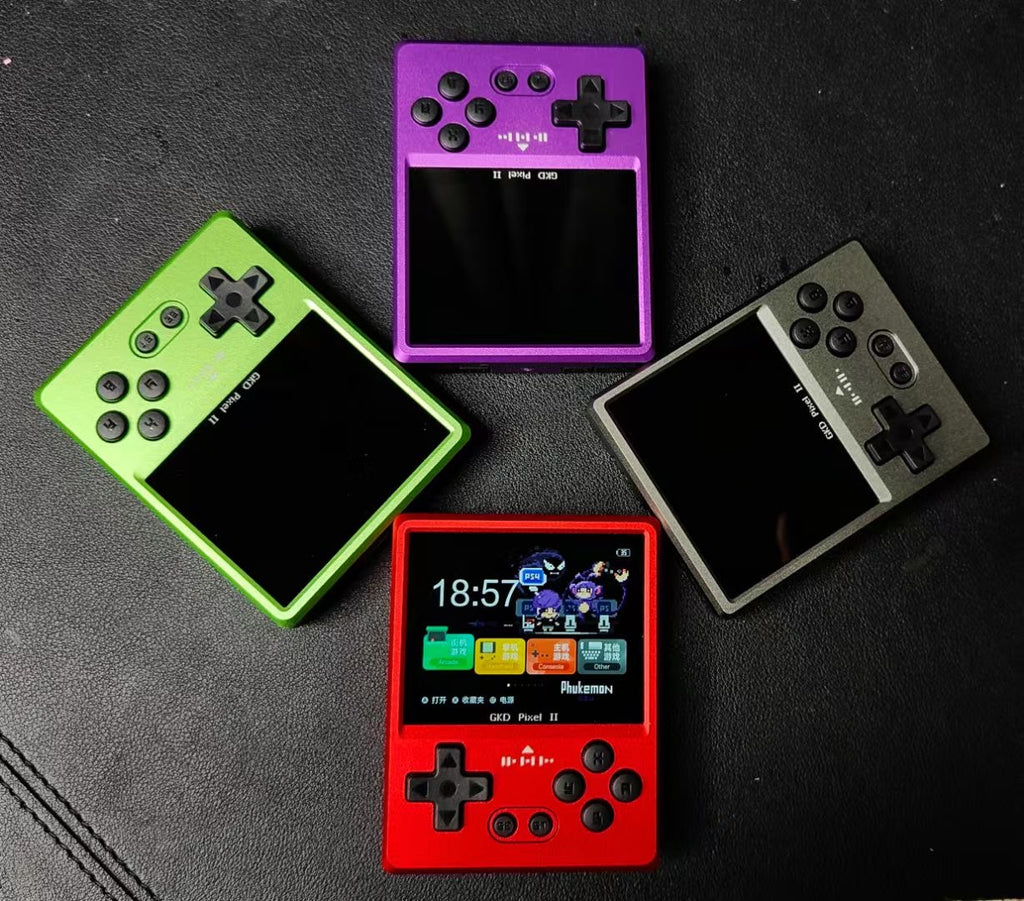
The Game Kiddy GKD Pixel 2 is a palm-sized metal micro-handheld, a 2025 follow-up to the 2021 GKD Pixel that keeps the original’s jacket-pocket footprint while fixing its biggest weakness. At 63 by 81 by 17mm and 115 grams, it is one of the smallest 4:3 emulation handhelds you can buy with a real d-pad and four shoulder buttons rather than a toy-grade layout. The headline change over the first Pixel is the screen: the old 320×240 panel is gone, replaced by a 640×480 IPS display that quadruples the pixel count. Under the hood, though, this is still a Rockchip RK3326S device, so it competes with the aging Anbernic RG351 family and the Powkiddy RGB10-class boards, not with anything running Android or a modern Cortex-A55 chip.
Emulation performance, generation by generation
The RK3326S is a quad-core Cortex-A35 clocked at 1.5GHz with a Mali-G31 MP2 GPU and 1GB of DDR3 RAM. That is a modest, well-understood budget, and it defines a hard ceiling. Everything up to and including the 16-bit era runs flawlessly: NES, SNES, Master System, Genesis/Mega Drive, PC Engine, Game Boy, Game Boy Color and Game Boy Advance all hit full speed through RetroArch cores such as Snes9x, Genesis Plus GX and gpSP. PlayStation 1 is the sweet spot and the reason to buy this over a Game Boy-shaped toy; PCSX ReARMed clears the large majority of the library at full frame rate, with only the heaviest 3D titles occasionally dipping. Above PS1 the picture gets honest fast. Dreamcast via Flycast runs a slice of 2D-heavy and lighter games but is not a dependable Dreamcast machine. Nintendo 64 through Mupen64Plus is rough: expect frame drops, audio crackle and per-game tweaking rather than a plug-and-play library. PSP on PPSSPP is a lottery limited to low-demand titles at reduced resolution, and Nintendo DS is effectively a no-go given both the horsepower and the single 4:3 screen. Treat this as a machine that peaks at PS1, not a pocket PC.
Screen, build and controls
The 2.4-inch, 60Hz IPS panel is the star. A native 640×480 resolution at 4:3 means SNES and PS1 output integer-scales cleanly, and pixel art looks sharp on a screen this dense; it is a genuine generational jump over the muddy 240p original. The shell is milled aluminium with grip grooves cut into the back, and it feels far more expensive than the price suggests: cold, solid, and reassuringly dense for something this tiny. The trade-off is ergonomics. This is a small slab, and long sessions cramp adult hands. The controls are a membrane d-pad, four face buttons, recessed Start/Select and, notably for a device this size, four shoulder buttons (L1/R1/L2/R2) that make PS1 mapping viable. There is no analog stick at all, so the Hall-effect question is moot; anything needing twin-stick or precise analog aiming is out. Connectivity is deliberately bare: USB-C for charging and OTG, a 3.5mm headphone jack, a microSD slot, and no Wi-Fi or Bluetooth whatsoever. The 1800mAh battery, charged at 5V/2A over USB-C, lasts roughly four to six hours on 8- and 16-bit games and drops to two or three hours once you push PS1.
Software and setup
Out of the box the Pixel 2 ships with Game Kiddy’s own Linux build on a preinstalled microSD, an EmuELEC-style front end that boots straight to a system list and works without fuss. The stock experience is fine but unremarkable, and the real value is that the RK3326S is one of the best-supported chips in the custom-firmware scene. ArkOS is the community default for this chip and gives you clean per-core configuration and reliable box art; ROCKNIX (the successor to the now-retired JELOS) and Batocera both run on RK3326 hardware and offer slicker theming and scraping. Knulli also reaches parts of the RK3326 lineup. Note what does not apply here: OnionOS is Miyoo Mini-only and muOS targets Allwinner H700 devices, so ignore any guide that name-drops them for this board. Because there is no Wi-Fi, you scrape artwork and transfer ROMs by pulling the card and using a PC, which is a mild annoyance but standard for the category.
Price, value and who it is for
The Pixel 2 launched around $76 to $80 depending on colour and storage, roughly $10 more than the original. That is a fair ask for the metal build and the far better screen, though it sits in a crowded bracket where an Anbernic RG35XX H or SP gives you a bigger screen and, in the H700 devices, more emulation headroom for similar money. Buy the GKD Pixel 2 if the appeal is specifically size and materials: a beautifully built aluminium keychain-scale console that plays everything from the NES up to a strong PS1 library and slips into a coin pocket. Do not buy it expecting Dreamcast, N64, PSP or DS to work reliably, and skip it if you want dual analog sticks or wireless. It is a focused retro machine for someone who values pocketability and a premium shell over raw power, and within that narrow remit it is one of the nicest small handhelds on the market.
📐 Size & Pocketability
⚖️ Weight vs Other Handhelds
🔋 Real-World Battery Estimator
⭐ Emulation Performance
📊 View How This Score is Calculated
The Hardware Power Score is an absolute metric. Perfect emulation of difficult, modern consoles awards significantly more points than standard retro consoles.
- 15× Multiplier: Modern PC
- 12× Multiplier: Switch, PS3, Xbox 360
- 10× Multiplier: Wii U
- 8× Multiplier: PS2, GameCube, Wii, Xbox
- 5× Multiplier: Saturn, Dreamcast, PSP
- 3× Multiplier: N64, PS1
- 1× Multiplier: SNES, GBA
Generation 6
Generation 5
Handhelds & Retro
⚡ Performance Benchmarks
Where Game Kiddy GKD Pixel 2 Mali-G31 MP2 lands against the handhelds everyone knows. Every bar shares one scale, so longer genuinely means faster — add up to two rivals to compare.
CPU = Geekbench 6 multi-core · GPU = 3DMark Wild Life. Median real-world scores; every bar shares one scale — add up to two rivals to compare.
📋 Full Specifications
📺 Display
⚙️ Platform
💾 Memory
🕹️ Controls
📏 Body
🔋 Battery
⚖️ Verdict
✅ The Good
- Genuinely pocketable milled-aluminium build that feels far more premium than its ~$80 price
- Sharp 640×480 4:3 IPS panel, a huge upgrade over the original Pixel's 320×240 screen
- Handles everything from NES through a strong PS1 library at full speed on the RK3326S
- Full L1/R1/L2/R2 shoulder buttons and broad custom-firmware support (ArkOS, ROCKNIX, Batocera)
❌ The Bad
- No analog stick and no Wi-Fi or Bluetooth, so ROM transfer and scraping mean pulling the card
- Emulation ceiling stops at PS1; N64, Dreamcast, PSP are hit-or-miss and DS is a no-go
- Tiny slab shape cramps adult hands in long sessions, and battery drops to 2-3 hours on PS1
📰 Latest News & Guides
The Ultimate Guide to ARMSX3: Android’s New PS3 Emulator, Competitor Comparisons, and Setup Tutorial
18/08/2026Pokémon Gold, Silver, and Crystal (Gen 2) Recomp Lands on Android
17/08/2026How to Play the Pokémon Red, Blue, or Yellow Recomp on Your Android, Windows, and Linux Devices
16/08/2026🔍 Similar Handhelds
Other handhelds that emulate up to DS.