
🛒 Where to Buy
⚠️ Golden Rule of Retro Handhelds: Throw away the cheap MicroSD card that comes in the box — it will fail. And never use a high-wattage PD “Fast Charger” on these devices; it can damage the battery. Use a standard 5V/1.5A brick.
Device Overview: KT Pocket KT R2 4:3
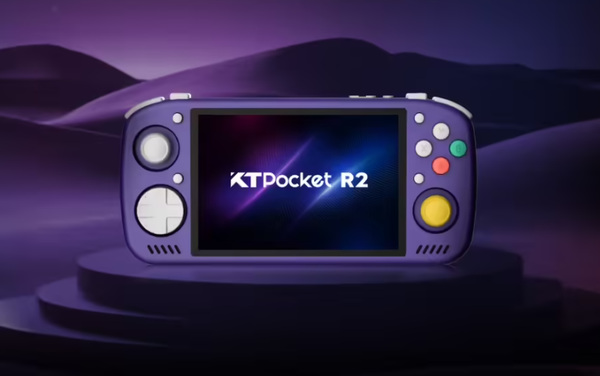
The KT Pocket KT R2 4:3 is the squarer-screen variant of KT Pocket’s second-generation Android handheld, built around a 4.2-inch 1280×960 IPS panel whose 4:3 shape is aimed at fourth- and fifth-generation consoles that were never meant to be letterboxed. This is not a low-power ARM toy in the Anbernic RG35XX mould, nor is it a flagship. It sits in the awkward, interesting middle: a MediaTek Dimensity 7300, a metal-shell option, Hall-effect sticks and active cooling, sold under the Retroid and Ayn devices it borrows ideas from. KT Pocket is a small brand with a patchy track record — the earlier KT R1 drew quality-control complaints — so the R2 is best judged on what it demonstrably ships with rather than the launch marketing.
Emulation performance, generation by generation
The Dimensity 7300 is a 4nm mid-range SoC: eight Cortex-A78 cores (four at 2.5 GHz, four at 2.0 GHz) paired with a Mali-G615 MP2 GPU. That two-core GPU configuration, not the CPU, is what caps this device. Everything through the 32-bit and early-3D era is effortless. NES, SNES, Genesis, Game Boy Advance, PS1 (DuckStation), Nintendo DS (melonDS), Saturn and Dreamcast (Flycast/Redream) all run without drama, and PSP via PPSSPP even upscales cleanly. On the 4:3 screen the natively-square libraries render pixel-clean instead of pillarboxed. Nintendo 3DS through Citra-derived forks like Azahar is comfortable. The realistic ceiling is PS2 and GameCube: with AetherSX2/NetherSX2 and Dolphin a large slice of both libraries is playable, but demanding 3D titles drop frames and need per-game tuning rather than running flawlessly out of the box. Wii is inconsistent, and Switch emulation through the post-Yuzu forks (Sudachi, Citron, Eden) is a stretch — lighter 2D games can work, but do not buy this expecting Tears of the Kingdom. PS Vita via Vita3K stays partial and title-dependent, as it does on any Android chip. Treat GameCube/PS2 as the honest headline and anything above it as a bonus.
Screen, build and controls
The 4.2-inch, 1280×960 IPS display works out to roughly 380 PPI at a true 4:3 ratio, with 60 Hz refresh and around 500 nits of brightness — bright enough indoors, marginal in direct sun. It is a sensible panel choice for a retro-first device: a 3:2 sibling exists for people who want widescreen, but the 4:3 model wastes no glass on content that cannot fill it. Build is the real differentiator. Buyers pick plastic, aluminium alloy or magnesium alloy shells, and the chassis carries a PC-style heat pipe with active cooling to hold clocks under sustained load. At 248 grams and 159.4 x 79.9 x 17.9 mm it is a chunky two-handed slab, not a pocketable. Controls are the modern set: Hall-effect analog sticks that resist drift, a d-pad, L1/R1 plus analog L2/R2 triggers, clickable L3/R3, gyro, a touchscreen and dual linear haptic motors. On paper the control package matches devices costing more.
Software and setup
The R2 runs stock Android 14, and that shapes the entire software story. The Linux custom-firmware scene that defines cheaper handhelds — muOS, Knulli, ArkOS, ROCKNIX, Batocera — is built for Allwinner and Rockchip chips and does not apply here; there is no drop-in OS swap for a Dimensity Android device. What you do instead is curate Android itself: install RetroArch and the standalone emulators above from APKs, then front them with a launcher like Daijisho, ES-DE or Beacon to hide the phone-style home screen. Expect the usual Android chores — sideloading, per-emulator settings, sorting BIOS files and mapping controls. WiFi 6 and Bluetooth 5.3 are aboard, an optional model adds 4G, and USB-C handles both charging and video-out to a TV. Because KT Pocket is a small operation, community support — optimized config packs, tested per-game settings — will be thinner than for Retroid or Anbernic, so early owners will be doing more of the legwork themselves.
Price, value and who it is for
Pricing spans configuration rather than sitting at one number: the plastic, WiFi-only, 6 GB LPDDR4X build starts in the rough $140 to $160 range and climbs toward roughly $289 for a magnesium-alloy, 12 GB unit, with 128 GB storage standard and up to 512 GB offered. Backing it is a 6000 mAh battery with 33 W fast charging, good for a long session on the lighter systems and considerably less on GameCube or PS2. The pitch is genuine: a metal-bodied, Hall-stick, actively-cooled Android handheld with a purpose-built 4:3 screen for less than the obvious competition. The caution is equally genuine — an unproven vendor, a mid-tier GPU and Android’s setup tax. It suits the hands-on emulation hobbyist who wants a 4:3 panel for 8- through 32-bit and early-3D libraries, is comfortable configuring Android, and treats solid GameCube/PS2 as the goal rather than 4K Switch dreams. Anyone wanting turnkey simplicity or guaranteed frame rates in the hardest games should look elsewhere.
📐 Size & Pocketability
⚖️ Weight vs Other Handhelds
🔋 Real-World Battery Estimator
⭐ Emulation Performance
📊 View How This Score is Calculated
The Hardware Power Score is an absolute metric. Perfect emulation of difficult, modern consoles awards significantly more points than standard retro consoles.
- 15× Multiplier: Modern PC
- 12× Multiplier: Switch, PS3, Xbox 360
- 10× Multiplier: Wii U
- 8× Multiplier: PS2, GameCube, Wii, Xbox
- 5× Multiplier: Saturn, Dreamcast, PSP
- 3× Multiplier: N64, PS1
- 1× Multiplier: SNES, GBA
Gen 8 & PC
Generation 7
Generation 6
Generation 5
Handhelds & Retro
⚡ Performance Benchmarks
Where KT Pocket KT R2 4:3 Mali-G615 MC2 lands against the handhelds everyone knows. Every bar shares one scale, so longer genuinely means faster — add up to two rivals to compare.
CPU = Geekbench 6 multi-core · GPU = 3DMark Wild Life. Median real-world scores; every bar shares one scale — add up to two rivals to compare.
📋 Full Specifications
📺 Display
⚙️ Platform
💾 Memory
🕹️ Controls
📏 Body
🔋 Battery
⚖️ Verdict
✅ The Good
- True 4:3 1280×960 IPS panel renders NES-through-PS1 libraries pixel-clean instead of pillarboxed
- Flagship-tier control set on a sub-$200 base: Hall-effect sticks, analog L2/R2 triggers, gyro and dual haptics
- Metal shell options (aluminium or magnesium) plus a real heat pipe and active cooling, rare at this price
- Modern 4nm Dimensity 7300 with 6-12 GB RAM clears PS1/DS/PSP/Dreamcast/3DS easily and reaches into GameCube and PS2
❌ The Bad
- The 2-core Mali-G615 MP2 GPU makes GameCube/PS2 the ceiling; demanding 3D and Switch titles struggle or need heavy tuning
- Stock Android 14 with no Linux custom-firmware path (no muOS/Knulli/ArkOS) means every emulator and launcher is set up by hand
- Small, unproven brand: the prior KT R1 had QC complaints and community/config support is thin
📰 Latest News & Guides
The Ultimate Guide to ARMSX3: Android’s New PS3 Emulator, Competitor Comparisons, and Setup Tutorial
18/08/2026Pokémon Gold, Silver, and Crystal (Gen 2) Recomp Lands on Android
17/08/2026How to Play the Pokémon Red, Blue, or Yellow Recomp on Your Android, Windows, and Linux Devices
16/08/2026🔍 Similar Handhelds
Other handhelds that emulate up to PS2.