
🛒 Where to Buy
⚠️ Golden Rule of Retro Handhelds: Throw away the cheap MicroSD card that comes in the box — it will fail. And never use a high-wattage PD “Fast Charger” on these devices; it can damage the battery. Use a standard 5V/1.5A brick.
Device Overview: KinHank K59
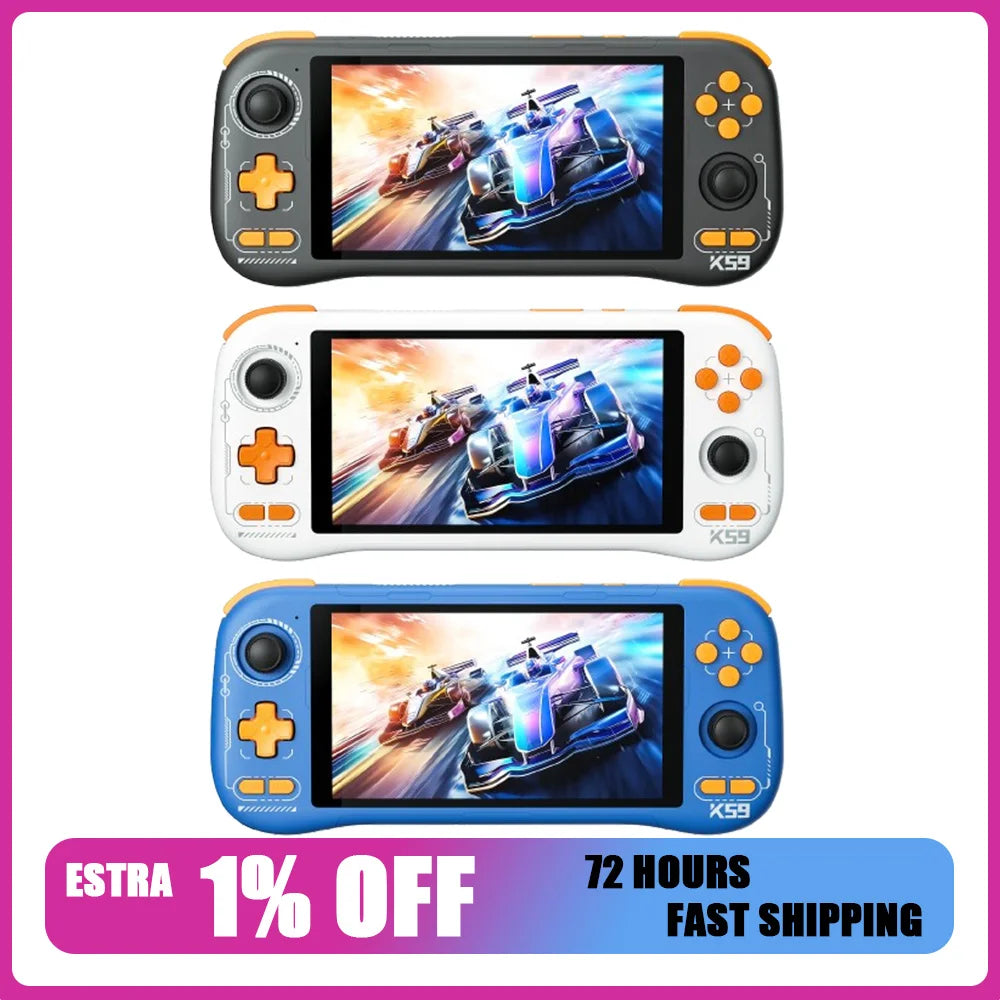
KinHank has spent the last few years churning out plug-and-play TV emulation boxes and cheap Android handhelds, and the K59 is the most serious portable the brand has shipped. It pairs a MediaTek Helio G99 with a 5.5-inch 1080p screen and packs the lot into a 307-gram horizontal shell that sells for roughly $160-$200 depending on where and when you buy it. That puts it in a crowded 2026 bracket against the Retroid Pocket Mini and a dozen other G99 boxes. Connectivity is competent rather than cutting-edge: Wi-Fi 5, Bluetooth 5.0, a USB-C port with video output, a 3.5mm jack and a microSD slot. What the K59 is really selling is a big, sharp panel at a low price, so judge it on whether that panel is worth the compromises around it.
Emulation performance, generation by generation
The Helio G99 is a 6nm chip with two Cortex-A76 cores at up to 2.2 GHz, six A55 efficiency cores, and a Mali-G57 MC2 GPU. It is a known, mid-tier emulation quantity, and nothing about the K59’s clocks changes that math. Everything up to and including the fifth generation is effectively solved: NES, SNES, Genesis, GBA, PS1 through DuckStation, N64 through Mupen64Plus-FZ, Saturn, and Dreamcast through Flycast all run at or above full speed with headroom to upscale. PSP on PPSSPP is the G99’s comfort zone, with most of the library playable at 2x-3x resolution. Above that, honesty matters. The catalog listings that quote “GameCube 80%” and “PS2 50%” are generous. In practice, Dolphin handles plenty of GameCube titles but stumbles on the demanding ones, and PS2 through NetherSX2 is a per-game gamble rather than a guarantee. A Citra fork makes 3DS genuinely good, and arcade libraries from CPS3 through Naomi are trivial. Switch is not a realistic target on this chip beyond a handful of light 2D games, and PS Vita emulation on Android remains a non-starter regardless of hardware. The G99 has no active cooling here, so expect throttling on the two systems that push it hardest, PS2 and GameCube, during long sessions. Buy the K59 for everything up to PSP and Dreamcast, treat GameCube and PS2 as bonuses, and ignore the Switch marketing.
Screen, build and controls
The 5.5-inch IPS panel is the headline. At 1920×1080 it is genuinely sharp for a sub-$200 handheld, around 400 ppi, where most rivals in this price band still ship 720p. It runs at a standard 60 Hz, is 16:9, and is a touchscreen, which matters for Android navigation and the odd mobile port. The trade-off is size: at 212mm wide and 307 grams, this is a two-hand slab, not a jacket-pocket device. The shell is plastic. Controls are the K59’s strongest surprise. Both analog sticks are Hall effect, so no drift, and the L2/R2 triggers are analog rather than clicky bumpers. There is a gyro for aiming. The layout is asymmetric with the D-pad sitting low on the left, which suits PSP and PlayStation-era games more than it suits SNES fighters. The 5000 mAh battery is average for the footprint: expect a few hours of heavy PS2/GameCube use and considerably more on 8- and 16-bit systems.
Software and setup
The K59 runs Android 14, and that single fact defines the whole software story. This is not a Linux retro handheld, so the custom-firmware ecosystem people associate with the space (muOS, Knulli, ArkOS, ROCKNIX, OnionOS) does not apply here; those images target Rockchip and Allwinner Linux boxes, not a MediaTek Android device. What you get instead is Google Play and the full Android emulator stack: RetroArch, DuckStation, PPSSPP, Dolphin, Flycast and the rest, installed and configured by you. KinHank preloads a frontend and, in some regions, ships microSD cards stuffed with ROMs of dubious legality; treat those as a liability, not a feature, and plan to supply your own games. If you want the console-like experience, layer a proper frontend on top, such as Daijisho or ES-DE for a clean library, with EmuDeck’s Android installer to automate emulator setup. Expect to spend an evening getting it how you want it.
Price, value and who it is for
At roughly $160-$200 the K59’s pitch is simple: the biggest, sharpest screen and Hall sticks you can get on a G99 at this price. If a 1080p panel and drift-free sticks are your priorities and you mostly emulate up to PSP, Dreamcast and 3DS, it is a lot of hardware for the money. The caveats are real. KinHank is a budget brand with thinner long-term software support than Retroid or AYN, the plastic build is unremarkable, and anyone chasing consistent PS2 or GameCube performance should spend up for a Snapdragon device. It is not pocketable and it is not a Switch emulator. Bought as a big-screen PS1/PSP/Dreamcast player with room to experiment above that, it earns its price.
📐 Size & Pocketability
⚖️ Weight vs Other Handhelds
🔋 Real-World Battery Estimator
⭐ Emulation Performance
📊 View How This Score is Calculated
The Hardware Power Score is an absolute metric. Perfect emulation of difficult, modern consoles awards significantly more points than standard retro consoles.
- 15× Multiplier: Modern PC
- 12× Multiplier: Switch, PS3, Xbox 360
- 10× Multiplier: Wii U
- 8× Multiplier: PS2, GameCube, Wii, Xbox
- 5× Multiplier: Saturn, Dreamcast, PSP
- 3× Multiplier: N64, PS1
- 1× Multiplier: SNES, GBA
Generation 7
Generation 6
Generation 5
Handhelds & Retro
⚡ Performance Benchmarks
Where KinHank K59 Arm Mali-G57 MC2 lands against the handhelds everyone knows. Every bar shares one scale, so longer genuinely means faster — add up to two rivals to compare.
CPU = Geekbench 6 multi-core · GPU = 3DMark Wild Life. Median real-world scores; every bar shares one scale — add up to two rivals to compare.
📋 Full Specifications
📺 Display
⚙️ Platform
💾 Memory
🕹️ Controls
📏 Body
🔋 Battery
⚖️ Verdict
✅ The Good
- Sharp 5.5-inch 1920×1080 IPS touchscreen, a rarity under $200 where rivals still ship 720p
- Both analog sticks are Hall effect (drift-free) with genuine analog L2/R2 triggers and a gyro
- Helio G99 comfortably clears everything up to PSP, N64, Saturn, Dreamcast and 3DS
- Android 14 with full Play Store access, 6 GB LPDDR4X RAM, 128 GB UFS 2.0 storage and microSD expansion
❌ The Bad
- Large 212mm-wide, 307g body is a two-handed slab, not pocketable
- No Linux custom-firmware support (muOS/ROCKNIX/ArkOS don't run on it), and Switch plus demanding PS2/GameCube stay out of reach
- KinHank is a budget brand with limited long-term software support, and the bundled ROM cards are a legal liability
📰 Latest News & Guides
The Ultimate Guide to ARMSX3: Android’s New PS3 Emulator, Competitor Comparisons, and Setup Tutorial
18/08/2026Pokémon Gold, Silver, and Crystal (Gen 2) Recomp Lands on Android
17/08/2026How to Play the Pokémon Red, Blue, or Yellow Recomp on Your Android, Windows, and Linux Devices
16/08/2026🔍 Similar Handhelds
Other handhelds that emulate up to Wii.