
🛒 Where to Buy
⚠️ Golden Rule of Retro Handhelds: Throw away the cheap MicroSD card that comes in the box — it will fail. And never use a high-wattage PD “Fast Charger” on these devices; it can damage the battery. Use a standard 5V/1.5A brick.
Device Overview: GamePad Digital GPD Win 4
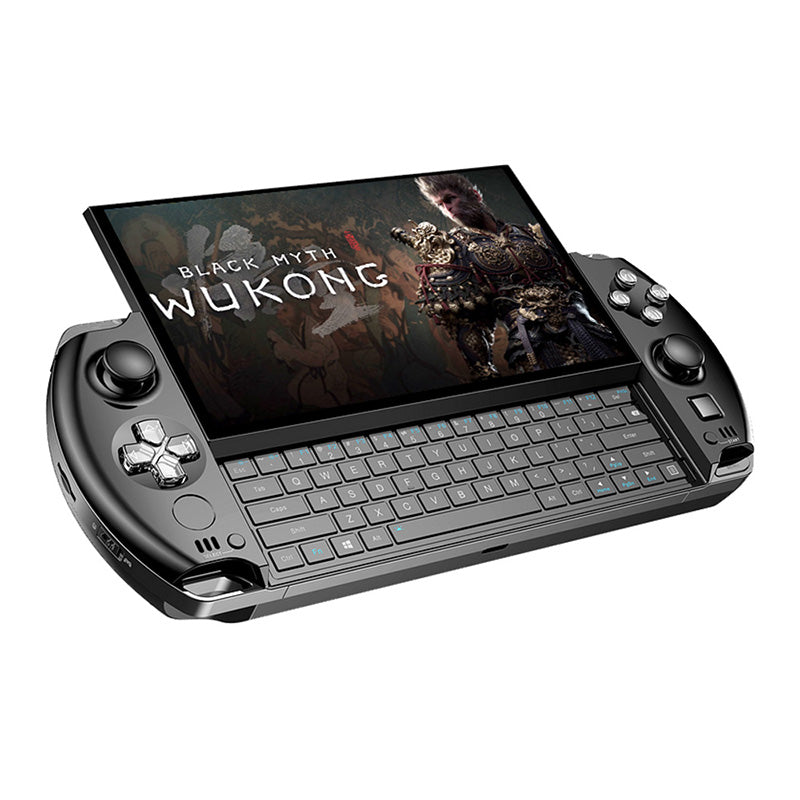
GamePad Digital (GPD) builds the Win 4 around one idea every other handheld maker abandoned: hide a real keyboard inside the thing. Push the screen upward and the 6-inch display slides on a rail to expose a full backlit QWERTY deck with dome-switch keys that physically travel under your thumbs. It is the PSP-go gesture rebuilt as a Windows 11 gaming PC, and it is the single feature that separates the Win 4 from a Steam Deck or an AYANEO. Valve gives you SteamOS, a trackpad, and a big 7-inch panel; AYANEO gives you premium materials and Windows; the Win 4 gives you a pocketable 598g slab that doubles as a tiny netbook the moment a game drops you to a desktop or a launcher login box.
Under the slider sits AMD’s Ryzen 7 7840U on the 2023 model, refreshed to the Ryzen 7 8840U on the 2024 and 2025 revisions. Functionally they are near-identical: eight Zen 4 cores, 16 threads, up to 5.1 GHz, and the Radeon 780M iGPU with 12 RDNA 3 compute units. The 8840U is a rebadge that buys you a single-digit CPU bump (roughly 7% in CPU-bound titles like Forza) and no GPU change. RAM runs LPDDR5X at 7500 MT/s in 16, 32, or 64GB configs; storage is a user-replaceable M.2 2280 PCIe 4.0 NVMe drive from 512GB up to 4TB, plus a microSD slot.
Emulation performance, generation by generation
The 780M is the real workhorse here, and it sorts cleanly by generation. PlayStation 2 (PCSX2), GameCube and Wii (Dolphin) are effortless: you can hold 60fps with internal resolution cranked to 1080p or higher and Vulkan selected. PSP (PPSSPP) and everything older runs at full speed without thinking about it; the only real tuning you do here is deciding how high to push the upscale before you stop caring. Nintendo Switch is realistic rather than flawless. With Yuzu gone, Ryujinx is the 2026 pick; lighter first-party and most 2D titles hold up, while the demanding 3D blockbusters still stutter and want every shader-cache trick you can throw at them. Wii U via Cemu is genuinely strong, often better-behaved than Switch. PS3 (RPCS3) is the honest “realistic” tier: many games are playable at 720p internal with Vulkan, but it leans hard on the 32GB RAM config because the shader cache alone eats several gigabytes. Xbox 360 (Xenia) is the rough edge. Xenia is single-platform and inconsistent; some titles run, plenty don’t, and you should treat 360 as a bonus, not a reason to buy.
Screen, build and controls
The 6-inch panel is a 1920×1080 H-IPS, 60Hz, 10-point touch, and crucially it is a native-landscape display, so you avoid the rotation artifacts that haunted older GPD units. At 6 inches, 1080p is sharp to the point of overkill for handheld emulation, and you will spend a lot of time dropping internal resolution anyway to keep frames up. The slide-up keyboard is the headline: actual moving dome-switch keys with adjustable backlighting, not the capacitive flat pad of the Win 3. It is a thumb keyboard, cramped and not for essays, but it is transformative for the moments a Windows handheld actually needs text: Wi-Fi passwords, Steam logins, RetroArch paths, BIOS file names. Controls are full-fat: Hall-effect-class sticks, a proper D-pad, four face buttons, shoulder and trigger pairs, and an OcuLink port on later units for an external GPU dock. At 220x92x28mm it is thicker than a Deck but noticeably smaller in footprint and genuinely pocketable. The 45.62Wh battery is the trade-off for that size: under a sustained synthetic load it drains in well under two hours, and real emulation sessions at higher TDP settings will have you reaching for the charger, so expect to cap the wattage when you want endurance rather than maximum frames.
Software and setup
This is Windows 11 Home, with everything that implies: more flexibility than SteamOS, and more babysitting. GPD ships its own utilities, WinControls for remapping the pads and configuring the keyboard LEDs, and Motion Assistant for gyro, alongside the usual third-party stack (HidHide, the Nefarius controller drivers) that emulation setups lean on. The slide-out keyboard quietly pays for itself during this exact phase. Standing up a fresh Windows handheld means typing, a lot, and being able to flip the screen up and bang out a path or a license key beats hunting an on-screen keyboard with a thumbstick every time.
Price, value and who it’s for
At launch the 7840U Win 4 with 32GB/512GB landed around $839, with a Ryzen 5 7640U entry model near $699; the later 8840U builds sit in the same roughly $799-and-up band depending on RAM and SSD. That is Steam Deck OLED money for a device that asks more of you and gives a smaller, denser screen in return. The Win 4 is for the person who specifically wants the keyboard and the pocket size, runs a deep emulation library through PS2, GameCube, Wii, PSP and Wii U, and treats Switch and PS3 as a stretch goal rather than a promise. If you want plug-and-play, buy a Steam Deck. If the slider is the whole point, nothing else does it.
📐 Size & Pocketability
⚖️ Weight vs Other Handhelds
🔋 Real-World Battery Estimator
⭐ Emulation Performance
📊 View How This Score is Calculated
The Hardware Power Score is an absolute metric. Perfect emulation of difficult, modern consoles awards significantly more points than standard retro consoles.
- 15× Multiplier: Modern PC
- 12× Multiplier: Switch, PS3, Xbox 360
- 10× Multiplier: Wii U
- 8× Multiplier: PS2, GameCube, Wii, Xbox
- 5× Multiplier: Saturn, Dreamcast, PSP
- 3× Multiplier: N64, PS1
- 1× Multiplier: SNES, GBA
Gen 8 & PC
Generation 7
Generation 6
Generation 5
Handhelds & Retro
⚡ Performance Benchmarks
Where GamePad Digital GPD Win 4 AMD Radeon 680M lands against the handhelds everyone knows. Every bar shares one scale, so longer genuinely means faster — add up to two rivals to compare.
CPU = Geekbench 6 multi-core · GPU = 3DMark Wild Life. Median real-world scores; every bar shares one scale — add up to two rivals to compare.
📋 Full Specifications
📺 Display
⚙️ Platform
💾 Memory
🕹️ Controls
📏 Body
🔋 Battery
⚖️ Verdict
✅ The Good
- Genuine slide-up backlit QWERTY keyboard with real dome-switch keys, unmatched on any other handheld for setup and text entry
- Strong through-PS2/GameCube/Wii/PSP/Wii U emulation on the Radeon 780M, holding 60fps at raised internal resolution
- Pocketable and light at 598g and 220x92x28mm, smaller footprint than a Steam Deck, with a sharp native-landscape 1080p panel
- Full Windows 11 flexibility plus user-replaceable M.2 PCIe 4.0 SSD, microSD, and OcuLink on later units for an external GPU
❌ The Bad
- 45.62Wh battery is small for the hardware; heavy sessions drain in under two hours and force you to cap TDP
- Around $799-$839 and up puts it at Steam Deck OLED prices while demanding far more setup and tinkering
- Switch (Ryujinx), PS3 (RPCS3), and especially Xbox 360 (Xenia) remain inconsistent, not the plug-and-play tier
📰 Latest News & Guides
The Ultimate Guide to ARMSX3: Android’s New PS3 Emulator, Competitor Comparisons, and Setup Tutorial
18/08/2026Pokémon Gold, Silver, and Crystal (Gen 2) Recomp Lands on Android
17/08/2026How to Play the Pokémon Red, Blue, or Yellow Recomp on Your Android, Windows, and Linux Devices
16/08/2026🔍 Similar Handhelds
Other handhelds that emulate up to CURRENTGEN.