
🛒 Where to Buy
⚠️ Golden Rule of Retro Handhelds: Throw away the cheap MicroSD card that comes in the box — it will fail. And never use a high-wattage PD “Fast Charger” on these devices; it can damage the battery. Use a standard 5V/1.5A brick.
Device Overview: Anbernic RG-405M
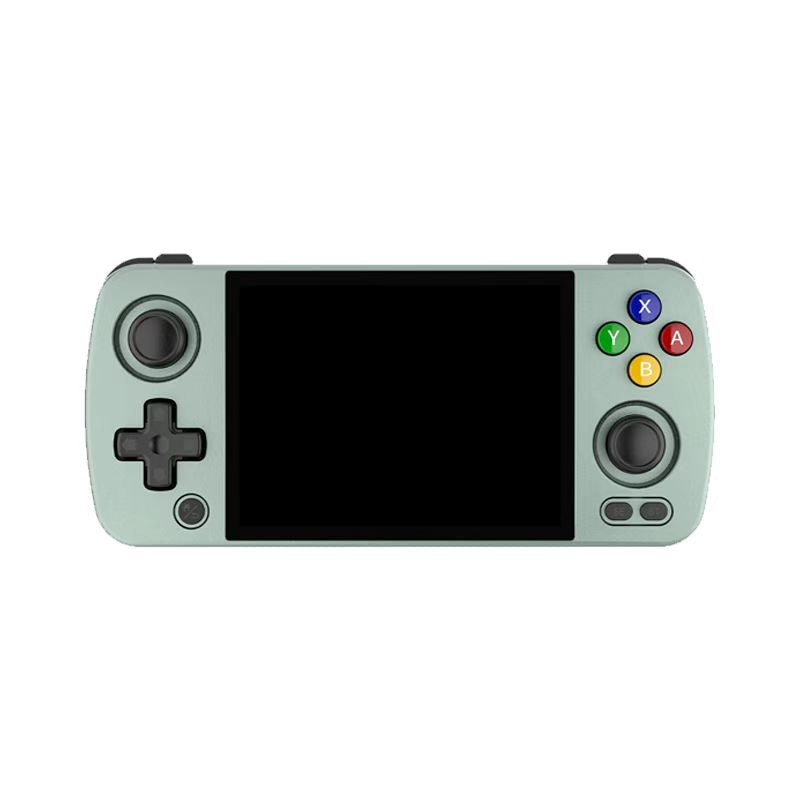
The Anbernic RG-405M is the company’s CNC aluminium answer to the question of what a mid-range Android emulation handheld should feel like in the hand. It is built around the Unisoc Tiger T618, wraps a 4-inch 4:3 screen in a dense metal shell, and sits a clear rung above the plastic RG35XX family while undercutting Snapdragon devices like the Retroid Pocket 4 Pro. If you want a pocketable machine with a squared-off retro aspect ratio and Hall-effect sticks, rather than the 16:9 widescreen layout most Android handhelds ship with, this is Anbernic’s pitch. It launched in March 2023 and has aged into a known quantity: capable through the sixth console generation, honest about where it stops.
Emulation performance, generation by generation
This is an ARM SoC, not a Windows box, so temper expectations accordingly. The T618 pairs two Cortex-A75 cores at 2.0GHz with six A55 cores and a Mali-G52 GPU, and that silhouette maps cleanly onto emulation reality. Everything up to and including PlayStation 1, Nintendo 64 and Nintendo DS runs at full speed with headroom to spare: RetroArch cores, DuckStation and DraStic never break a sweat. Dreamcast through Flycast is largely a solved problem, holding 60fps in most of the library. PSP via PPSSPP is a genuine strength, with many titles playable at 2x internal resolution, though the heaviest 3D games force you back to native res. GameCube is where you start negotiating: standalone Dolphin (the MMJR2 build) runs a good chunk of the catalogue at or near full speed, but demanding games such as Twilight Princess dip into the 20s. PS2 through AetherSX2 or NetherSX2 is strictly case-by-case; lighter titles are enjoyable after settings tweaks, while something like Shadow of the Colossus is a slideshow. Saturn is patchy, and Wii is effectively off the table. Treat PSP, Dreamcast and lighter GameCube as the practical ceiling.
Screen, build and controls
The 4-inch IPS panel runs at 640×480, and that 4:3 shape is the whole point: it fills the screen with 8-bit, 16-bit, PS1 and GBA content instead of pillarboxing it, and the modest resolution scales those systems cleanly. It is a touchscreen, which matters for Android navigation and DS input. The aluminium unibody is the standout: at 260g and 163 x 76 x 15.9mm it feels machined rather than moulded, cool to the touch and reassuringly solid. The dual analogue sticks are Hall-effect, so stick drift should not be in your future, arranged in an offset layout above a proper D-pad and face buttons. The L2/R2 shoulder triggers are conventional digital buttons, not analogue, which is a fair thing to know before buying. A single front-firing speaker gets loud but stays mono; there is a 3.5mm jack, a six-axis gyro, and a single microSD slot that reads cards up to 2TB. The 4500mAh battery is good for roughly seven hours of light 2D play, dropping to three or four hours under GameCube and PS2 load, and USB-C tops it up in about two hours.
Software and setup
Out of the box the RG-405M runs Android 12 with Anbernic’s own launcher sitting over it. That means you are curating standalone emulators yourself: RetroArch for the retro spread, PPSSPP, Flycast, Dolphin MMJR2, AetherSX2/NetherSX2, DuckStation and DraStic, plus a front-end like Daijisho or ES-DE if you want a console-style menu. The important caveat: this is a Unisoc device, so the Linux custom-firmware ecosystem that defines Rockchip handhelds – ArkOS, muOS, Knulli, ROCKNIX, Batocera – does not apply here. The custom-firmware story instead is GammaOS by TheGammaSqueeze, a debloated LineageOS 19.1 build that strips the bloat, ships a pre-configured Daijisho front-end, adds root and performance tiles, and crucially fixes the stock 61.2Hz refresh rate down to a clean 60Hz that resolves frame-pacing judder. A GammaOS Lite variant drops Google services for extra headroom. Flashing it is the single biggest quality-of-life upgrade this device accepts.
Price, value and who it is for
The RG-405M launched around $179 and now floats between roughly $120 on Anbernic sales and $180-200 through third-party retailers, which makes value entirely dependent on what you pay. At the low end it is easy to recommend; near $200 the calculus tightens, because a Snapdragon handheld will chew through PS2 and Switch that this device cannot. Its close sibling, the RG405V, uses identical internals in a taller vertical shell, so choose between them on ergonomics rather than performance. Buy the RG-405M if you specifically want a premium metal 4:3 handheld, you value Hall sticks and build quality, and your library tops out around PSP, Dreamcast and lighter GameCube. Skip it if you are chasing PS2, Wii or Switch, or if you would rather have the Linux distro ecosystem – in either case a more powerful chip is the smarter money.
📐 Size & Pocketability
⚖️ Weight vs Other Handhelds
🔋 Real-World Battery Estimator
⭐ Emulation Performance
📊 View How This Score is Calculated
The Hardware Power Score is an absolute metric. Perfect emulation of difficult, modern consoles awards significantly more points than standard retro consoles.
- 15× Multiplier: Modern PC
- 12× Multiplier: Switch, PS3, Xbox 360
- 10× Multiplier: Wii U
- 8× Multiplier: PS2, GameCube, Wii, Xbox
- 5× Multiplier: Saturn, Dreamcast, PSP
- 3× Multiplier: N64, PS1
- 1× Multiplier: SNES, GBA
Generation 7
Generation 6
Generation 5
Handhelds & Retro
⚡ Performance Benchmarks
Where Anbernic RG-405M Mali-G52 MP2 lands against the handhelds everyone knows. Every bar shares one scale, so longer genuinely means faster — add up to two rivals to compare.
CPU = Geekbench 6 multi-core · GPU = 3DMark Wild Life. Median real-world scores; every bar shares one scale — add up to two rivals to compare.
📋 Full Specifications
📺 Display
⚙️ Platform
💾 Memory
🕹️ Controls
📏 Body
🔋 Battery
⚖️ Verdict
✅ The Good
- Machined aluminium unibody that feels a class above plastic handhelds at 260g
- Hall-effect analogue sticks eliminate the drift that plagues potentiometer designs
- Sharp 4:3 640×480 IPS panel that fills the screen with retro content instead of pillarboxing it
- Strong custom-firmware support via GammaOS, including a real 60Hz frame-pacing fix over the stock 61.2Hz panel
❌ The Bad
- T618 hits a hard wall at PS2 and Wii, so demanding sixth-gen titles are unreliable or unplayable
- L2/R2 shoulders are digital buttons and the speaker is mono, both compromises for the price bracket
- No Linux CFW ecosystem (ArkOS/muOS/Knulli) since it is a Unisoc device, so you are tied to Android
📰 Latest News & Guides
The Ultimate Guide to ARMSX3: Android’s New PS3 Emulator, Competitor Comparisons, and Setup Tutorial
18/08/2026Pokémon Gold, Silver, and Crystal (Gen 2) Recomp Lands on Android
17/08/2026How to Play the Pokémon Red, Blue, or Yellow Recomp on Your Android, Windows, and Linux Devices
16/08/2026🔍 Similar Handhelds
Other handhelds that emulate up to Saturn.