
🛒 Where to Buy
⚠️ Golden Rule of Retro Handhelds: Throw away the cheap MicroSD card that comes in the box — it will fail. And never use a high-wattage PD “Fast Charger” on these devices; it can damage the battery. Use a standard 5V/1.5A brick.
Device Overview: AYN Odin
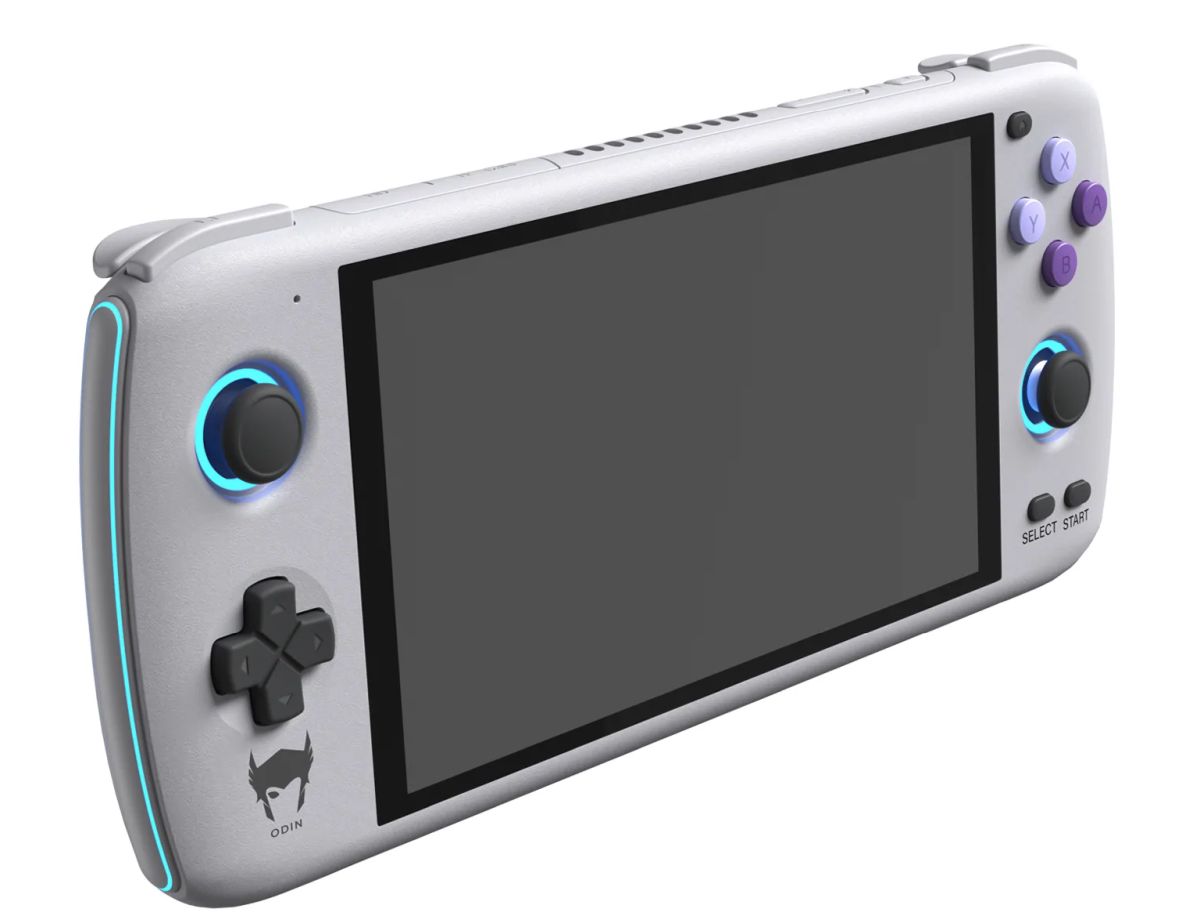
The AYN Odin arrived in early 2022 and effectively drew the ceiling for what a sub-$300 Android handheld could do at the time. Its headline part is Qualcomm’s Snapdragon 845 — a 2018 phone flagship, not a purpose-built gaming chip — which sat well above the RK3399-class hardware in devices like the Retroid Pocket 2 and comfortably below anything x86. AYN shipped it in three flavours: an entry Base (4GB RAM), a maxed Pro (8GB RAM, up to 256GB storage), and a later, cheaper Odin Lite built on the MediaTek Dimensity 900 rather than the 845. The chassis borrows Nintendo Switch Lite ergonomics but stretches them out to a full 16:9 slab. For its moment, this was the Android handheld that made GameCube emulation a realistic buying reason.
Emulation performance, generation by generation
Treat the Snapdragon 845 and its Adreno 630 GPU as an aging but muscular ARM part, not a PC. Everything through the fifth generation is trivial: NES, SNES, Genesis, GBA, PS1 (via DuckStation), N64, Saturn and DS all run at full speed with headroom to upscale. PSP through PPSSPP is a highlight — most of the library holds native speed at 2x or 3x internal resolution. Dreamcast via Flycast is essentially solved, and arcade boards up to Naomi/CPS3 along with Neo Geo run without complaint. GameCube through Dolphin is where the 845 earns the money: a large slice of the catalogue — Wind Waker, Metroid Prime, Mario Sunshine — runs full speed at 1x-2x, though the heaviest titles and most Wii games stutter. PlayStation 2 through AetherSX2 (later NetherSX2) is the honest ceiling: lighter and mid-weight games such as the Ratchet & Clank and Kingdom Hearts titles hold up with per-game tweaks, but heavyweights like God of War II or Shadow of the Colossus drop frames, and the Adreno 630 simply cannot brute-force the whole library. Nintendo 3DS via Citra is inconsistent. Switch is not realistic on this hardware and never was — the early Skyline effort was too immature and is now defunct. Native Android games run too; Genshin Impact holds roughly 30fps on medium, at which point the fan gets audible.
Screen, build and controls
The 5.98-inch IPS LCD is 1920×1080, 16:9, 60Hz and OCA-laminated — sharp and bright, though the widescreen ratio means 4:3 retro content sits between fat black bars. At around 368g and 224mm wide, the Odin is noticeably larger and heavier than a Switch Lite. The shell is plastic, offered in several colourways including transparent editions with LED trim. The dual analog sticks use an offset, Xbox-style layout, but they are ordinary potentiometer sticks, not Hall effect — drift complaints surfaced within months, and swapping in Gulikit Hall replacements became a common mod. The genuine standout is a pair of true analog L2/R2 triggers, rare in this class and excellent for driving and racing games. The Vita-style clicky D-pad is one of the best in any handheld. You also get two programmable rear buttons, a gyroscope, rumble, an active cooling fan you can tune in software, micro-HDMI output and an optional dock. Stereo speakers sit on the bottom edge, and the roughly 6,600 mAh battery is good for around five to six hours of lighter emulation, closer to three under a Dolphin or PS2 load.
Software and setup
The Odin ships with Android — version 10 on Base/Pro, 11 on the Lite — running AYN’s own launcher over stock, which you can switch off. This matters for expectations: the Odin is a full Android tablet in a controller, so the Linux SD-card scene that defines Anbernic and Miyoo hardware does not apply here. There is no muOS, Knulli, ArkOS, ROCKNIX or OnionOS build for it, and EmuDeck and Batocera are not the answer either. “Custom setup” instead means installing emulator apps — RetroArch, Dolphin, PPSSPP, AetherSX2/NetherSX2, DuckStation, Flycast, Citra — and tying them together with an Android frontend such as Daijisho, Beacon, ES-DE or Pegasus. A small community got Linux dual-boot running, but it is niche and unnecessary for almost everyone. Retro Game Corps’ Odin starter guide remains the standard reference for a clean configuration.
Price, value and who it is for
At launch the Lite ran about $199, the Base about $239, the Pro about $287, and the 256GB Pro $328. In 2026 the original Odin is plainly an older device: the Snapdragon 8 Gen 2 Odin 2 and the newer Odin 3 have leapfrogged it on raw power, and the first-generation unit now turns up cheaply on the used market. That is exactly where its value sits. Buy an original Odin if you want everything up through PSP and Dreamcast running flawlessly, most of the GameCube library playable, real analog triggers, and a proper Android device for native games — and if you accept that PS2 is a case-by-case affair and Switch is off the table. Skip it if you specifically want reliable PS2, or the plug-and-play Linux emulation-station experience of a dedicated retro handheld; in those cases buy a Linux device or step up to an Odin 2.
📐 Size & Pocketability
⚖️ Weight vs Other Handhelds
🔋 Real-World Battery Estimator
⭐ Emulation Performance
📊 View How This Score is Calculated
The Hardware Power Score is an absolute metric. Perfect emulation of difficult, modern consoles awards significantly more points than standard retro consoles.
- 15× Multiplier: Modern PC
- 12× Multiplier: Switch, PS3, Xbox 360
- 10× Multiplier: Wii U
- 8× Multiplier: PS2, GameCube, Wii, Xbox
- 5× Multiplier: Saturn, Dreamcast, PSP
- 3× Multiplier: N64, PS1
- 1× Multiplier: SNES, GBA
Gen 8 & PC
Generation 7
Generation 6
Generation 5
Handhelds & Retro
⚡ Performance Benchmarks
Where AYN Odin Adreno 630 lands against the handhelds everyone knows. Every bar shares one scale, so longer genuinely means faster — add up to two rivals to compare.
CPU = Geekbench 6 multi-core · GPU = 3DMark Wild Life. Median real-world scores; every bar shares one scale — add up to two rivals to compare.
📋 Full Specifications
📺 Display
⚙️ Platform
💾 Memory
🕹️ Controls
📏 Body
🔋 Battery
⚖️ Verdict
✅ The Good
- Snapdragon 845 handles a large share of the GameCube library at full speed, plus flawless PSP/Dreamcast/PS1 upscaling
- Rare true analog L2/R2 triggers and an excellent Vita-style D-pad
- Sharp 5.98-inch 1080p laminated screen, big battery (~6,600 mAh) and an active, software-tunable cooling fan
- Full Android OS with micro-HDMI out means it doubles as a native gaming and media device, not just an emulator box
❌ The Bad
- Stock analog sticks are potentiometer, not Hall effect, and are prone to drift within months
- PS2 is only partly playable and Switch emulation is out of reach on this hardware
- No Linux custom-firmware scene (no muOS/ArkOS/ROCKNIX); 16:9 screen letterboxes 4:3 retro games, and it is now outclassed by the Odin 2/3
📰 Latest News & Guides
The Ultimate Guide to ARMSX3: Android’s New PS3 Emulator, Competitor Comparisons, and Setup Tutorial
18/08/2026Pokémon Gold, Silver, and Crystal (Gen 2) Recomp Lands on Android
17/08/2026How to Play the Pokémon Red, Blue, or Yellow Recomp on Your Android, Windows, and Linux Devices
16/08/2026🔍 Similar Handhelds
Other handhelds that emulate up to PS2.