
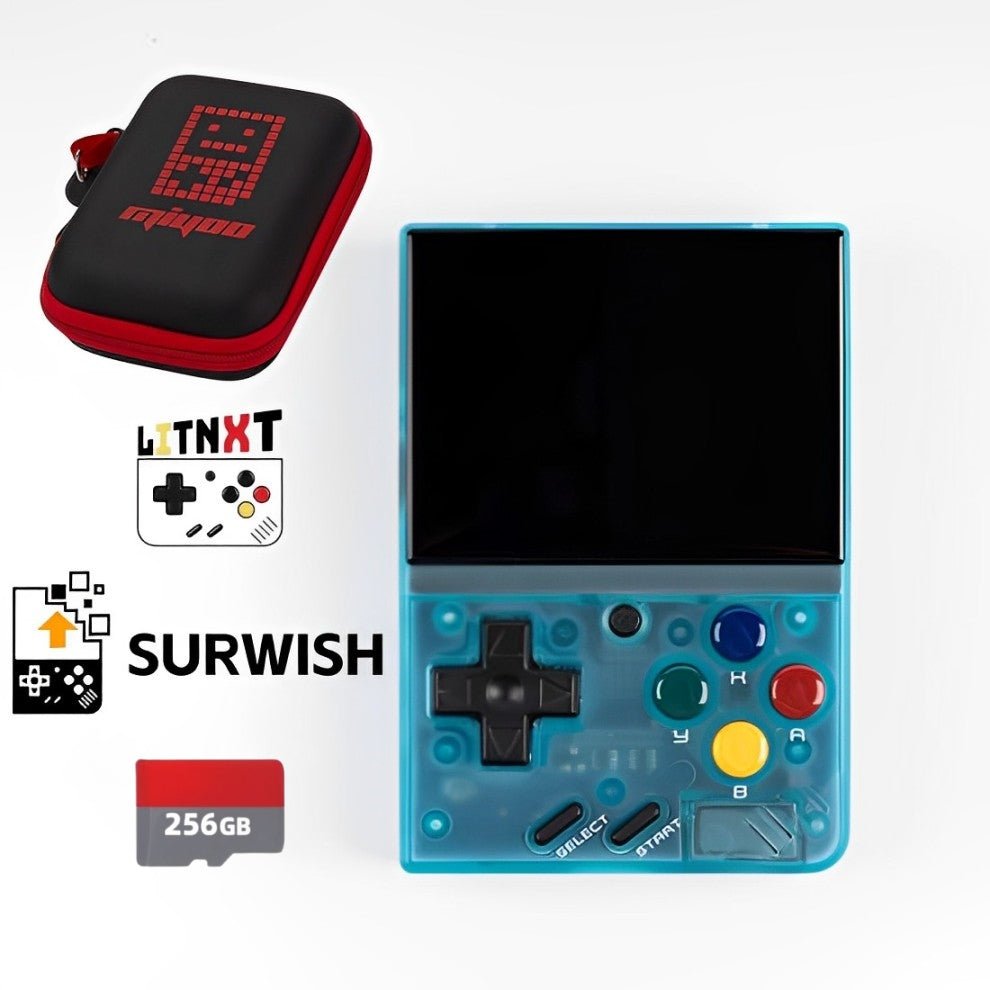
🛒 Where to Buy
⚠️ Golden Rule of Retro Handhelds: Throw away the cheap MicroSD card that comes in the box — it will fail. And never use a high-wattage PD “Fast Charger” on these devices; it can damage the battery. Use a standard 5V/1.5A brick.
Device Overview: Miyoo Mini
The Miyoo Mini is the device that lit the fuse on the modern sub-$50 retro handheld boom. Released in December 2021 for around $50, it was a tiny, cheap, BlackBerry-screened oddity from a then-obscure brand, and it became a cult object almost by accident. The stock firmware was rough, the shoulder buttons were awkward, and early V1 units shipped with a swappable flip-phone style battery that felt like a relic. None of that mattered once the community got hold of it. What people actually fell in love with was the form factor: a console roughly the size of a deck of playing cards, weighing about 106 grams, with a genuinely lovely screen bolted to the front.
It is worth being precise about what “Miyoo Mini” means, because the name gets muddied. This is the original 2.8-inch model, not the Miyoo Mini Plus that arrived in 2023. The Plus kept the same SigmaStar brain but grew to a 3.5-inch laminated screen, jumped to a 3000mAh battery, added WiFi and Bluetooth, and pushed the price to roughly $70. The original has none of that. It is smaller, lighter, has no wireless of any kind, and now sells largely as old stock or in its later V4 revision. For most buyers the Plus is the more sensible purchase. The original survives on charm, pocketability, and the fact that it was first.
Emulation performance, generation by generation
The hardware is modest and honest about it: a SigmaStar SSD202D with a dual-core Cortex-A7 at 1.2GHz, 128MB of DDR3, and no meaningful 3D GPU. That sets a hard ceiling, and the Mini sits comfortably below it for 8- and 16-bit work. NES, Game Boy, Game Boy Color, Genesis, Sega CD, and 32X all run flat-out with no compromises. Game Boy Advance is excellent and is one of the system’s real highlights, helped by that 640×480 panel scaling GBA’s resolution cleanly.
SNES is the first place you feel the limits. The bread-and-butter library is essentially perfect, but cartridges with enhancement chips, Super FX and SA-1 titles like Star Fox and Super Mario RPG, stutter or misbehave. PlayStation is the genuine surprise. A large slice of the PS1 catalog, especially RPGs and 2D-leaning action games, runs at full speed and looks great shrunk down. Push into heavy 3D and it cracks: a fighter like Tekken 3 gets uncomfortably choppy. Above PS1 there is nothing. N64, Dreamcast, Saturn, PSP, and DS are not viable. Treat this as an 8/16-bit plus GBA plus selective-PS1 machine and you will never be disappointed.
Screen, build and controls
The screen is the whole reason this thing exists. It is a 2.8-inch IPS panel at 640×480 in a 4:3 ratio, around 285 PPI, reportedly built from surplus BlackBerry smartphone displays. On a device this size the pixel density is striking, blacks are good, and the 4:3 shape suits retro content exactly. Bezels are slim. It is the kind of screen that makes a $50 toy feel more expensive than it is.
The build is all plastic and unmistakably budget, but it holds together. The d-pad and face buttons are responsive and well-spaced. The recurring complaint, and it is a real one, is the shoulder buttons: they sit high on the back edge and feel loose, so any game leaning on L and R while you work the d-pad gets fiddly. Battery life on the V2’s 2000mAh cell lands around five to six hours. There is a USB-C port and a headphone jack, and that is the extent of the I/O. No video out, no wireless.
Software and setup
Out of the box the stock firmware is the weakest part of the package, which is why almost nobody runs it. The fix is OnionOS, the community custom firmware that transformed the Mini’s reputation. It cleans up the interface, organizes RetroArch cores sensibly, adds proper box art and a game switcher, and crucially papers over the lack of a true sleep mode with a boot sequence so fast the device is usable again in under ten seconds. MiniUI is the leaner alternative for people who want a stripped, no-clutter list of games and nothing else. Setup means flashing the firmware to a microSD card and supplying your own ROMs; it is approachable but not quite plug-and-play, and the time you spend on it is repaid in full.
Price, value and who it’s for
At its ~$50 launch the original Miyoo Mini was a small miracle, and that price is the foundation of its reputation. The problem in 2026 is that the Miyoo Mini Plus exists, costs only about $20 more, and beats the original on nearly every measurable axis: bigger laminated screen, larger battery, WiFi for things like over-the-air ROM transfers and netplay. For a first handheld, buy the Plus.
The original Mini is for two specific people. The first wants the single most pocketable capable retro machine made, something that genuinely disappears into a coin pocket, and will trade screen size and battery for that. The second is the collector who wants the device that started it all, ideally a clean V2 or V4. If you are either of those, the original still delivers. Everyone else should size up.
📐 Size & Pocketability
⚖️ Weight vs Other Handhelds
🔋 Real-World Battery Estimator
⭐ Emulation Performance
📊 View How This Score is Calculated
The Hardware Power Score is an absolute metric. Perfect emulation of difficult, modern consoles awards significantly more points than standard retro consoles.
- 15× Multiplier: Modern PC
- 12× Multiplier: Switch, PS3, Xbox 360
- 10× Multiplier: Wii U
- 8× Multiplier: PS2, GameCube, Wii, Xbox
- 5× Multiplier: Saturn, Dreamcast, PSP
- 3× Multiplier: N64, PS1
- 1× Multiplier: SNES, GBA
Generation 5
Handhelds & Retro
📋 Full Specifications
📺 Display
⚙️ Platform
💾 Memory
🕹️ Controls
📏 Body
🔋 Battery
⚖️ Verdict
✅ The Good
- Exceptional 2.8-inch 640×480 IPS screen with high pixel density for the price
- Genuinely pocketable and light (~106g, deck-of-cards footprint)
- Excellent 8/16-bit and GBA emulation, plus a strong slice of the PS1 library
- OnionOS and MiniUI custom firmware fix the stock software and add fast boot, save states, and a game switcher
❌ The Bad
- Loose, awkwardly placed shoulder buttons hurt games that need L/R
- No WiFi, Bluetooth, or video out, and weak stock firmware out of the box
- Largely superseded by the Mini Plus, which costs only ~$20 more for a bigger screen, larger battery, and wireless
📰 Latest News & Guides
The Ultimate Guide to ARMSX3: Android’s New PS3 Emulator, Competitor Comparisons, and Setup Tutorial
18/08/2026Pokémon Gold, Silver, and Crystal (Gen 2) Recomp Lands on Android
17/08/2026How to Play the Pokémon Red, Blue, or Yellow Recomp on Your Android, Windows, and Linux Devices
16/08/2026🔍 Similar Handhelds
Other handhelds that emulate up to DS.