
🛒 Where to Buy
⚠️ Golden Rule of Retro Handhelds: Throw away the cheap MicroSD card that comes in the box — it will fail. And never use a high-wattage PD “Fast Charger” on these devices; it can damage the battery. Use a standard 5V/1.5A brick.
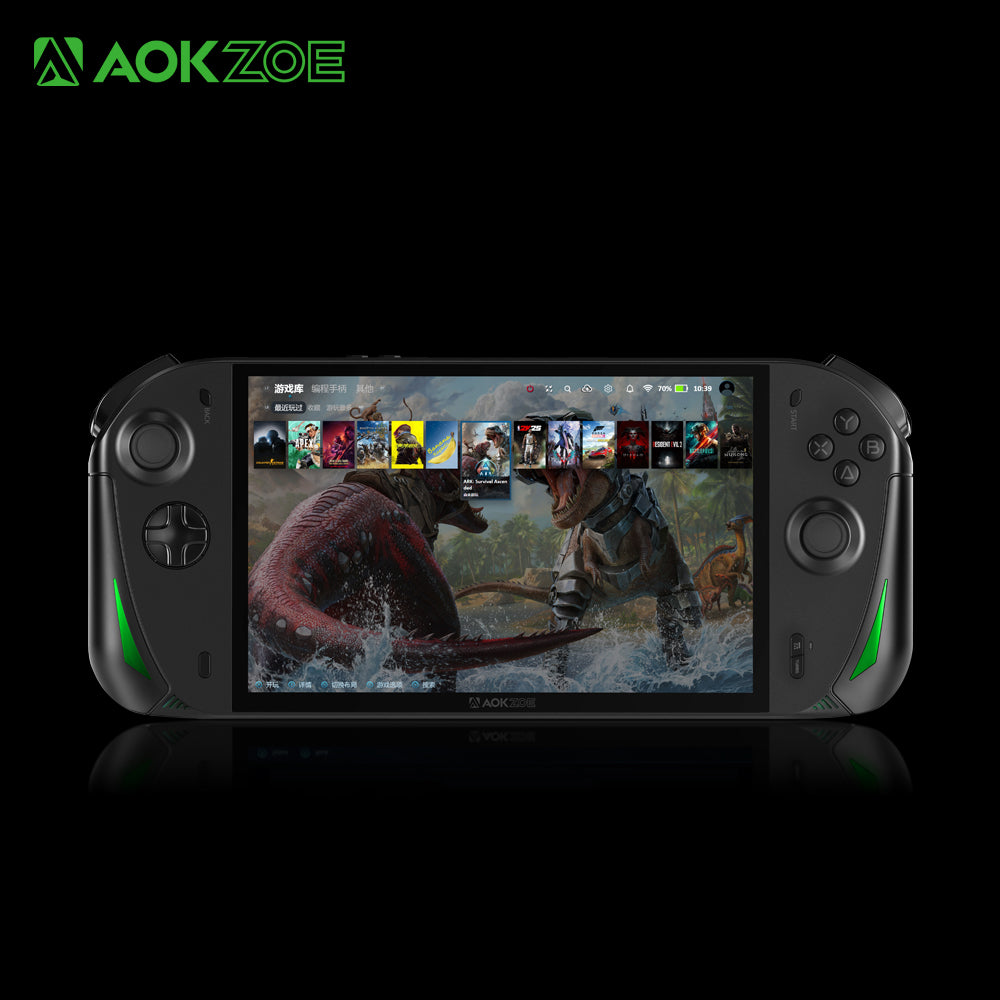
Device Overview: AOKZOE A1X
The AOKZOE A1X is a full x86 Windows handheld, not a pocketable ARM emulator, and that framing shapes everything below. It is built around AMD’s Ryzen AI 9 HX 370, a 12-core Strix Point chip pairing four Zen 5 cores with eight Zen 5c cores, feeding the Radeon 890M iGPU on RDNA 3.5. That is the same premium silicon inside 2025’s flagship handhelds, and AOKZOE aims the A1X squarely at the ASUS ROG Ally X and MSI Claw 8 AI+. Its pitch rests on two things those rivals skimp on: an 8-inch landscape screen bolted to a large 72.7 Wh battery, and an OCuLink port for external-GPU docking alongside USB4 at 40 Gbps. A cheaper Ryzen 7 8840U (Hawk Point) configuration also exists for buyers who do not need the top chip.
Emulation performance, generation by generation
Because this is a desktop-class x86 machine, its emulation ceiling is genuinely high, and it runs the real Windows emulators rather than cut-down ARM ports. Everything through the sixth generation is trivial: Dolphin drives GameCube and Wii at 3x-4x internal resolution with headroom, and PCSX2 handles PS2 the same way. The interesting territory is the seventh and eighth generations. RPCS3 pushes many PS3 titles at or near full speed, though the notoriously heavy ones still stutter and demand per-game tuning. Cemu runs Wii U cleanly, often smoother than the original console. Nintendo Switch emulation through Ryujinx forks and the successors that replaced Yuzu is very playable on the 890M, with the extra TDP headroom helping demanding first-party games. 3DS via Azahar (the Citra continuation) and PS Vita via Vita3K are comfortable, and PSP through PPSSPP is effortless at high internal resolutions. Xbox 360 via Xenia is the one place you should temper expectations: it remains experimental and compatibility is spotty regardless of horsepower. On this device the bottleneck is emulator maturity and shader-compilation stutter, not the chip, and of course you also get the entire native Windows PC library on top.
Screen, build and controls
The 8-inch LCD runs 1920×1200 at 120 Hz with VRR, 500 nits, DC dimming and full sRGB coverage. It is sharp and fluid, but it is LCD, not OLED, so blacks read as grey next to a Steam Deck OLED. The chassis weighs roughly 730g and spans 285mm wide, large but lighter than a Legion Go (854g) or Claw 8 (795g). Controls are the weak point. The Hall-effect triggers are linear and precise, the D-pad and Xbox-layout face buttons are solid, and there is a 3-axis gyro, but the contact-free thumbsticks are noticeably small with a short throw that reviewers found fiddly in shooters. There are no rear paddles and no built-in mouse-binding, which stings at this price. The device is about 21mm at its thinnest and boxes at roughly 750g. Cooling stays quiet and cool around 18W but gets loud and hot when you push the configurable TDP toward its 30W ceiling, and the stock speakers are underwhelming until you lean on third-party audio software.
Software and setup
It ships with Windows 11 Home plus AOKZOE’s OneXConsole overlay for TDP, fan curves and button mapping. That is the honest reality of a Windows handheld: you get full Steam, Game Pass, Epic and every launcher, but also Windows’ clumsy touch UI and the chore of babysitting updates. For emulation, EmuDeck’s Windows installer sets up the entire stack in one pass, and many owners dual-boot or wipe to Linux instead. Bazzite gives you a SteamOS-style couch experience, and Batocera turns the machine into a dedicated retro box. The ARM-only firmwares people associate with budget handhelds, muOS, Knulli, ArkOS, ROCKNIX and OnionOS, simply do not apply here because this is a PC; the equivalents are Windows tools and desktop-Linux distros. One quirk: the stock SSD arrives split into two partitions, an odd default you will likely want to repartition.
Price, value and who it is for
Pricing is the sticking point. Crowdfunding early-bird units started near $799 for the Ryzen 7 8840U model, but the Ryzen AI 9 HX 370 configurations, the ones actually worth buying, begin around $1,059-$1,199 and climb toward $1,699 for 64GB/2TB. That is ROG Ally X money and then some, and you are paying for the big battery, the OCuLink port and the larger screen rather than a better control layout. Battery life is the genuine payoff: roughly five hours of real gaming at 13-18W, stretching to about ten hours at a 4W cap. If you want the longest endurance in a current flagship handheld, intend to dock it to an external GPU, or simply want the largest comfortable screen without a Legion Go’s bulk, the A1X earns its keep. If you mainly play indies and retro libraries, a Steam Deck OLED does that for half the money with better sticks. Buy the A1X for endurance and expandability, not as a value pick.
📐 Size & Pocketability
⚖️ Weight vs Other Handhelds
🔋 Real-World Battery Estimator
⭐ Emulation Performance
📊 View How This Score is Calculated
The Hardware Power Score is an absolute metric. Perfect emulation of difficult, modern consoles awards significantly more points than standard retro consoles.
- 15× Multiplier: Modern PC
- 12× Multiplier: Switch, PS3, Xbox 360
- 10× Multiplier: Wii U
- 8× Multiplier: PS2, GameCube, Wii, Xbox
- 5× Multiplier: Saturn, Dreamcast, PSP
- 3× Multiplier: N64, PS1
- 1× Multiplier: SNES, GBA
Gen 8 & PC
Generation 7
Generation 6
Generation 5
Handhelds & Retro
⚡ Performance Benchmarks
Where AOKZOE A1X AMD Radeon 890M lands against the handhelds everyone knows. Every bar shares one scale, so longer genuinely means faster — add up to two rivals to compare.
CPU = Geekbench 6 multi-core · GPU = 3DMark Wild Life. Median real-world scores; every bar shares one scale — add up to two rivals to compare.
📋 Full Specifications
📺 Display
⚙️ Platform
💾 Memory
🕹️ Controls
📏 Body
🔋 Battery
⚖️ Verdict
✅ The Good
- Desktop-class Ryzen AI 9 HX 370 and Radeon 890M handle heavy PS3, Wii U and Switch emulation, not just retro
- Large 72.7 Wh battery delivers standout endurance, up to roughly ten hours at a low TDP cap
- OCuLink plus USB4 (40 Gbps) allow external-GPU docking for desktop-level performance
- Bright, fast 8-inch 1920×1200 120 Hz VRR screen in a chassis lighter than a Legion Go or Claw 8
❌ The Bad
- Small, short-throw thumbsticks with no rear paddles or mouse-binding feel cheap for the price
- Expensive: worthwhile HX 370 configs run roughly $1,059-$1,699, well above a Steam Deck OLED
- LCD (not OLED) panel, loud fan at 30W, and a stock SSD awkwardly split into two partitions
📰 Latest News & Guides
The Ultimate Guide to ARMSX3: Android’s New PS3 Emulator, Competitor Comparisons, and Setup Tutorial
18/08/2026Pokémon Gold, Silver, and Crystal (Gen 2) Recomp Lands on Android
17/08/2026How to Play the Pokémon Red, Blue, or Yellow Recomp on Your Android, Windows, and Linux Devices
16/08/2026🔍 Similar Handhelds
Other handhelds that emulate up to CURRENTGEN.