
🛒 Where to Buy
⚠️ Golden Rule of Retro Handhelds: Throw away the cheap MicroSD card that comes in the box — it will fail. And never use a high-wattage PD “Fast Charger” on these devices; it can damage the battery. Use a standard 5V/1.5A brick.
Device Overview: Anbernic RG-35XX Pro
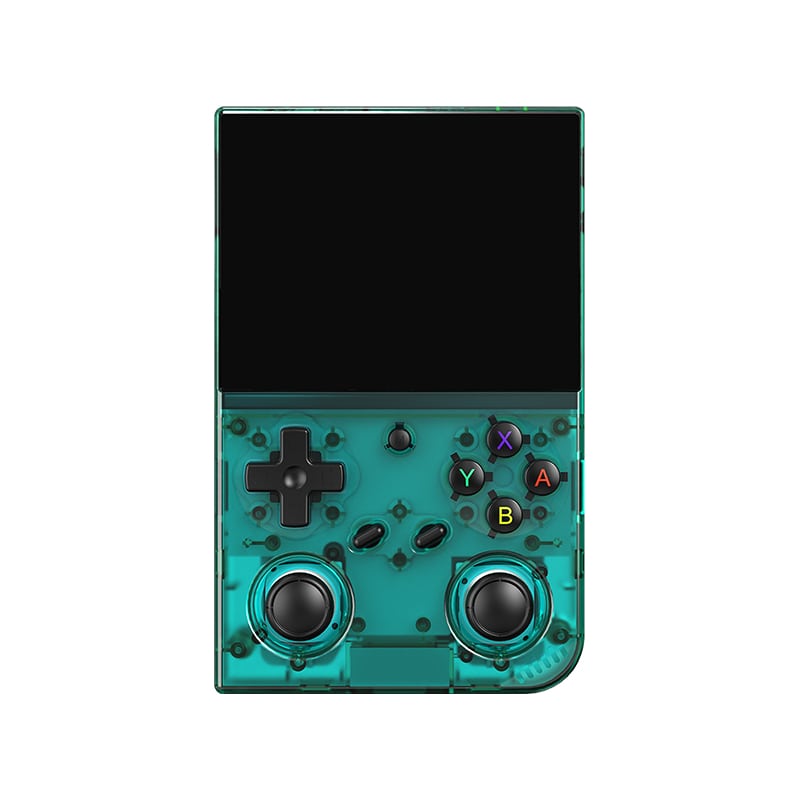
The Anbernic RG-35XX Pro is the analog-stick answer to a question the rest of the RG35XX line kept dodging. It takes the same Allwinner H700 chip that powers the Plus, the H and the clamshell SP, wraps it in a vertical Game Boy-shaped shell, and finally bolts two thumbsticks onto the front so N64 and PlayStation games are actually controllable. At roughly $49.99, with an early-bird coupon that dropped the first buyers to $44.99, it is one of the cheapest ways to get a laminated 640×480 screen, dual sticks and mini-HDMI output in one hand. It is not a leap in horsepower over its siblings; it is the same silicon in a nicer, better-thought-out body.
Emulation performance, generation by generation
The H700 is a quad-core Cortex-A53 clocked at 1.5GHz with a dual-core Mali-G31 GPU and 1GB of LPDDR4. That is a low-power ARM handheld, not a pocket PC, and the emulation ceiling reflects it. Everything up to the 16-bit era runs perfectly: NES, SNES, Genesis, Game Boy, Game Boy Advance, Neo Geo and arcade boards from that period all lock to full speed with headroom to spare. PlayStation 1 is the device’s comfort zone, where DuckStation and the PCSX cores hold 60fps across effectively the entire library, so Final Fantasy IX, Metal Gear Solid and Gran Turismo behave exactly as you would hope.
Above that, expectations need calibrating. Nintendo 64 lands somewhere near 85% playable, with the reliable crowd-pleasers such as GoldenEye, Mario 64 and Ocarina of Time running well while the known problem children stutter or glitch. Dreamcast is the pleasant surprise: with the Vulkan-backed Flycast core on Knulli or muOS, a large chunk of the catalog runs full speed, and Soulcalibur, Crazy Taxi and Jet Set Radio are genuinely enjoyable. PSP is where the H700 hits its wall. Lightweight 2D and menu-driven games are fine, but 3D-heavy titles like God of War or Gran Turismo drop frames and need aggressive downscaling. Saturn is hit-and-miss, and anything past that line, meaning GameCube, Wii, PS2, 3DS and Switch, is simply not on the menu. Buy it for everything up to and including PS1 and Dreamcast, and treat N64 and PSP as a bonus you tune per-game.
Screen, build and controls
The 3.5-inch IPS panel runs at a native 640×480 in a 4:3 ratio, fully laminated, with good viewing angles and no obvious backlight bleed. It is the correct aspect ratio for retro content and sharp enough that PS1 games look clean; it is not an OLED, so blacks read as grey, but at this price that is expected. The shell is plastic and vertical, like a chunky Game Boy that still fits in a jacket pocket, and reviewers consistently call it solid, with a pleasant pivoting D-pad and clicky dome face buttons.
The headline addition is the pair of analog sticks sitting low on the face in a parallel, PlayStation-style layout. They are compact and Switch-sized, fine for light 3D and camera control, but small enough that long camera-heavy sessions get cramped, and the L3/R3 clicks are loud. Note that Anbernic did not market these as Hall-effect units, so treat them as standard potentiometer sticks that may drift eventually. You also get L1/L2/R1/R2 shoulders, a vibration motor, a bottom-firing speaker, mini-HDMI out for TV play, WiFi 5, Bluetooth 4.2, dual microSD slots and USB-C, all on a 3200mAh battery rated at around seven hours.
Software and setup
Out of the box it runs Anbernic’s own 64-bit Linux build with an EmulationStation-style launcher: functional, a little cluttered, and the reason most owners reflash it within a week. Because the H700 is now a well-supported chip, the custom-firmware options are strong. muOS is the community favourite for its clean menus and per-emulator control, Knulli (a Batocera fork) is excellent for RetroAchievements and box art, and MinUI offers a stripped-back, load-a-game-and-go experience. ROCKNIX and Batocera images circulate for the platform as well, though at launch a couple of them were still being adapted. Setup is the usual routine: image a microSD, drop your legally owned ROMs and BIOS files onto the second card, and go. None of this is unique to the Pro; it inherits the entire H700 software ecosystem, which is the single biggest reason to buy an Anbernic over an off-brand clone.
Price, value and who it is for
At around $50 the RG-35XX Pro is aimed squarely at someone who wants dual sticks and PS1-class emulation without spending Steam Deck money. It makes the most sense if you specifically want analog control in this RG35XX form factor; otherwise the stickless SP or the horizontal H cover much of the same ground for similar cash. It is a poor fit if your want list starts at PSP-heavy 3D, GameCube or anything newer, because the H700 will only frustrate you there and a Snapdragon-based handheld is the right tool. But as a cheap, pocketable, endlessly customisable machine for 8-bit through PS1 and Dreamcast, with a mature firmware scene behind it, it is one of the easier budget recommendations to make. Just go in knowing you are paying for ergonomics and a good screen, not for new speed.
📐 Size & Pocketability
⚖️ Weight vs Other Handhelds
🔋 Real-World Battery Estimator
⭐ Emulation Performance
📊 View How This Score is Calculated
The Hardware Power Score is an absolute metric. Perfect emulation of difficult, modern consoles awards significantly more points than standard retro consoles.
- 15× Multiplier: Modern PC
- 12× Multiplier: Switch, PS3, Xbox 360
- 10× Multiplier: Wii U
- 8× Multiplier: PS2, GameCube, Wii, Xbox
- 5× Multiplier: Saturn, Dreamcast, PSP
- 3× Multiplier: N64, PS1
- 1× Multiplier: SNES, GBA
Generation 6
Generation 5
Handhelds & Retro
⚡ Performance Benchmarks
Where Anbernic RG-35XX Pro ARM Mali-G31 MP2 lands against the handhelds everyone knows. Every bar shares one scale, so longer genuinely means faster — add up to two rivals to compare.
CPU = Geekbench 6 multi-core · GPU = 3DMark Wild Life. Median real-world scores; every bar shares one scale — add up to two rivals to compare.
📋 Full Specifications
📺 Display
⚙️ Platform
💾 Memory
🕹️ Controls
📏 Body
🔋 Battery
⚖️ Verdict
✅ The Good
- Dual analog sticks finally make N64, PS1 and Dreamcast 3D games controllable in the RG35XX shape, a real functional upgrade over the stickless SP
- Locked-60fps PlayStation 1 emulation plus flawless everything through the 16-bit and Game Boy Advance era
- Sharp, fully-laminated 3.5-inch 640×480 4:3 IPS screen suited to retro content, with mini-HDMI output for TV play
- Backed by the mature H700 custom-firmware scene (muOS, Knulli, MinUI, ROCKNIX) rather than throwaway off-brand software
❌ The Bad
- The Allwinner H700 tops out fast: PSP is only partly playable and GameCube, Wii, PS2 and Switch are off the table entirely
- Sticks are small and standard (not advertised as Hall-effect, so drift is possible), cramped for long camera-heavy play, and the L3/R3 clicks are loud
- Stock Linux OS is cluttered enough that most owners reflash custom firmware, and at launch some CFW was still being ported to the device
📰 Latest News & Guides
The Ultimate Guide to ARMSX3: Android’s New PS3 Emulator, Competitor Comparisons, and Setup Tutorial
18/08/2026Pokémon Gold, Silver, and Crystal (Gen 2) Recomp Lands on Android
17/08/2026How to Play the Pokémon Red, Blue, or Yellow Recomp on Your Android, Windows, and Linux Devices
16/08/2026🔍 Similar Handhelds
Other handhelds that emulate up to Dreamcast.