
🛒 Where to Buy
⚠️ Golden Rule of Retro Handhelds: Throw away the cheap MicroSD card that comes in the box — it will fail. And never use a high-wattage PD “Fast Charger” on these devices; it can damage the battery. Use a standard 5V/1.5A brick.
Device Overview: Abxylute One Pro
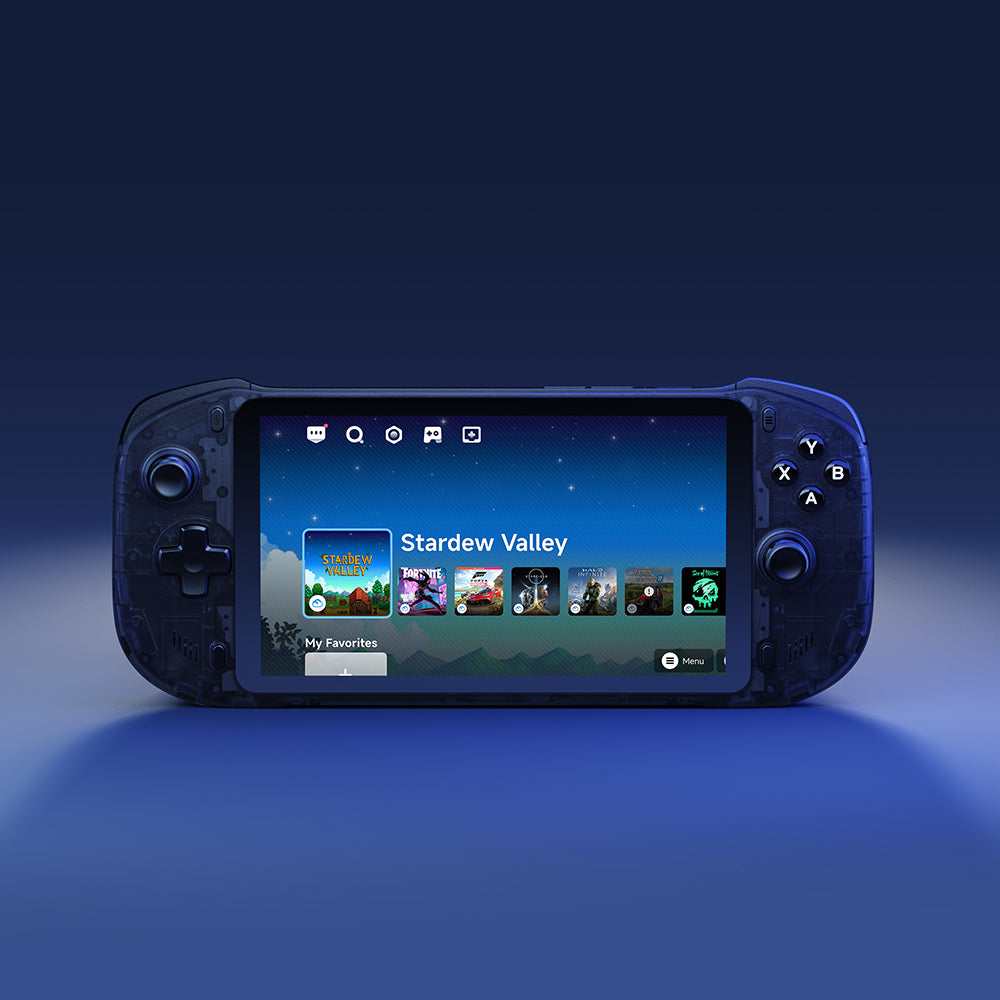
The Abxylute One Pro is a 7-inch Android 13 handheld built first for streaming and remote play, with local emulation treated as a bonus rather than the headline. That ordering explains almost every decision Abxylute made. The company’s original One was a cloud-only slab running a weak MediaTek MT8365; the One Pro keeps the same streaming DNA but swaps in a MediaTek Genio 510, a 6nm octa-core chip pairing two Cortex-A78 performance cores with a cluster of Cortex-A55 efficiency cores and a Mali-G57 MC2 GPU. It arrived via Kickstarter from around $209 for early backers and now retails in the $249 to $259 range. It ships with 4GB of LPDDR4X RAM and 64GB of storage expandable by microSD up to 2TB, which is tight memory for a modern Android gaming device and a genuine limiter on heavier workloads. Understand what it is before you buy: this is a big, light streaming tablet with gamepad grips, not a Retroid or a Steam Deck rival.
Emulation performance, generation by generation
The Genio 510 is an edge/IoT-class SoC, not a phone flagship, and it shows. Everything up to and including the fifth generation runs cleanly. PlayStation 1 through DuckStation, Nintendo 64 through Mupen64Plus FZ, and Dreamcast through Flycast are comfortable, and PSP on PPSSPP is the sweet spot, with most of that library holding full speed at native or 2x resolution. Above that line, temper expectations. Abxylute’s marketing claims PS2 and GameCube at 60fps, and while lighter titles on AetherSX2/NetherSX2 and Dolphin can hit playable frame rates, a hands-on tester flatly called reliable PS2 emulation “out of reach” on this chip. The truth sits in between: 2D and lighter 3D sixth-gen games are doable with per-game tuning, but demanding titles stutter, and this is not a machine to buy specifically for that generation. Wii, Switch and PS3 are off the table. If your target is PS1/PSP-and-below plus streaming, the One Pro delivers; if you want a dependable Dolphin box, a Snapdragon 8-series handheld will serve you better.
Screen, build and controls
The screen is the standout. It’s a 7-inch 1920×1080 IPS panel at 60Hz, and Russ Crandall of Retro Game Corps singled out its color reproduction as better than several rivals. At 1080p across 7 inches you get a sharp 314ppi, and the 16:9 shape suits streaming and modern Android games even as it letterboxes 4:3 retro content. The body measures 250x115x30mm and weighs 430g: large, but genuinely light for the footprint, thanks to a plastic shell with contoured grips. The controls are the divisive part. Instead of conventional or Hall-effect analog sticks, Abxylute fits full-size digital capacitive joysticks with selectable circle and square gates. They can’t drift like a potentiometer stick, a real durability win, but they behave closer to directional inputs than true analog, and anyone expecting smooth analog control in shooters or racers should try before committing. You still get L1/R1, L2/R2, L3/R3, a d-pad, a six-axis gyro and dual Z-axis haptic motors.
Software and setup
This is a full Android 13 device with Google services, so the Linux custom-firmware world of muOS, Knulli, ArkOS, ROCKNIX and Batocera simply does not apply here; you can’t and shouldn’t flash it. Setup is Android sideloading instead. Out of the box you meet Abxylute’s own launcher, which several reviewers found restrictive and awkward if you treat the unit like a normal tablet. The fix is the usual Android-handheld routine: install RetroArch or standalone cores, front-end them with Daijisho or ES-DE, then add Moonlight, Steam Link, GeForce NOW, Xbox Cloud Gaming and PS Remote Play for the streaming half of its personality. The hardware leans hard into that side, with dual-band Wi-Fi, Bluetooth, a 3.5mm headphone jack, dual microphones, dual speakers and 4K video-out over USB-C for TVs or AR glasses. That 4GB RAM ceiling occasionally bites when juggling a heavy frontend and a background stream, so keep the software stack lean. None of this is difficult, but plan on an evening of app installation to reach the experience you actually want.
Price, value and who it is for
At roughly $249 the One Pro sits alongside the Retroid Pocket 5 and AYN Odin 2 on price but not on raw emulation muscle; those Snapdragon devices will outrun it on PS2 and beyond. Where it earns its keep is the combination of a large, high-quality 1080p screen, a light chassis, drift-proof sticks and a streaming-first feature set. Buy it if your gaming is mostly cloud services, PC and console remote play, and retro up to the PSP era, and you value screen quality and battery life (a 5,200mAh cell rated near eight hours, 18W charging) over cutting-edge emulation. Skip it if you specifically want reliable GameCube, Wii or PS2 speed, or if capacitive digital sticks sound like a dealbreaker. It’s a focused, honestly-priced streaming handheld, just not the emulation powerhouse its own marketing implies.
📐 Size & Pocketability
⚖️ Weight vs Other Handhelds
🔋 Real-World Battery Estimator
⭐ Emulation Performance
📊 View How This Score is Calculated
The Hardware Power Score is an absolute metric. Perfect emulation of difficult, modern consoles awards significantly more points than standard retro consoles.
- 15× Multiplier: Modern PC
- 12× Multiplier: Switch, PS3, Xbox 360
- 10× Multiplier: Wii U
- 8× Multiplier: PS2, GameCube, Wii, Xbox
- 5× Multiplier: Saturn, Dreamcast, PSP
- 3× Multiplier: N64, PS1
- 1× Multiplier: SNES, GBA
Gen 8 & PC
Generation 7
Generation 6
Generation 5
Handhelds & Retro
📋 Full Specifications
📺 Display
⚙️ Platform
💾 Memory
🕹️ Controls
📏 Body
🔋 Battery
⚖️ Verdict
✅ The Good
- Excellent 7-inch 1080p IPS screen with color reproduction praised above similarly priced rivals
- Large-screened yet genuinely light at 430g, with comfortable contoured grips
- Full-size digital capacitive sticks that cannot develop the potentiometer drift common on analog handhelds
- Strong streaming and remote-play package: 4K USB-C video out, GeForce NOW/Xbox Cloud/Moonlight support, dual mics and speakers, plus solid retro emulation up to the PSP era
❌ The Bad
- Edge-class MediaTek Genio 510 makes PS2 and GameCube emulation unreliable despite marketing claims of 60fps
- Capacitive digital joysticks are not true analog and feel closer to a d-pad, which hurts shooters and racers
- Restrictive stock launcher and Android-only setup: no Linux custom-firmware (muOS/ArkOS/Batocera) option, and sideloading is required to get the best experience
📰 Latest News & Guides
The Ultimate Guide to ARMSX3: Android’s New PS3 Emulator, Competitor Comparisons, and Setup Tutorial
18/08/2026Pokémon Gold, Silver, and Crystal (Gen 2) Recomp Lands on Android
17/08/2026How to Play the Pokémon Red, Blue, or Yellow Recomp on Your Android, Windows, and Linux Devices
16/08/2026🔍 Similar Handhelds
Other handhelds that emulate up to PS2.