
🛒 Where to Buy
⚠️ Golden Rule of Retro Handhelds: Throw away the cheap MicroSD card that comes in the box — it will fail. And never use a high-wattage PD “Fast Charger” on these devices; it can damage the battery. Use a standard 5V/1.5A brick.
Device Overview: Anbernic RG-505
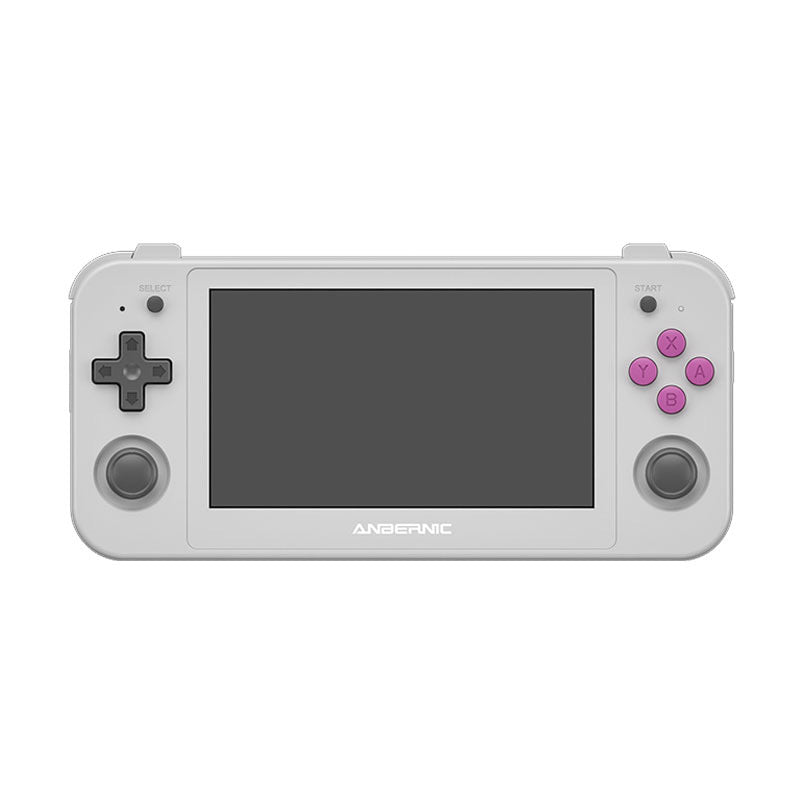
The Anbernic RG-505 arrived in late 2022 as the company’s first OLED Android handheld, and it is best understood as an experiment Anbernic ran on its customers rather than a finished product. The formula is straightforward: a Unisoc Tiger T618, 4GB of LPDDR4X RAM, and a 4.95-inch 960×544 OLED panel widely reported to be recycled from unused PS Vita screen stock, all in a horizontal shell that weighs 286 grams. It launched around $147.99 to $157.99 depending on the bundled microSD card. On paper that is a lot of hardware for the money. In the hand it is a device that does several things adequately and nothing exceptionally.
Emulation performance, generation by generation
The T618 is a mid-tier Arm SoC — two Cortex-A75 cores at 2.0GHz, six A55 cores, and a Mali-G52 GPU — and it sets a hard ceiling. Everything up to and including the 32-bit and Dreamcast era runs without drama: NES, SNES, Genesis, Game Boy, PS1 (DuckStation), Saturn, and Dreamcast (Flycast) are effectively solved. PSP is the panel’s showcase, since 960×544 is a clean 2x of the PSP’s native resolution and PPSSPP renders most of the library crisply. Nintendo 64 through Mupen is playable but title-dependent, with the usual awkward games stuttering. Above that it gets honest quickly. GameCube on Dolphin handles lighter titles such as Wind Waker or Mario Kart near full speed; PS2 via AetherSX2 runs the simpler 2D and lighter 3D games but chokes on demanding ones — reviewers saw slowdown and flicker in Need for Speed Most Wanted. 3DS through Citra suffers graphical glitches on this Mali GPU. Wii, PS3, and anything newer are not realistic. Anyone shopping this device expecting reliable PS2 or GameCube performance should look at a Snapdragon-class handheld instead.
Screen, build and controls
The OLED is the selling point and the compromise at once. Blacks are perfect and PSP content looks lovely, but it is an old, low-resolution panel with a modest brightness range that washes out outdoors, and the bezels around it are enormous. The joysticks are the genuine highlight: recessed Hall-effect sticks that will not develop drift. The rest of the controls are where corners show. The D-pad has been criticised for mis-registering down-presses, the face buttons and shoulders feel cheap and rattly, and the L1/L2/R1/R2 shoulders are digital, small, and awkwardly placed for anyone resting fingers on the sticks. At 189 x 87 x 18mm the grip is comfortable enough, but the plastics and loose buttons undercut the premium impression the OLED tries to set. There is a single USB-C port, a 3.5mm jack, dual speakers, WiFi 5, Bluetooth 5.0, and a 5000mAh battery good for roughly four to eight hours depending on what you emulate. There is no HDMI output.
Software and setup
The RG-505 runs Android 12 with Anbernic’s own launcher, and the stock software is the weakest part of the package. Reviewers found the bundled front end clumsy and unintuitive, several to the point of abandoning it entirely. The good news is that this is Android, so you are not trapped with it. Unlike Anbernic’s Allwinner and Rockchip Linux handhelds, the T618 has no meaningful Linux custom-firmware scene — you will not find muOS, Knulli, ArkOS, or ROCKNIX for this chip, and treating it like an SD-card-flashing Linux device is a mistake. Instead you fix it from inside Android: the Play Store works, so install standalone emulators (RetroArch, DuckStation, PPSSPP, Dolphin, AetherSX2, Flycast) and a proper front end such as Daijisho or ES-DE, then ignore the stock launcher. Set up that way it becomes a competent Android emulation box; out of the box it is rough.
Price, value and who it is for
At roughly $150 the RG-505 is hard to recommend without caveats, and it was hard to recommend at launch. Its own contemporaries undercut it: the Retroid Pocket 3+ delivered similar or better performance for less money and with a saner software story, which is exactly where several reviewers pointed buyers. The RG-505 makes sense for a specific person — someone who genuinely wants an OLED screen, plays mostly PSP, PS1, Dreamcast, and 16-bit libraries, values drift-proof Hall sticks, and is willing to spend an evening replacing the software. For that buyer it delivers. For anyone wanting strong PS2 or GameCube emulation, modern screen brightness, or a device that simply works out of the box, the money is better spent elsewhere.
📐 Size & Pocketability
⚖️ Weight vs Other Handhelds
🔋 Real-World Battery Estimator
⭐ Emulation Performance
📊 View How This Score is Calculated
The Hardware Power Score is an absolute metric. Perfect emulation of difficult, modern consoles awards significantly more points than standard retro consoles.
- 15× Multiplier: Modern PC
- 12× Multiplier: Switch, PS3, Xbox 360
- 10× Multiplier: Wii U
- 8× Multiplier: PS2, GameCube, Wii, Xbox
- 5× Multiplier: Saturn, Dreamcast, PSP
- 3× Multiplier: N64, PS1
- 1× Multiplier: SNES, GBA
Gen 8 & PC
Generation 7
Generation 6
Generation 5
Handhelds & Retro
⚡ Performance Benchmarks
Where Anbernic RG-505 Mali-G52 MP2 lands against the handhelds everyone knows. Every bar shares one scale, so longer genuinely means faster — add up to two rivals to compare.
CPU = Geekbench 6 multi-core · GPU = 3DMark Wild Life. Median real-world scores; every bar shares one scale — add up to two rivals to compare.
📋 Full Specifications
📺 Display
⚙️ Platform
💾 Memory
🕹️ Controls
📏 Body
🔋 Battery
⚖️ Verdict
✅ The Good
- Genuine OLED panel with perfect blacks, and 960×544 is a clean 2x for PSP so PPSSPP games look crisp
- Recessed Hall-effect joysticks that will not develop stick drift over time
- Full Android 12 with Play Store access plus a large 5000mAh battery, so you can install any emulator or front end you like
- Strong price-to-power for 32-bit and Dreamcast-era systems: PS1, Saturn, Dreamcast, and PSP are all fully playable
❌ The Bad
- Stock Anbernic launcher is clumsy, and the T618 has no Linux custom firmware (no muOS, ROCKNIX, or ArkOS), so you effectively have to fix the software yourself
- Build quality lets it down: rattly cheap-feeling buttons, a criticised D-pad, small awkward digital shoulders, and huge screen bezels
- T618 ceiling makes PS2 and GameCube hit-or-miss, the dim older panel struggles outdoors, and there is no HDMI output
📰 Latest News & Guides
The Ultimate Guide to ARMSX3: Android’s New PS3 Emulator, Competitor Comparisons, and Setup Tutorial
18/08/2026Pokémon Gold, Silver, and Crystal (Gen 2) Recomp Lands on Android
17/08/2026How to Play the Pokémon Red, Blue, or Yellow Recomp on Your Android, Windows, and Linux Devices
16/08/2026🔍 Similar Handhelds
Other handhelds that emulate up to PS2.