
🛒 Where to Buy
⚠️ Golden Rule of Retro Handhelds: Throw away the cheap MicroSD card that comes in the box — it will fail. And never use a high-wattage PD “Fast Charger” on these devices; it can damage the battery. Use a standard 5V/1.5A brick.
Device Overview: Retroid Pocket 3 Plus
The Retroid Pocket 3 Plus (RP3+) is the November 2022 mid-cycle refresh that turned Retroid’s Pocket 3 into the reference budget Android handheld of its era. For $149 it swapped the original Pocket 3’s weaker Unisoc T310 for the Unisoc Tiger T618, a chip that punches above the price and pushed the realistic playable ceiling up from PSP and Dreamcast to “most of GameCube plus a curated slice of PS2.” It is emphatically not a Linux retro handheld in the Anbernic mold. It is a small Android tablet with real gamepad controls bolted on, and that single distinction shapes everything about living with it.
Emulation performance, generation by generation
The T618 pairs two Cortex-A75 cores and six A55s, all clocked to 2.0GHz, with a Mali-G52 MP2 GPU at 850MHz. In practice, everything from the 8-bit era through the 32/64-bit generation is effectively solved. NES, SNES, Genesis, Game Boy and GBA, PS1, N64 and Nintendo DS all hold full speed in RetroArch or their standalone cores, with headroom left for shaders and higher internal resolutions. Dreamcast through Flycast is excellent, and Saturn, historically the awkward one, is mostly playable via Yaba Sanshiro, with only the heaviest games as exceptions. PSP is a genuine highlight: PPSSPP stays locked at full speed while upscaling to 2x or even 3x native, which is exactly what makes the 16:9 screen worthwhile. GameCube sits at the top of the comfortable range. Dolphin runs a large share of the library at or near native resolution and full speed, so Melee, Wind Waker and Super Mario Sunshine are relaxed, while the most demanding titles such as F-Zero GX dip and are best kept at native res. Wii is a coin flip, since lighter games play but motion-heavy ones fight the absence of real pointer controls. PS2 is the honest ceiling. With AetherSX2 or NetherSX2 the RP3+ will run a real subset, including Gradius V, Final Fantasy X and Tekken 5, but heavier 3D games like Gran Turismo 4 drop frames or need frameskip. Treat PS2 as a “some games” proposition, never a promise. 3DS through Citra is patchy, and Wii U and Switch are out of reach entirely.
Screen, build and controls
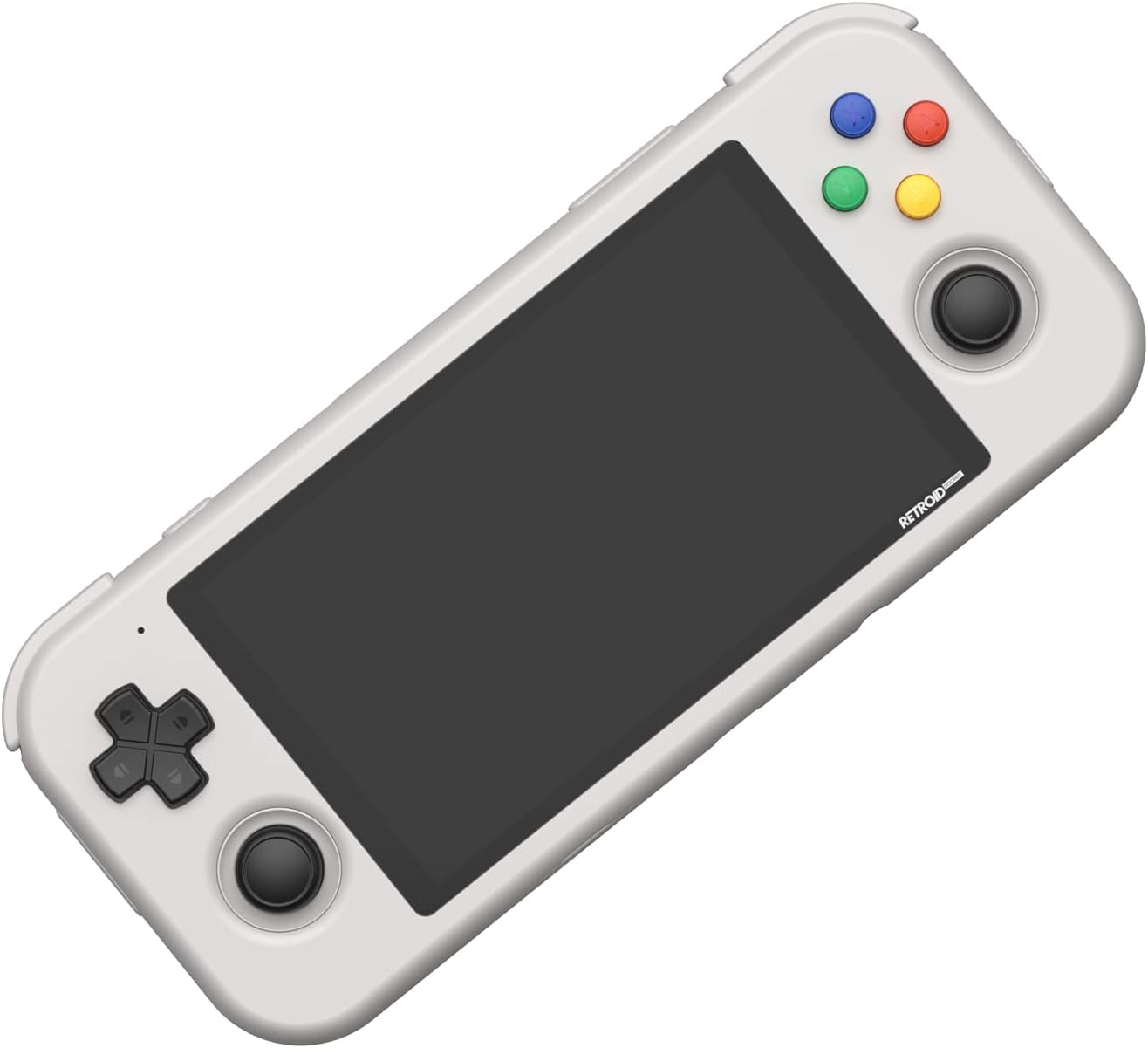
The 4.7-inch IPS panel runs 1334×750 at 16:9, roughly 325 PPI, 60Hz and about 450 nits. It is sharp, bright enough indoors, and a natural fit for PSP and widescreen Android games. The tradeoff is real: 4:3 content like SNES, PS1 and GameCube gets pillarboxed with black bars on both sides, so a library that is mostly 4:3 is better served by a squarer screen. The shell is plastic over an aluminum mid-frame, weighs 230g and measures about 185 x 81 x 24mm, pocketable in a jacket and chunky in jeans. The controls are the RP3+’s quiet strength: offset, slightly recessed dual analog sticks, a solid d-pad up top, responsive face buttons, and stacked L1/L2 and R1/R2 shoulders. Two caveats deserve stating plainly. First, the stock sticks are standard clickable analog sticks, not Hall effect; Retroid sells an official Hall-sensor stick kit for about $10 as a DIY swap if you want drift-proof modules. Second, L2 and R2 are digital, not analog or linear, so pressure-sensitive racing triggers behave as on/off. Gyro aiming is supported. A 3.5mm jack, dual-band Wi-Fi 5, Bluetooth 5.0 and USB-C with video output round out the package.
Software and setup
This is the part buyers underestimate. The RP3+ ships with Android 11 and Retroid’s own launcher, not a plug-and-play retro OS. Because the Unisoc T618 sits outside the Rockchip ecosystem, the familiar Linux custom-firmware options, ArkOS, muOS, Knulli, ROCKNIX, Batocera and OnionOS, simply do not apply here; you cannot flash muOS onto this device. What you get instead is the flexibility and the setup burden of Android. You install RetroArch and the standalone emulators (Dolphin, PPSSPP, DuckStation, Flycast, AetherSX2 or NetherSX2), then add a proper front-end on top. Daijisho and EmulationStation-DE are the community favorites for a console-style grid, and EmuDeck’s Android installer can automate much of the emulator-and-frontend wiring if you would rather not do it by hand. Retro Game Corps’ Retroid setup guides are close to required reading. The payoff of the Android base is concrete: Bluetooth gamepads and headphones, streaming apps, cloud gaming and the Play Store all work without a fight.
Price, value and who it is for
At $149 for the opaque colors, with the clear Purple and Blue finishes at about $154, the RP3+ was the value benchmark of its moment. It undercut Anbernic’s T618 rivals while shipping a nicer screen and better controls. Today it sits below the Retroid Pocket 4 and 4 Pro and the Pocket 5, which move the ceiling into stronger PS2 and light Switch territory, so buy the 3+ only at a discount and with clear eyes. It is the right handheld for someone who wants everything through GameCube, Dreamcast and PSP to run reliably, is content to dabble in PS2 rather than depend on it, and does not mind spending an evening configuring Android. It is the wrong pick if you want a flash-and-go Linux experience or a guaranteed PS2 machine. For either of those, spend up a tier.
📐 Size & Pocketability
⚖️ Weight vs Other Handhelds
🔋 Real-World Battery Estimator
⭐ Emulation Performance
📊 View How This Score is Calculated
The Hardware Power Score is an absolute metric. Perfect emulation of difficult, modern consoles awards significantly more points than standard retro consoles.
- 15× Multiplier: Modern PC
- 12× Multiplier: Switch, PS3, Xbox 360
- 10× Multiplier: Wii U
- 8× Multiplier: PS2, GameCube, Wii, Xbox
- 5× Multiplier: Saturn, Dreamcast, PSP
- 3× Multiplier: N64, PS1
- 1× Multiplier: SNES, GBA
Generation 7
Generation 6
Generation 5
Handhelds & Retro
⚡ Performance Benchmarks
Where Retroid Pocket 3 Plus Mali-G52 MP2 lands against the handhelds everyone knows. Every bar shares one scale, so longer genuinely means faster — add up to two rivals to compare.
CPU = Geekbench 6 multi-core · GPU = 3DMark Wild Life. Median real-world scores; every bar shares one scale — add up to two rivals to compare.
📋 Full Specifications
📺 Display
⚙️ Platform
💾 Memory
🕹️ Controls
📏 Body
🔋 Battery
⚖️ Verdict
✅ The Good
- Unisoc T618 comfortably clears GameCube, Dreamcast and 2x-3x PSP for its $149 launch price
- Sharp, bright 4.7-inch 16:9 IPS screen that shows off PSP and widescreen content
- Full Android 11 base adds Bluetooth peripherals, streaming, cloud gaming and the Play Store
- Good ergonomics with offset sticks, a solid d-pad, and an official $10 Hall-stick DIY upgrade path
❌ The Bad
- No Linux custom firmware (muOS, ArkOS, Knulli, Batocera) works on the Unisoc T618 chip; Android setup is on you
- PS2 is unreliable, the stock sticks are not Hall effect, and L2/R2 are digital-only with no analog triggers
- 16:9 panel pillarboxes 4:3 systems, and newer Retroid models now outclass it, so it is worth buying only on discount