
🛒 Where to Buy
⚠️ Golden Rule of Retro Handhelds: Throw away the cheap MicroSD card that comes in the box — it will fail. And never use a high-wattage PD “Fast Charger” on these devices; it can damage the battery. Use a standard 5V/1.5A brick.
Device Overview: Retroid Pocket Flip
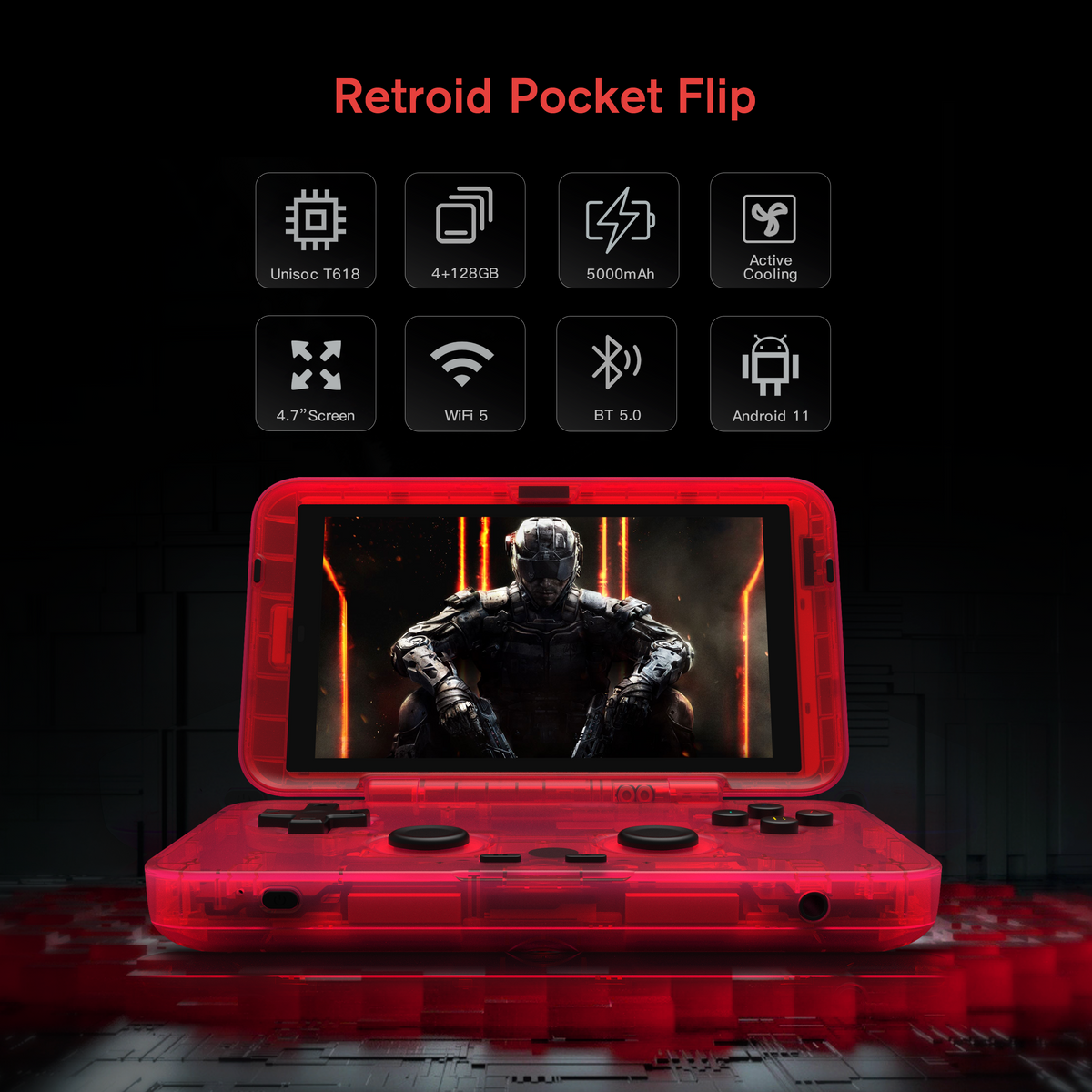
The Retroid Pocket Flip is Retroid’s 2023 attempt to wrap a Nintendo DS-style clamshell around the internals of its popular Pocket 3+. It runs the same Unisoc Tiger T618 and the same 4.7-inch screen, then hides both behind a hinge so the panel and sticks are protected in a bag or pocket. At roughly $149 to $159 it was never the cheapest way into emulation, and the folding shell is the entire reason to pay the premium. If the clamshell does not matter to you, the slab-shaped Pocket 3+ delivers identical performance for less money.
Emulation performance, generation by generation
This is a mid-tier Android handheld, not a pocket PC, and the T618 sets a hard ceiling that no amount of tinkering moves. The chip is familiar silicon, a 12nm part with two Cortex-A75 cores and a Mali-G52 GPU that also powers the Anbernic RG556 and Powkiddy X55, so its emulation limits are thoroughly mapped by the community. Everything through the fifth generation is effortless: NES, SNES, Genesis, Game Boy Advance, PlayStation 1 and Nintendo 64 run at full speed under RetroArch and DuckStation with room to spare. PSP is the star of the show, where PPSSPP holds 60fps across most of the library and lighter 3D games such as God of War tolerate 2x or 3x internal resolution. Dreamcast through Flycast and Saturn through Yaba Sanshiro 2 are both comfortable, which is more than many cheaper chips manage. Above that line, honesty is required. GameCube on Dolphin, or the MMJR2 fork, is a lottery: Wind Waker and lighter titles can be playable, but anything demanding stutters. PS2 is effectively off the table. AetherSX2 and NetherSX2 will boot games, yet the T618 cannot deliver full speed across the library, and RetroDodo’s review flatly called PS2 a no-go. Wii and Switch are not realistic targets. Treat this as a machine that masters everything up to and including PSP and Dreamcast, and treats GameCube as an occasional bonus.
Screen, build and controls
The 4.7-inch IPS panel runs at 1334×750, 60Hz, and around 450 nits, sharp enough for retro sprites at 325 PPI, though you will want to drop the brightness indoors. It is a 16:9 screen, so 4:3 systems letterbox, but the resolution flatters PSP and Dreamcast nicely. The clamshell is the headline feature and it is a mixed bag: the plastic shell feels solid and the folded footprint is genuinely bag-friendly, but the hinge flops rather than clicking into place, and the glossy finish smears with fingerprints. Controls are decent. The Hall effect analog sticks resist drift by design, the D-pad and face buttons are crisp, and there are stacked L1/R1/L2/R2 shoulders plus programmable M1/M2 buttons and a gyroscope. The one real weakness reviewers flag is stick responsiveness during fast movement. A 5000mAh battery delivers a real-world seven hours or so, though standby drain is heavy, so expect to lose a quarter of the charge overnight in sleep. At 270g and 139 x 82 x 25.4mm folded it slips into a jacket pocket, and it charges over USB-C on top, with video out, microSD and a headphone jack.
Software and setup
The Flip ships with Android 11 and Retroid’s own launcher, and Android is the important word here. Unlike the Anbernic and Miyoo Linux handhelds, Retroid devices are not part of the muOS, Knulli, ArkOS, ROCKNIX, OnionOS or Batocera scene; those custom firmwares target Rockchip and Allwinner hardware and simply do not run on this chip. Setup instead happens inside Android: you install standalone emulators such as DuckStation, PPSSPP, Dolphin and Flycast alongside RetroArch, then bolt a proper front end on top. Daijisho, ES-DE and Beacon all turn the stock launcher into a console-style library, and that is the route most owners take. GammaOS, the debloated LineageOS build people often ask about, is built for Anbernic’s T618 handhelds rather than Retroid’s, so do not count on a drop-in flash. The upside of Android is real: Moonlight and GeForce Now streaming, native store games and controller-mapped Android titles all work out of the box.
Price, value and who it is for
At launch the Flip cost about $149 to $159 with 4GB of RAM, 128GB of eMMC storage and microSD expansion, a fair price for the hardware and a small tax over the Pocket 3+ purely for the folding shell. It is worth buying if you specifically want a clamshell that shields its screen and sticks when closed and you are content topping out at PSP, Dreamcast and Saturn. It is the wrong device if you are chasing GameCube and PS2, in which case a Snapdragon machine, including Retroid’s own Pocket Flip 2, is the honest recommendation. Since the Flip 2 arrived, the original mostly makes sense secondhand, where the T618 clamshell is a tidy, pocketable emulator for anyone whose library stops at the sixth generation’s lighter end.
📐 Size & Pocketability
⚖️ Weight vs Other Handhelds
🔋 Real-World Battery Estimator
⭐ Emulation Performance
📊 View How This Score is Calculated
The Hardware Power Score is an absolute metric. Perfect emulation of difficult, modern consoles awards significantly more points than standard retro consoles.
- 15× Multiplier: Modern PC
- 12× Multiplier: Switch, PS3, Xbox 360
- 10× Multiplier: Wii U
- 8× Multiplier: PS2, GameCube, Wii, Xbox
- 5× Multiplier: Saturn, Dreamcast, PSP
- 3× Multiplier: N64, PS1
- 1× Multiplier: SNES, GBA
Generation 7
Generation 6
Generation 5
Handhelds & Retro
⚡ Performance Benchmarks
Where Retroid Pocket Flip Mali-G52 MP2 lands against the handhelds everyone knows. Every bar shares one scale, so longer genuinely means faster — add up to two rivals to compare.
CPU = Geekbench 6 multi-core · GPU = 3DMark Wild Life. Median real-world scores; every bar shares one scale — add up to two rivals to compare.
📋 Full Specifications
📺 Display
⚙️ Platform
💾 Memory
🕹️ Controls
📏 Body
🔋 Battery
⚖️ Verdict
✅ The Good
- Clamshell shell folds shut to protect the 4.7-inch screen and Hall effect sticks, making it far more bag- and pocket-friendly than a slab handheld
- Runs everything up to PSP, Dreamcast and Saturn at full speed, with PPSSPP even handling 2x-3x upscaling on lighter 3D titles
- Hall effect analog sticks resist the drift that plagues cheaper potentiometer-based sticks
- Strong endurance for the class, roughly seven hours of real gameplay from the 5000mAh cell, plus USB-C, video out and microSD expansion
❌ The Bad
- The Unisoc T618 caps out below GameCube and PS2, so those systems are a lottery or a non-starter and demanding sixth-gen libraries are out
- Hinge flops instead of clicking, the glossy finish is a fingerprint magnet, and standby drain is heavy at around a quarter of the battery overnight
- No Linux custom-firmware scene (no muOS, ArkOS or ROCKNIX); you are limited to customizing stock Android 11 with front ends, and GammaOS targets Anbernic rather than Retroid
📰 Latest News & Guides
The Ultimate Guide to ARMSX3: Android’s New PS3 Emulator, Competitor Comparisons, and Setup Tutorial
18/08/2026Pokémon Gold, Silver, and Crystal (Gen 2) Recomp Lands on Android
17/08/2026How to Play the Pokémon Red, Blue, or Yellow Recomp on Your Android, Windows, and Linux Devices
16/08/2026🔍 Similar Handhelds
Other handhelds that emulate up to Saturn.