
🛒 Where to Buy
⚠️ Golden Rule of Retro Handhelds: Throw away the cheap MicroSD card that comes in the box — it will fail. And never use a high-wattage PD “Fast Charger” on these devices; it can damage the battery. Use a standard 5V/1.5A brick.
Device Overview: One Netbook OneXPlayer X1 Mini
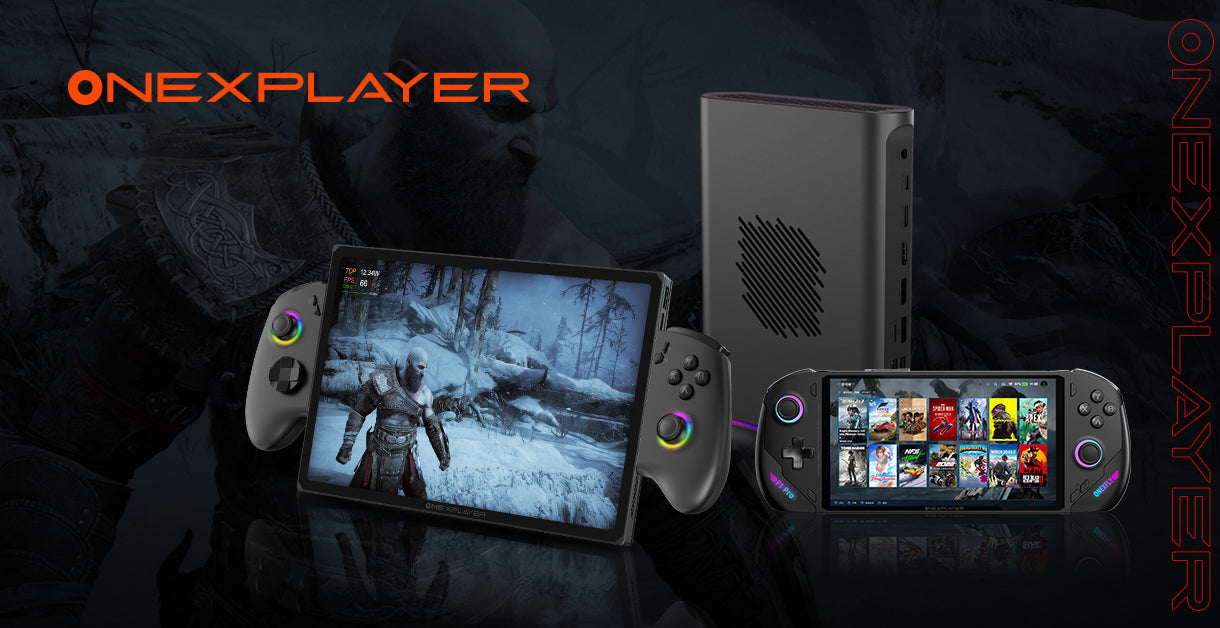
The One Netbook OneXPlayer X1 Mini is not a pocket emulator in the SNES-in-your-jeans sense. It is a full x86 Windows 11 handheld PC that One-Netbook shrank down from the larger X1. The “3-in-1” pitch is literal: slide the Hall-effect controllers off the sides and it becomes an 8.8-inch tablet, then snap on the bundled magnetic QWERTY cover and it plays laptop. It runs on AMD’s Radeon-equipped APUs, either the Zen 4 Ryzen 7 8840U in the original run or the newer Zen 5 Ryzen AI 9 HX 370 in the 2025 refresh, so it plays native Steam libraries first and emulates everything else as a side benefit. That framing matters, because unlike an ARM stick handheld nothing here is bottlenecked by a mobile SoC; the ceiling is set by wattage and cooling, not by the instruction set. The 8840U brings eight Zen 4 cores and a 12-CU Radeon 780M, while the HX 370 steps up to twelve Zen 5 cores, twenty-four threads and the 16-CU 890M, so the refresh is a real jump rather than a rebadge.
Emulation performance, generation by generation
With a Radeon 780M (8840U) or 890M (HX 370) driving a real Windows desktop, this device sits near the top of what a handheld can emulate. Sixth generation and earlier is trivial: PCSX2 runs PS2 at 3x-4x internal resolution, Dolphin pushes GameCube and Wii cleanly, and PPSSPP or the current 3DS forks (Lime3DS, Azahar) upscale to sharp output without breaking a sweat. Wii U through Cemu is comfortable. The interesting frontier is seventh and eighth gen. Nintendo Switch via Ryujinx or the post-Yuzu community forks runs the bulk of the catalog well, though shader-compilation stutter and the odd CPU-heavy title still bite, and the HX 370’s stronger single-thread helps here. PS3 through RPCS3 is genuinely playable in many games but remains the heaviest lift, and you will hear the fan. Xbox 360 (Xenia) and early PS4 (shadPS4) are experimental: some titles boot and run, many do not, on any hardware. Treat those two as curiosities, not selling points. For scale, the same 780M that walks through PS2 and GameCube only manages the native Forza Horizon 5 at about 47fps and Apex Legends at 66fps at 30W, so emulation of older systems runs with enormous headroom to spare while modern AAA gaming leans on that OCuLink port.
Screen, build and controls
The 8.8-inch panel is the standout. It is an LTPS IPS LCD at 2560×1600 (16:10), 144Hz, with 10-point touch; independent testing measured close to 550 nits against an advertised 500, plus full sRGB and roughly 96% DCI-P3, so it is bright and accurate rather than merely spec-sheet impressive. The trade-off is size and mass: at 710g for the body and 210.6 x 129.2 x 20mm, this is a two-handed slab, not something for a coat pocket. The detachable controllers use ALPS Hall-effect sticks and Hall linear triggers (around 8mm of trigger travel) plus a swappable D-pad top, and they slide-and-lock onto the chassis; going wireless requires a separately sold connector with its own 1200mAh battery and USB dongle, which is a mild irritation. Ports are generous for the class: two USB4 Type-C, a USB-A 3.0, microSD, 3.5mm, and the headline OCuLink port for an external GPU.
Software and setup
It ships with a genuine Windows 11 license, which is both blessing and curse. You get the entire PC ecosystem (Steam, Epic, Game Pass, GOG and every emulator above) but also Windows’ clumsy touch handling on a small screen. The ARM custom-firmware scene the budget handhelds live on (muOS, Knulli, ArkOS, OnionOS) simply does not apply to an x86 machine; the equivalent moves here are installing Bazzite for a SteamOS-style console UI, running EmuDeck on Windows to auto-configure the emulators and front-ends, and leaning on Playnite or Steam Big Picture to hide the desktop. One-Netbook’s own OneXConsole utility handles TDP, fan curves and the stick RGB. Budget a couple of hours to set it up properly; out of the box it is a laptop that happens to have thumbsticks.
Price, value and who it is for
This is where honesty is required. The 8840U model launched around $1,049, and the HX 370 refresh runs roughly $1,439 for 32GB and $1,599 for 64GB: flagship money. For that you get the best-in-class 8.8-inch screen, OCuLink eGPU expansion, and 32-64GB of LPDDR5X-7500 that most rivals cannot match. But the 65Wh battery only stretches to about two hours in demanding native games, and reviewers have repeatedly noted that a Steam Deck OLED or ROG Ally delivers a smoother, cheaper experience for most players. Buy the X1 Mini if you specifically want a Windows handheld that doubles as a tablet-laptop, plan to dock it to an external GPU, and value the screen and RAM ceiling over battery life and price. As a pure emulator it is wildly over-specified; as a do-everything portable PC with emulation thrown in, it is a niche flex that delivers, for a price only enthusiasts will stomach.
📐 Size & Pocketability
⚖️ Weight vs Other Handhelds
🔋 Real-World Battery Estimator
⭐ Emulation Performance
📊 View How This Score is Calculated
The Hardware Power Score is an absolute metric. Perfect emulation of difficult, modern consoles awards significantly more points than standard retro consoles.
- 15× Multiplier: Modern PC
- 12× Multiplier: Switch, PS3, Xbox 360
- 10× Multiplier: Wii U
- 8× Multiplier: PS2, GameCube, Wii, Xbox
- 5× Multiplier: Saturn, Dreamcast, PSP
- 3× Multiplier: N64, PS1
- 1× Multiplier: SNES, GBA
Gen 8 & PC
Generation 7
Generation 6
Generation 5
Handhelds & Retro
⚡ Performance Benchmarks
Where One Netbook OneXPlayer X1 Mini Radeon 780M lands against the handhelds everyone knows. Every bar shares one scale, so longer genuinely means faster — add up to two rivals to compare.
CPU = Geekbench 6 multi-core · GPU = 3DMark Wild Life. Median real-world scores; every bar shares one scale — add up to two rivals to compare.
📋 Full Specifications
📺 Display
⚙️ Platform
💾 Memory
🕹️ Controls
📏 Body
🔋 Battery
⚖️ Verdict
✅ The Good
- Class-leading 8.8-inch 2560×1600 144Hz LTPS screen, measured near 550 nits with near-full DCI-P3 coverage
- Genuine Windows 11 x86 power (Radeon 780M or 890M) emulates up to PS3, Switch and Wii U while also running native PC games
- OCuLink eGPU port plus up to 64GB LPDDR5X-7500 make it a true desktop-replacement handheld
- Detachable Hall-effect controllers and magnetic QWERTY cover turn it into a genuine tablet/laptop 3-in-1
❌ The Bad
- Flagship pricing ($1,049 to $1,599) is hard to justify against a cheaper Steam Deck OLED or ROG Ally
- Only about two hours of battery in demanding games from the 65Wh cell, and it is a heavy 710g two-hander
- Wireless controller use needs a separately purchased connector and dongle, and Windows touch UX on 8.8 inches is fiddly
📰 Latest News & Guides
The Ultimate Guide to ARMSX3: Android’s New PS3 Emulator, Competitor Comparisons, and Setup Tutorial
18/08/2026Pokémon Gold, Silver, and Crystal (Gen 2) Recomp Lands on Android
17/08/2026How to Play the Pokémon Red, Blue, or Yellow Recomp on Your Android, Windows, and Linux Devices
16/08/2026🔍 Similar Handhelds
Other handhelds that emulate up to CURRENTGEN.