
🛒 Where to Buy
⚠️ Golden Rule of Retro Handhelds: Throw away the cheap MicroSD card that comes in the box — it will fail. And never use a high-wattage PD “Fast Charger” on these devices; it can damage the battery. Use a standard 5V/1.5A brick.
Device Overview: Anbernic RG-40XXH
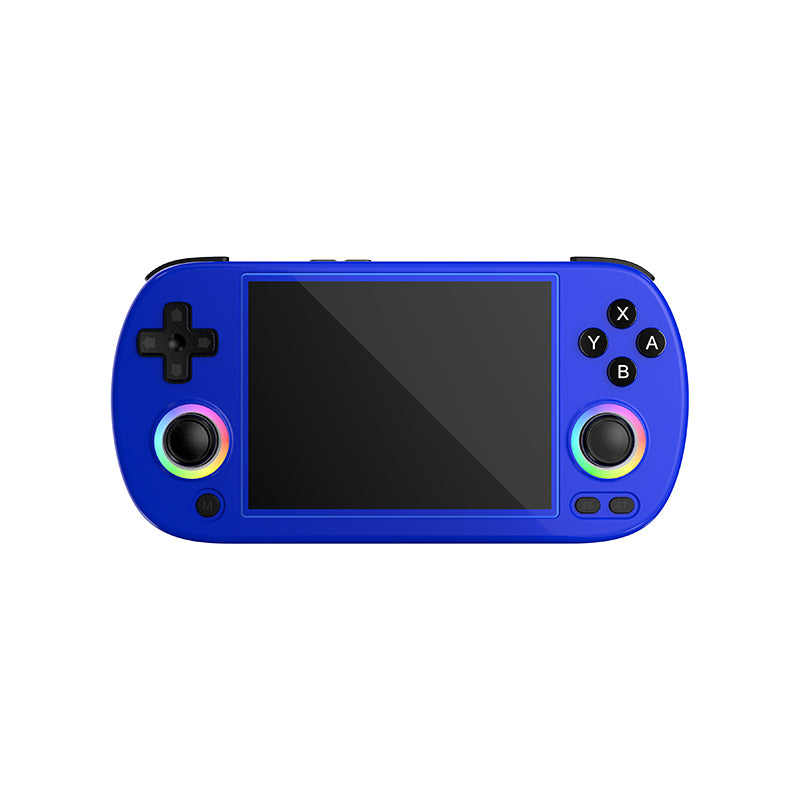
The Anbernic RG-40XXH is the four-inch, dual-stick member of Anbernic’s H700 family, and by the company’s own admission the last handheld built on that Allwinner chip. It slots directly above the pocket-sized RG35XX H and well below Anbernic’s Android and RK3566 machines. The pitch is deliberately plain: a native 4:3 640×480 panel, two analog sticks, and enough grunt for everything up to the fifth console generation, sold for around 70 dollars. Nothing here is exotic. What you are buying is a mature, thoroughly understood platform with a large emulation-firmware community already behind it.
Emulation performance, generation by generation
The heart is an Allwinner H700, a quad-core ARM Cortex-A53 clocked at 1.5 GHz, paired with a Mali G31 MP2 GPU and 1 GB of LPDDR4. That is a low-power ARM SoC, not a PC, and it sets a hard ceiling that no amount of firmware tuning removes. Everything from the 8- and 16-bit eras runs flawlessly: NES, SNES, Genesis, Game Boy through GBA, PC Engine and Neo Geo all hit full speed with headroom for shaders. PlayStation 1 is effectively a solved problem through DuckStation or PCSX ReARMed. Nintendo 64 is where honesty starts to matter: with mupen64plus many first-party titles are playable, but the harder engines such as the Rare catalogue, GoldenEye and Conker still stutter and demand per-game tweaks. Nintendo DS runs on DraStic near full speed, though the tall two-screen layout fights a 4:3 display. Dreamcast via Flycast handles 2D fighters and lighter 3D games while dropping frames in demanding scenes. PSP is the true edge case: simpler 2D and 3D titles are playable through PPSSPP at reduced resolution, but heavy games like God of War are out. Saturn is mostly a no. This is standard H700 territory, and the RG-40XXH neither exceeds nor falls short of it.
Screen, build and controls
The four-inch IPS panel is the strongest single reason to pick this device. At 640×480 it is a genuine 4:3 shape, so SNES, Genesis and PS1 games fill the glass with no pillarboxing, and the OCA full lamination bonds the image tight to the surface. Text is crisp and colour is even across the panel. The body is plastic, 163 by 79 by 16 mm, and roughly 208 grams, so it is comfortably pocketable while noticeably larger than the 35XX. Controls are a decent, mixed bag: two analog sticks ringed with RGB lighting, a solid d-pad, clicky face buttons and four shoulders. Be clear-eyed about two things: the sticks are conventional potentiometer units, not Hall-effect, so drift is possible over years of heavy use, and the L2/R2 triggers are digital rather than analog. There is a rumble motor, dual microSD slots, USB-C, a headphone jack and HDMI output for TV play.
Software and setup
Out of the box it boots Anbernic’s own Linux build from a bundled card, which works but is not why enthusiasts buy these. The real appeal is the custom-firmware scene. Because the H700 is so widely adopted, the RG-40XXH is supported by muOS, Knulli, ROCKNIX and Batocera, each giving you cleaner front-ends, better scraping, RetroAchievements and consistent per-core settings. muOS is the popular default on this hardware, with Knulli as the Batocera-derived alternative. Setup follows the usual routine: flash firmware to a second microSD, add your own legally dumped ROMs and BIOS files, then boot from the second slot. WiFi 802.11ac and Bluetooth 4.2 cover wireless pads and network features, though Bluetooth 4.2 is dated by 2026. EmuDeck, worth noting, is not relevant here; that is a Steam Deck and Windows PC tool, not something you run on an ARM Anbernic.
Price, value and who it is for
At roughly 70 dollars the RG-40XXH is priced as a commodity, and its value rests almost entirely on that laminated 4:3 screen and the pair of sticks. If you want the largest comfortable H700 display for 2D and PS1 libraries, with the occasional dip into N64 or DS, it is an easy recommendation. If you need reliable Dreamcast, PSP or anything sixth-generation, this chip simply cannot deliver, and your money is better spent on an RK3566 or Snapdragon handheld. This is a device for the player who prizes a great retro-shaped panel and mature, well-supported firmware over raw horsepower, and who does not mind flashing a card to get there. As the self-declared final H700, it reads as a polished end-of-line product rather than any kind of leap forward.
📐 Size & Pocketability
⚖️ Weight vs Other Handhelds
🔋 Real-World Battery Estimator
⭐ Emulation Performance
📊 View How This Score is Calculated
The Hardware Power Score is an absolute metric. Perfect emulation of difficult, modern consoles awards significantly more points than standard retro consoles.
- 15× Multiplier: Modern PC
- 12× Multiplier: Switch, PS3, Xbox 360
- 10× Multiplier: Wii U
- 8× Multiplier: PS2, GameCube, Wii, Xbox
- 5× Multiplier: Saturn, Dreamcast, PSP
- 3× Multiplier: N64, PS1
- 1× Multiplier: SNES, GBA
Generation 6
Generation 5
Handhelds & Retro
⚡ Performance Benchmarks
Where Anbernic RG-40XXH ARM Mali-G31 MP2 lands against the handhelds everyone knows. Every bar shares one scale, so longer genuinely means faster — add up to two rivals to compare.
CPU = Geekbench 6 multi-core · GPU = 3DMark Wild Life. Median real-world scores; every bar shares one scale — add up to two rivals to compare.
📋 Full Specifications
📺 Display
⚙️ Platform
💾 Memory
🕹️ Controls
📏 Body
🔋 Battery
⚖️ Verdict
✅ The Good
- Native 4:3 640×480 IPS panel with OCA full lamination, one of the best displays at its price
- Dual analog sticks plus a full four-shoulder layout on a genuinely pocketable body
- Very broad custom-firmware support: muOS, Knulli, ROCKNIX and Batocera all run on the H700
- Around 70 dollars with dual microSD slots, HDMI out, WiFi 5 and roughly six hours of battery
❌ The Bad
- H700 hits a hard ceiling: Dreamcast, PSP and Saturn are unreliable and N64 is hit-or-miss
- Potentiometer sticks rather than Hall-effect, so long-term drift is a real possibility
- Digital L2/R2 triggers and dated Bluetooth 4.2, with no meaningful power gain over older H700 models
📰 Latest News & Guides
The Ultimate Guide to ARMSX3: Android’s New PS3 Emulator, Competitor Comparisons, and Setup Tutorial
18/08/2026Pokémon Gold, Silver, and Crystal (Gen 2) Recomp Lands on Android
17/08/2026How to Play the Pokémon Red, Blue, or Yellow Recomp on Your Android, Windows, and Linux Devices
16/08/2026🔍 Similar Handhelds
Other handhelds that emulate up to Dreamcast.