
🛒 Where to Buy
⚠️ Golden Rule of Retro Handhelds: Throw away the cheap MicroSD card that comes in the box — it will fail. And never use a high-wattage PD “Fast Charger” on these devices; it can damage the battery. Use a standard 5V/1.5A brick.
Device Overview: Retroid Pocket G2
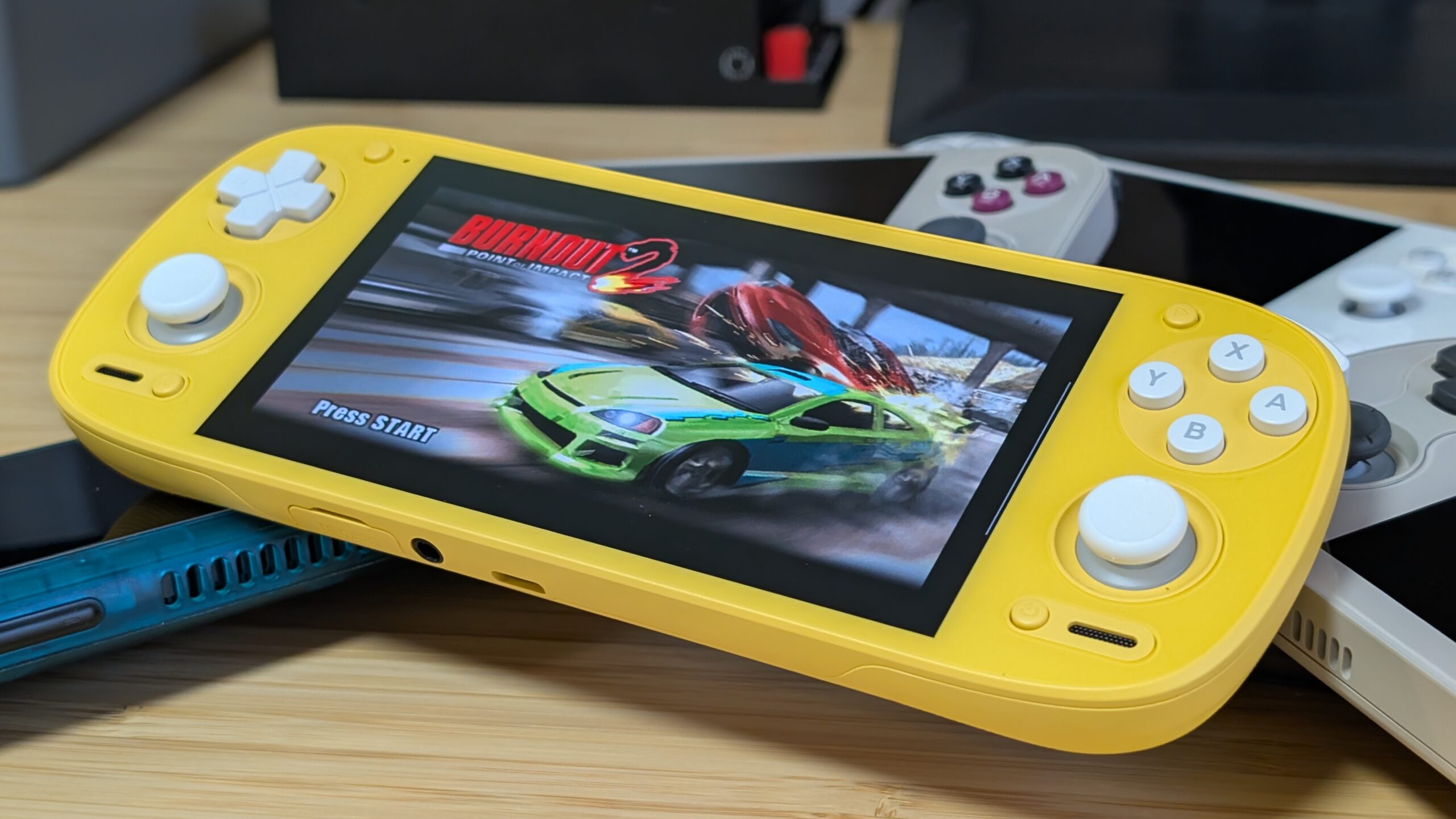
The Retroid Pocket G2 is a horizontal Android emulation handheld that Retroid slotted in just above the Pocket 5, reusing the exact 5.5-inch shell but swapping the older Snapdragon 865 for Qualcomm’s newer Snapdragon G2 Gen 2. It arrived in late 2025 at $219, with a two-week $199 launch window. If you have ever held a Pocket 5, the G2 feels identical in the hand; the meaningful changes are almost entirely in the silicon and the tuning around it. Storage is 128GB of UFS 3.1 with a microSD slot for ROM libraries, power comes from a 5000mAh battery over 27W wired charging, and a small internal fan keeps the chip from throttling.
Emulation performance, generation by generation
The G2’s chip is an octa-core Kryo layout (1x Gold+ at 2.8GHz, 4x Gold at 2.57GHz, 3x Silver at 1.9GHz) paired with an Adreno A22 GPU and 8GB of LPDDR5X. Read that as an upper-mid Android gaming SoC, not a PC. Everything through the sixth console generation is trivial: PS1 in DuckStation, N64 in Mupen64Plus-FZ, Dreamcast in Flycast, PSP in PPSSPP, plus Saturn and DS all run at full speed with headroom to spare for upscaling and shaders. PS2 through NetherSX2 is the sweet spot here, with most of the library holding 60fps at 2-3x internal resolution; only genuinely brutal titles like Gran Turismo 4 need compromises. GameCube and Wii in Dolphin are largely playable, frequently at native 1080p, though heavier Wii games and the most demanding GameCube titles still stutter. Switch emulation via Eden (a Yuzu-derived fork) and its cousins works across a real slice of the catalog but stays inconsistent and fiddly, so treat it as a bonus rather than a promise. PS3 and Wii U are not realistic targets on ARM Android hardware, and you should distrust anyone who implies otherwise. Native Android games run without drama, and Winlator can coax lighter x86 Windows titles into life through the GameHub launcher, but this is emphatically not a Windows gaming machine and heavier PC ports will disappoint. Expect roughly three to five hours of demanding PS2 or GameCube play from the battery, and considerably longer on 8-bit and 16-bit systems.
Screen, build and controls
The 5.5-inch 1080p AMOLED (roughly 400 PPI, 60Hz) is the headline part: deep blacks, punchy color, and enough brightness for indoor play, which flatters both pixel art and 3D depth. It is a 60Hz panel, so if you specifically want 120Hz you are looking at the pricier Pocket 6 instead. The shell is plastic, measures 199 x 78.5 x 15.6 mm, weighs about 280 grams, and hides a small active fan for sustained loads. Controls are where Retroid tends to deliver: dual symmetrical Hall-effect sticks with RGB rings, analog L2/R2 triggers, stacked shoulder buttons, and a clicky, Vita-style d-pad. The honest gripe from hands-on use is ergonomics. The low, symmetrical stick placement makes some people claw their thumbs inward, and the grip bumps are shallow enough that a three-finger hold feels more secure. The face buttons and shoulders are also loud and clacky, which you will either enjoy or find grating.
Software and setup
This is an Android 15 device, and that framing matters more than any spec. You do not flash muOS, Knulli, ArkOS, ROCKNIX or Batocera onto the G2. Those Linux firmwares belong to cheaper Rockchip and Allwinner handhelds, and applying that mental model here is a common beginner mistake. Instead you live in Android: install RetroArch alongside standalone emulators (DuckStation, Dolphin, PPSSPP, NetherSX2, Eden), then dress the whole thing up with a front-end. Retroid’s own GameHub launcher is decent, and community favorites Daijisho and ES-DE give you a console-like grid over your ROM folders. EmuDeck’s Android port can automate most of the emulator install and configuration if you would rather not do it by hand. Play Store access, Wi-Fi 6, Bluetooth 5.4 controllers, 1080p USB-C DisplayPort output to a TV, and optional mobile-data support all come with the Android bargain. Retroid ships incremental OTA updates and the device inherits the Pocket 5’s fairly active support.
Price, value and who it is for
At $219 the G2 lands in an awkward, interesting spot inside Retroid’s own catalog. It clearly outperforms the Pocket 5 it replaces, yet the Pocket 6 above it brings more GPU muscle and a 120Hz screen, and several reviewers have called the G2 a stopgap between the two. Buy it if you want a 1080p AMOLED horizontal handheld that eats everything up to and comfortably including PS2, plays most GameCube and Wii, and dabbles in Switch, without paying flagship money. Skip it if you were counting on reliable Switch or PS3 performance, if 60Hz bothers you, or if the clawed stick position is a dealbreaker, in which case the Pocket 6 or a vertical Pocket Classic may suit you better. Understood for what it actually is, it remains one of the more sensible mid-tier Android picks of 2026.
📐 Size & Pocketability
⚖️ Weight vs Other Handhelds
🔋 Real-World Battery Estimator
⭐ Emulation Performance
📊 View How This Score is Calculated
The Hardware Power Score is an absolute metric. Perfect emulation of difficult, modern consoles awards significantly more points than standard retro consoles.
- 15× Multiplier: Modern PC
- 12× Multiplier: Switch, PS3, Xbox 360
- 10× Multiplier: Wii U
- 8× Multiplier: PS2, GameCube, Wii, Xbox
- 5× Multiplier: Saturn, Dreamcast, PSP
- 3× Multiplier: N64, PS1
- 1× Multiplier: SNES, GBA
Gen 8 & PC
Generation 7
Generation 6
Generation 5
Handhelds & Retro
📋 Full Specifications
📺 Display
⚙️ Platform
💾 Memory
🕹️ Controls
📏 Body
🔋 Battery
⚖️ Verdict
✅ The Good
- Snapdragon G2 Gen 2 with 8GB LPDDR5X handles PS2 and much of GameCube at 1080p, a real step up from the Pocket 5's Snapdragon 865
- Excellent 5.5-inch 1080p AMOLED with deep blacks, strong color and good indoor brightness
- Hall-effect analog sticks plus analog L2/R2 triggers and a crisp, clicky Vita-style d-pad
- Full Android 15 with Play Store, Wi-Fi 6, Bluetooth 5.4 and 1080p USB-C DisplayPort output
❌ The Bad
- Low, symmetrical stick placement and shallow grip bumps cause a crab-claw hold for some hands
- 60Hz panel and a price close to the more capable Pocket 6 make it feel like a stopgap
- Switch emulation is hit-or-miss and PS3/Wii U are off the table; this is an ARM Android device, not a PC
📰 Latest News & Guides
The Ultimate Guide to ARMSX3: Android’s New PS3 Emulator, Competitor Comparisons, and Setup Tutorial
18/08/2026Pokémon Gold, Silver, and Crystal (Gen 2) Recomp Lands on Android
17/08/2026How to Play the Pokémon Red, Blue, or Yellow Recomp on Your Android, Windows, and Linux Devices
16/08/2026🔍 Similar Handhelds
Other handhelds that emulate up to CURRENTGEN.