
🛒 Where to Buy
⚠️ Golden Rule of Retro Handhelds: Throw away the cheap MicroSD card that comes in the box — it will fail. And never use a high-wattage PD “Fast Charger” on these devices; it can damage the battery. Use a standard 5V/1.5A brick.
Device Overview: Lenovo Legion Go Gen 2
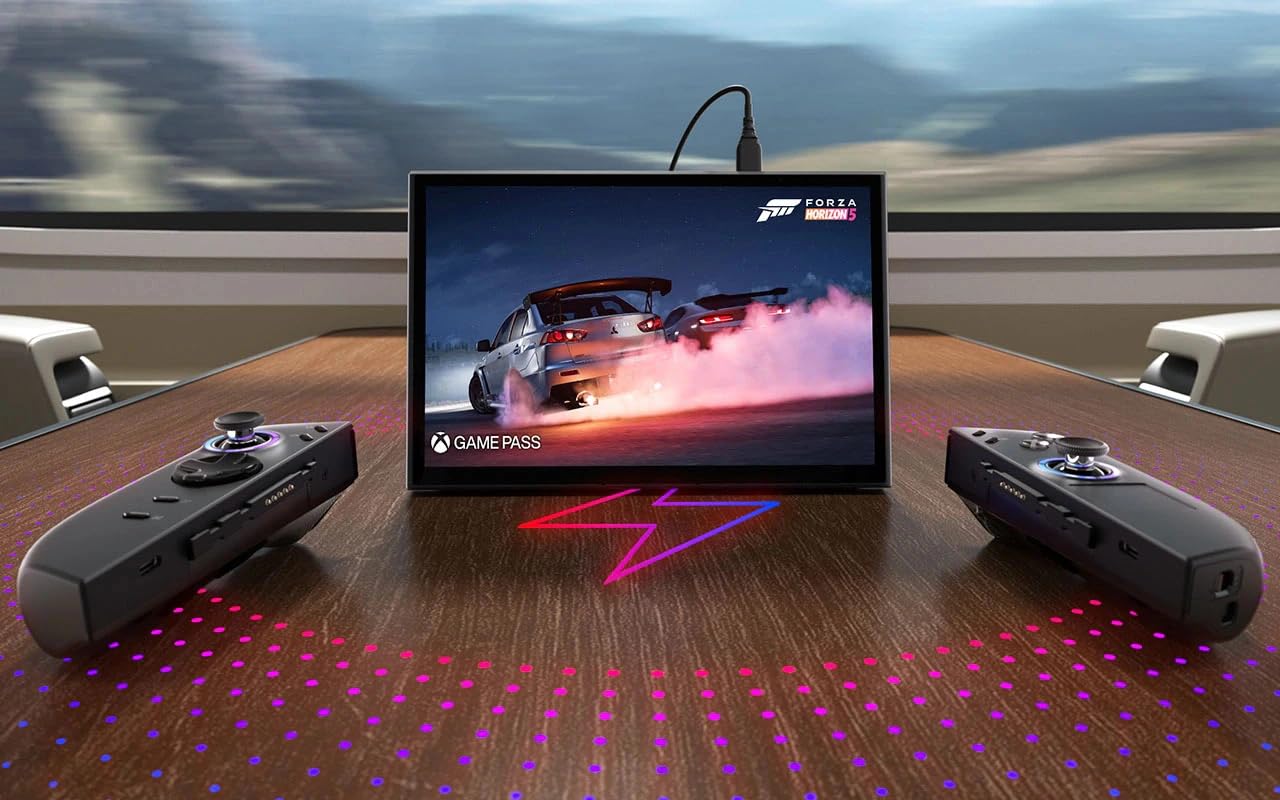
The Lenovo Legion Go Gen 2 is a full x86 Windows 11 handheld built around AMD’s Ryzen Z2 Extreme, and it is priced and sized like a statement piece rather than a pick-up-and-play toy. Revealed at IFA in September 2025 and shipping from December 2025, it is not really an “emulation handheld” in the ARM sense at all: it is a pocketable gaming PC that plays the current Steam library natively and treats retro emulation as a side benefit. The headline features are the 8.8-inch OLED and the return of the detachable TrueStrike controllers from the original Legion Go, now riding on Hall-effect sticks. It is heavy at roughly 920g with the pads attached, it is thick, and it is expensive, and Lenovo makes no apology for any of it.
Emulation performance, generation by generation
Because this runs desktop Windows on a Zen 5 CPU (8 cores, three of them boosting to 5.0 GHz) and a Radeon 890M (RDNA 3.5, 16 compute units at around 2,900 MHz), you are not limited to lightweight ARM builds. You install the same PCSX2, Dolphin, PPSSPP, melonDS, Azahar, RPCS3, Cemu, Vita3K and Xenia releases you would run on a desktop. Everything through PS2, GameCube, Wii, PSP, DS and 3DS runs at full speed with headroom for internal-resolution upscaling. Wii U on Cemu and PS Vita on Vita3K are comfortable. The genuinely demanding tiers, PS3 on RPCS3, Xbox 360 on Xenia Canary, and Switch on the Ryujinx forks that outlived yuzu’s shutdown, are where the Z2 Extreme earns its keep: most first-party titles are playable, but the heaviest games still stutter and lean hard on per-game tuning. The 32GB of LPDDR5X-8000 on the top configuration also helps the memory-hungry emulators, RPCS3 and the Switch forks especially, and the adjustable TDP lets you cap the chip lower for cooler, quieter retro sessions where you do not need all 35W. That ceiling scales down on the cheaper base unit, which ships the plain Ryzen Z2 and 16GB rather than the Extreme.
Screen, build and controls
The 8.8-inch, 1920×1200 OLED is the best panel Lenovo has put in a handheld: 144Hz with variable refresh from 30Hz, roughly 500 nits in SDR and over 1,100 nits peak in HDR, 97% DCI-P3 and DisplayHDR True Black 1000 certification. It does use PWM dimming near 720Hz, which flicker-sensitive users should note. The detachable controllers are the party trick, sliding off so the tablet can stand on its built-in kickstand, or dropping the right pad into a base to use its stick as a vertical FPS mouse. Sticks are now Hall-effect to resist drift, the d-pad pivots, there are extra mappable buttons and a fingerprint reader, and haptics have improved. The 74Wh battery charges at 65W and lasts about two hours fifteen in Cyberpunk at the full 35W power mode, stretching much further on light emulation; Legion Coldfront cooling moves roughly 45% more air than before but runs audibly under load. Connectivity is dual USB4 at 40Gbps with DisplayPort, Wi-Fi 6E and Bluetooth 5.3, a 3.5mm jack and microSD, though notably no Wi-Fi 7 and no SD Express.
Software and setup
Out of the box it is Windows 11 Home with Lenovo’s Legion Space launcher layered on top to corral games and quick settings. That is the honest weak spot of every Windows handheld: the desktop UI was never designed for a controller, and Legion Space smooths but does not eliminate the friction. For emulation the clean path is EmuDeck for Windows, which installs and configures the emulators above and wires them into a couch-friendly front end such as Steam Big Picture or Playnite. Enthusiasts who want a true console feel can wipe Windows and install Bazzite, the SteamOS-style Linux distro that runs superbly on this hardware and drops the desktop entirely; Batocera is another option for a pure emulation box. The ARM-handheld firmwares, muOS, Knulli, ROCKNIX and ArkOS, simply do not apply here, because this is an x86 PC.
Price, value and who it is for
This is one of the most expensive handhelds on the market. The base configuration (plain Ryzen Z2, 16GB, 1TB) launched around $1,099, the Z2 Extreme with 32GB and a 1TB M.2 2280 SSD lands near $1,349, and 2TB or European pricing pushes it higher still, well above the Xbox Ally X it competes with. You are paying for the OLED, the modular controllers and the top APU, and launch demand was strong enough that resellers charged over MSRP. It is overkill for anyone who mainly wants a retro machine: a cheap ARM handheld or a Steam Deck covers that for a fraction of the price and weight. The Legion Go Gen 2 makes sense for the buyer who wants a no-compromise portable Windows gaming PC that happens to emulate everything up to the seventh console generation, and who will actually use the detachable controllers rather than pay for a feature they leave clipped on. If that describes you, nothing else on the market matches the panel and the modular design at once; if it does not, the price is very hard to justify.
📐 Size & Pocketability
⚖️ Weight vs Other Handhelds
🔋 Real-World Battery Estimator
⭐ Emulation Performance
📊 View How This Score is Calculated
The Hardware Power Score is an absolute metric. Perfect emulation of difficult, modern consoles awards significantly more points than standard retro consoles.
- 15× Multiplier: Modern PC
- 12× Multiplier: Switch, PS3, Xbox 360
- 10× Multiplier: Wii U
- 8× Multiplier: PS2, GameCube, Wii, Xbox
- 5× Multiplier: Saturn, Dreamcast, PSP
- 3× Multiplier: N64, PS1
- 1× Multiplier: SNES, GBA
Gen 8 & PC
Generation 7
Generation 6
Generation 5
Handhelds & Retro
📋 Full Specifications
📺 Display
⚙️ Platform
💾 Memory
🕹️ Controls
📏 Body
🔋 Battery
⚖️ Verdict
✅ The Good
- Class-leading 8.8-inch 1920×1200 OLED at 144Hz with VRR, ~1,100-nit HDR peak and DisplayHDR True Black 1000
- Full Windows 11 on a Zen 5 Ryzen Z2 Extreme with Radeon 890M runs native PC games and desktop-class emulators (RPCS3, Cemu, PCSX2, Xenia) that ARM handhelds cannot touch
- Detachable Hall-effect TrueStrike controllers with FPS mouse mode, kickstand and extra mappable buttons add real versatility
- Dual USB4 (40Gbps, DisplayPort), user-replaceable M.2 2280 SSD, 74Wh battery and Wi-Fi 6E
❌ The Bad
- Very expensive: about $1,099 base and ~$1,349 for the Z2 Extreme/32GB config, pricier than the Xbox Ally X
- Heavy (~920g) and thick, and battery life still falls to roughly two hours in demanding native games at full power
- Windows-on-a-handheld experience stays clunky despite Legion Space, and it omits Wi-Fi 7 and SD Express
📰 Latest News & Guides
The Ultimate Guide to ARMSX3: Android’s New PS3 Emulator, Competitor Comparisons, and Setup Tutorial
18/08/2026Pokémon Gold, Silver, and Crystal (Gen 2) Recomp Lands on Android
17/08/2026How to Play the Pokémon Red, Blue, or Yellow Recomp on Your Android, Windows, and Linux Devices
16/08/2026🔍 Similar Handhelds
Other handhelds that emulate up to CURRENTGEN.