
🛒 Where to Buy
⚠️ Golden Rule of Retro Handhelds: Throw away the cheap MicroSD card that comes in the box — it will fail. And never use a high-wattage PD “Fast Charger” on these devices; it can damage the battery. Use a standard 5V/1.5A brick.
Device Overview: AYANEO Pocket DS
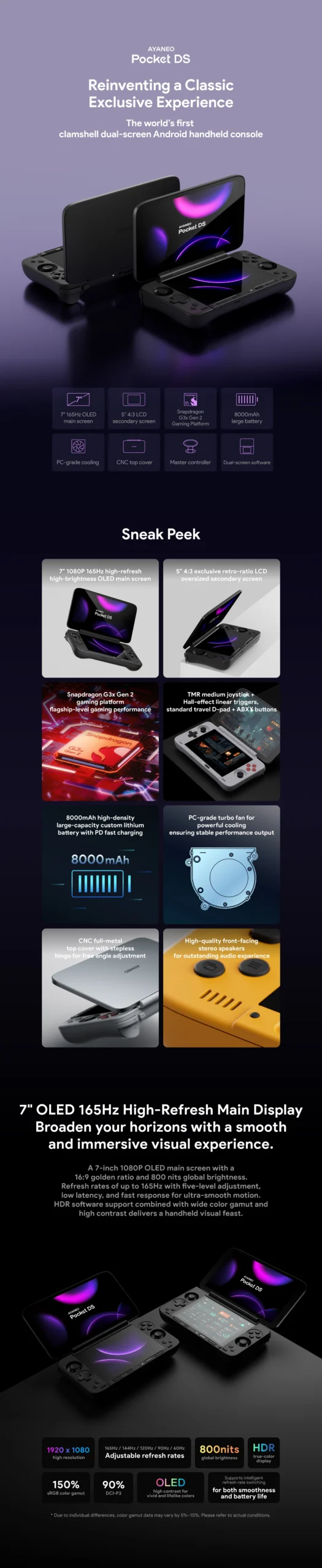
The AYANEO Pocket DS is a flip-style, dual-screen Android handheld built around one specific idea: emulate the Nintendo DS and 3DS the way they were meant to be played, on two real screens instead of a squashed single-panel compromise. It is not a general-purpose PC handheld and it is not a budget retro toy. It runs the Qualcomm Snapdragon G3x Gen 2, an 8-core Kryo chip on a 4nm process paired with an Adreno A32 GPU, in a clamshell body that weighs a hefty 540g. Launched in October 2025 with an Indiegogo entry price of $399 (retail around $519), it sits at the premium end of the Android emulation market, and its whole reason to exist is that second screen.
Emulation performance, generation by generation
The G3x Gen 2 is one of the stronger mobile chips you can put in a handheld, roughly Snapdragon 8 Gen 2 class, so the low-to-mid retro spectrum is trivial. Everything through PS1, N64, Dreamcast, PSP and Saturn runs at full speed with headroom to spare, typically via RetroArch cores, DuckStation, PPSSPP and Flycast. The interesting tier is the sixth and seventh generation. PS2 (AetherSX2/NetherSX2) and GameCube plus Wii (Dolphin) run well and can even be pushed above native resolution, though a handful of demanding titles need per-game tuning. The DS itself is the headline act: DraStic and melonDS map the two logical screens onto the two physical panels, which is the trick no single-screen handheld can pull off. 3DS emulation through Citra forks (Azahar/Lime3DS) also benefits from the dual-display layout, mapping the 3DS top and bottom screens natively. Switch is the honest ceiling here. Eden, Citron and other Yuzu descendants will boot and run many games, but the G3x Gen 2 shows graphical glitches on stock GPU drivers; switching to third-party Turnip drivers fixes the visuals but drops performance enough that some titles become unplayable. Treat Switch as a bonus, not a promise. The 8000mAh battery gives this chip a real advantage over higher-clocked PC handhelds: light retro sessions stretch for hours, and even Dolphin and PS2 workloads land in a respectable range rather than draining flat in ninety minutes.
Screen, build and controls
The two displays are deliberately mismatched for their jobs. The main screen is a 7-inch 1920×1080 OLED running at 165Hz, which is overkill for retro content but genuinely nice for Android games and 60fps GameCube titles. The secondary is a 5-inch 1024×768 IPS panel in a 4:3 shape, chosen because a square-ish second screen suits DS and 3DS bottom-screen layouts far better than a widescreen strip would. It is the dimmer of the two at roughly 550 nits versus the OLED’s brighter output, but it is a touch panel, which matters for stylus-driven DS games. The body is aluminium and plastic in a laptop-style hinge, cooled by an active fan AYANEO calls a PC-grade system. Controls are proper full-size: Hall effect analog sticks in an asymmetric layout that resist drift, a d-pad, stacked L1/L2 and R1/R2 shoulders plus L3/R3, gyro for aiming, and stereo front speakers. Connectivity is current-generation, with WiFi 6, Bluetooth 5.3, a USB-C port that supports video output, a headphone jack and a microSD slot for expanding past the base 128GB of UFS 4.0. Higher configurations scale RAM up to 16GB and storage up to 1TB. At 540g with the clamshell mass, this is a two-hands-on-a-couch device, not something for your jacket pocket despite the “Pocket” name.
Software and setup
Out of the box it runs Android 13 with AYANEO’s AYAHome/AYASpace front-end layered on top for launching games and managing the dual screens. Being Android, you install your own emulators from the Play Store or APKs and point them at ROMs on the microSD card or the 128GB of UFS 4.0 internal storage. The dual-screen advantage is only as good as each emulator’s support for it, so part of the setup is configuring screen layouts app by app. For people who want to escape Android entirely, the device is listed with ROCKNIX custom-firmware support, giving a leaner Linux-based front-end focused purely on retro gaming, though the second screen’s usefulness under CFW depends on driver maturity. This is not a plug-and-play console; budget an afternoon to get emulators, drivers and per-system layouts dialled in.
Price, value and who it is for
At $399 to $519 the Pocket DS is expensive for an Android handheld, and if you never touch DS or 3DS games you are overpaying for a second screen you will not use. A single-screen device like an AYN Odin 2 gives you similar or better raw power for less. The Pocket DS earns its price for exactly one buyer: the person whose favourite library is the DS and 3DS catalogue and who has been squinting at those two screens crammed onto one panel for years. For that person, native two-screen play with Hall sticks, a bright OLED and enough grunt to also handle GameCube and PS2 is close to the ideal machine. For everyone else, it is a well-built but oversized luxury.
📐 Size & Pocketability
⚖️ Weight vs Other Handhelds
🔋 Real-World Battery Estimator
⭐ Emulation Performance
📊 View How This Score is Calculated
The Hardware Power Score is an absolute metric. Perfect emulation of difficult, modern consoles awards significantly more points than standard retro consoles.
- 15× Multiplier: Modern PC
- 12× Multiplier: Switch, PS3, Xbox 360
- 10× Multiplier: Wii U
- 8× Multiplier: PS2, GameCube, Wii, Xbox
- 5× Multiplier: Saturn, Dreamcast, PSP
- 3× Multiplier: N64, PS1
- 1× Multiplier: SNES, GBA
Gen 8 & PC
Generation 7
Generation 6
Generation 5
Handhelds & Retro
⚡ Performance Benchmarks
Where AYANEO Pocket DS Adreno A32 lands against the handhelds everyone knows. Every bar shares one scale, so longer genuinely means faster — add up to two rivals to compare.
CPU = Geekbench 6 multi-core · GPU = 3DMark Wild Life. Median real-world scores; every bar shares one scale — add up to two rivals to compare.
📋 Full Specifications
📺 Display
⚙️ Platform
💾 Memory
🕹️ Controls
📏 Body
🔋 Battery
⚖️ Verdict
✅ The Good
- Genuine dual physical screens make DS and 3DS emulation feel native instead of a cramped single-panel workaround
- Snapdragon G3x Gen 2 comfortably handles PS2, GameCube and Wii, often above original resolution
- Sharp 7-inch 1080p 165Hz OLED main screen plus a touch-capable 4:3 secondary panel
- Hall effect analog sticks and full-size stacked shoulder buttons with active fan cooling
❌ The Bad
- Heavy 540g clamshell that is not actually pocketable despite the name
- Switch emulation is unreliable, with driver trade-offs between broken visuals and unplayable performance
- Premium $399 to $519 price is hard to justify unless DS and 3DS are your main libraries
📰 Latest News & Guides
The Ultimate Guide to ARMSX3: Android’s New PS3 Emulator, Competitor Comparisons, and Setup Tutorial
18/08/2026Pokémon Gold, Silver, and Crystal (Gen 2) Recomp Lands on Android
17/08/2026How to Play the Pokémon Red, Blue, or Yellow Recomp on Your Android, Windows, and Linux Devices
16/08/2026🔍 Similar Handhelds
Other handhelds that emulate up to CURRENTGEN.