
🛒 Where to Buy
⚠️ Golden Rule of Retro Handhelds: Throw away the cheap MicroSD card that comes in the box — it will fail. And never use a high-wattage PD “Fast Charger” on these devices; it can damage the battery. Use a standard 5V/1.5A brick.
Device Overview: Zotac Zone
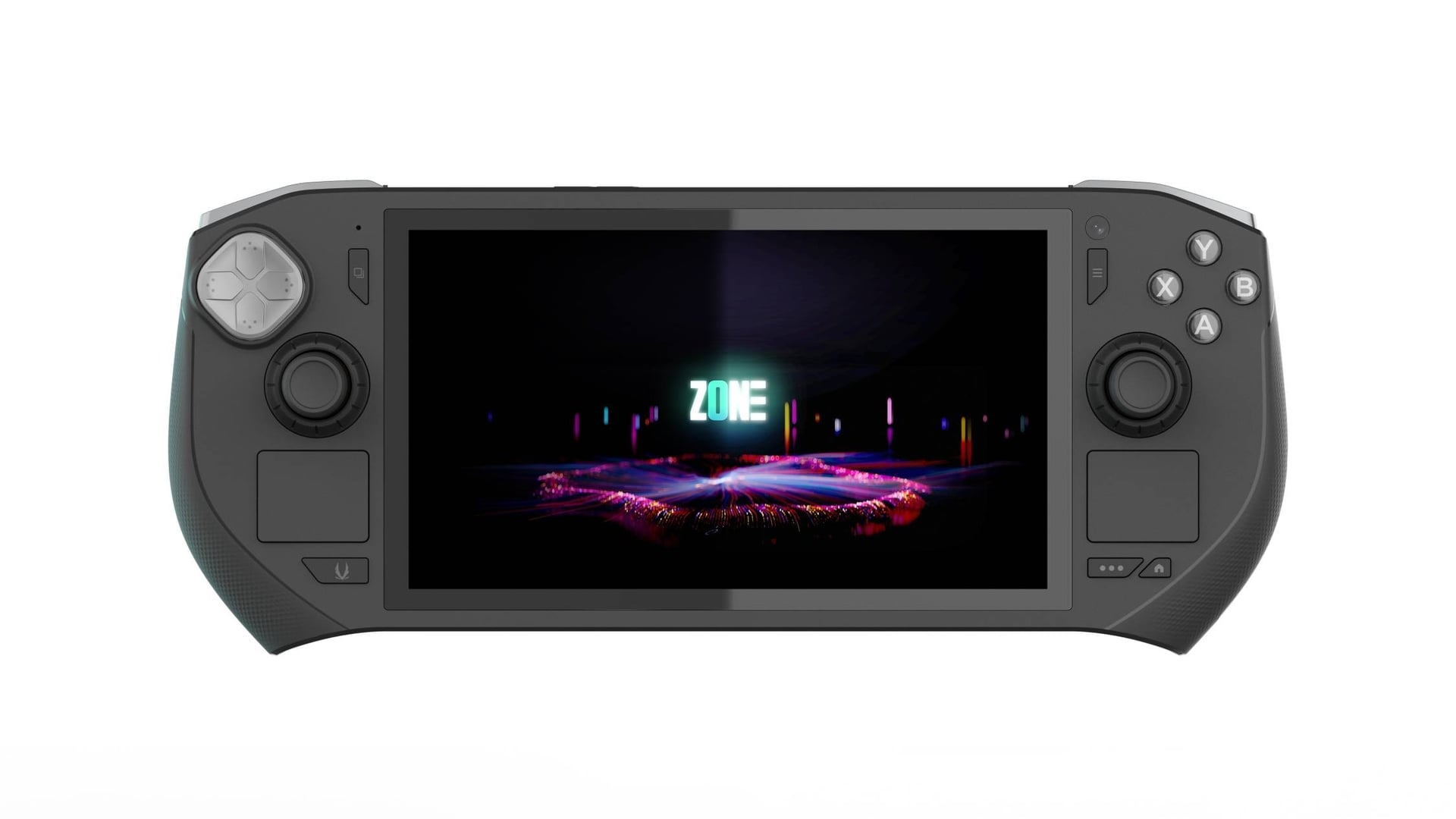
The Zotac Zone is the first handheld Zotac ever built, and the company clearly decided it wasn’t going to enter the category quietly. Announced at Gamescom 2024 and shipping in late 2024 at $799, the Zone leads with two things almost nobody else in its price bracket offered at launch: a 7-inch 1080p AMOLED panel running at 120Hz, and a wraparound control cluster with capacitive ratcheting dials and two trackpads. It is a Windows 11 machine built on AMD’s Ryzen 7 8840U (Hawk Point, eight Zen 4 cores, Radeon 780M with 12 RDNA 3 CUs), 16GB of LPDDR5X-7500, and a 512GB PCIe 4.0 SSD. In other words, the silicon is the same Hawk Point part you’ll find in dozens of 2024 handhelds; the differentiation is entirely in the screen and the controls.
That matters for positioning. Against the Steam Deck OLED, the Zone wins on raw resolution and clock headroom but loses on price, software polish, and battery endurance. Against the ROG Ally (Z1 Extreme) it trades blows on performance and clearly beats it on the panel. Against the Legion Go it’s smaller, lighter, and less sprawling. Note this is the original Zone, not the later Zone 2 / Zone Pro, which swap in the Ryzen AI 9 HX 370, 32GB of RAM, a 1TB SSD, and Manjaro Linux instead of Windows. Same chassis, very different brain. Everything below concerns the 8840U Windows model.
Emulation performance, generation by generation
The 780M inside the 8840U is a known quantity for emulation, and the Zone behaves exactly as that chip does elsewhere. PlayStation 2 (PCSX2), GameCube and Wii (Dolphin) run effortlessly at 2x-3x internal resolution with the AMOLED making the upscaled output genuinely sharp. PSP (PPSSPP) and everything below it are trivial. The realistic middle tier is Switch (Ryujinx, since yuzu’s demise) and Wii U (Cemu): plenty of first-party titles hit 30-60fps at native or near-native, but the heavier 3D games still demand per-title tuning, and you’ll be living in graphics-pack and resolution menus. PlayStation 3 (RPCS3) is the classic “depends entirely on the game” situation — 2D and lighter 3D titles are fine, the demanding ones are a slideshow. Xbox 360 (Xenia) remains rough and experimental on any handheld APU, and the Zone doesn’t change that. The 120Hz panel is a real bonus here: high-refresh emulators and frame-doubled content actually look like high refresh, which a 60Hz LCD competitor simply can’t show you.
Screen, build and controls
The AMOLED is the reason to buy this thing. It’s a 7-inch 1920×1080 120Hz panel that measured north of 800 nits in testing, with the perfect blacks and saturated color you expect from OLED. It’s the best screen in this class outside the Steam Deck OLED, and it’s higher resolution than that. The chassis is 692g — heavier than a Steam Deck, lighter than a Legion Go — with a high-quality, ergonomic build and Hall-effect sticks that should never develop drift. Now the headline gimmick: the capacitive ratcheting dials encircling each stick. They’re real, they’re tactile, and they work — but understand what they do. They’re for system functions: volume, brightness, RGB. They are not in-game mappable axes, so temper expectations. The genuinely clever bit is the two-stage triggers, with a physical switch under each that converts a full analog pull into a clicky mouse-button “hair trigger” — excellent for shooters. The dual trackpads handle desktop navigation and mouse-driven games, the right pad splitting into distinct left/right click zones. None of it feels tacked on; this is the most thought-through control layout of any first-gen handheld I can name.
Software and setup
Then you turn it on, and it’s Windows 11. The Zone ships with Zotac’s One Launcher overlay, which aggregates your storefronts, surfaces cover art, and exposes a quick-settings sidebar that, to its credit, mostly works without bugs. But it’s rudimentary next to what Ayaneo, Asus, or Valve offer, and underneath it you’re still managing Windows on a 7-inch screen: driver updates, the occasional desktop detour, tiny touch targets, sleep that doesn’t always behave. This is the Windows tax every Windows handheld pays, and the Zone pays it in full. If you’re comfortable installing your own tools (Playnite, third-party TDP utilities) you can build something nice. If you wanted console-grade pick-up-and-play, SteamOS this is not.
Price, value and who it’s for
At $799 the Zone is a hard sell on a spec sheet — it’s $250+ over a Steam Deck OLED while running the same Hawk Point silicon as cheaper Windows rivals. You are paying for the 1080p 120Hz OLED and the control hardware, full stop. If those two things are what you care about, and you’ll tolerate mediocre software and a 48.5Wh battery that runs short under load, it’s a defensible premium buy. It’s for the enthusiast who wants the sharpest, smoothest handheld panel available, Hall sticks, switchable triggers, and trackpads, and who already lives comfortably in Windows. For everyone else, the price and the software are the two walls you’ll keep hitting.
📐 Size & Pocketability
🔋 Real-World Battery Estimator
⭐ Emulation Performance
📊 View How This Score is Calculated
The Hardware Power Score is an absolute metric. Perfect emulation of difficult, modern consoles awards significantly more points than standard retro consoles.
- 15× Multiplier: Modern PC
- 12× Multiplier: Switch, PS3, Xbox 360
- 10× Multiplier: Wii U
- 8× Multiplier: PS2, GameCube, Wii, Xbox
- 5× Multiplier: Saturn, Dreamcast, PSP
- 3× Multiplier: N64, PS1
- 1× Multiplier: SNES, GBA
Gen 8 & PC
Generation 7
Generation 6
Generation 5
Handhelds & Retro
⚡ Performance Benchmarks
Where Zotac Zone Radeon 780M lands against the handhelds everyone knows. Every bar shares one scale, so longer genuinely means faster — add up to two rivals to compare.
CPU = Geekbench 6 multi-core · GPU = 3DMark Wild Life. Median real-world scores; every bar shares one scale — add up to two rivals to compare.
📋 Full Specifications
📺 Display
⚙️ Platform
💾 Memory
🕹️ Controls
📏 Body
🔋 Battery
⚖️ Verdict
✅ The Good
- Best-in-class 7-inch 1080p 120Hz AMOLED, over 800 nits with perfect OLED blacks
- Genuinely useful control hardware: Hall sticks, two-stage switchable triggers, and dual trackpads
- Capacitive ratcheting dials give fast on-the-fly volume, brightness and RGB control
- Solid 8840U/780M performance with 16GB LPDDR5X-7500, plus USB4 x2, Wi-Fi 6E and a microSD slot
❌ The Bad
- $799 is steep for Hawk Point silicon you can get cheaper in other Windows handhelds
- Zotac's One Launcher is rudimentary and you're still wrangling full Windows 11 on a tiny screen
- 48.5Wh battery runs short under gaming load, and 692g is no featherweight
📰 Latest News & Guides
The Ultimate Guide to ARMSX3: Android’s New PS3 Emulator, Competitor Comparisons, and Setup Tutorial
18/08/2026Pokémon Gold, Silver, and Crystal (Gen 2) Recomp Lands on Android
17/08/2026How to Play the Pokémon Red, Blue, or Yellow Recomp on Your Android, Windows, and Linux Devices
16/08/2026🔍 Similar Handhelds
Other handhelds that emulate up to CURRENTGEN.