
🛒 Where to Buy
⚠️ Golden Rule of Retro Handhelds: Throw away the cheap MicroSD card that comes in the box — it will fail. And never use a high-wattage PD “Fast Charger” on these devices; it can damage the battery. Use a standard 5V/1.5A brick.
Device Overview: Game Kiddy GKD Bubble
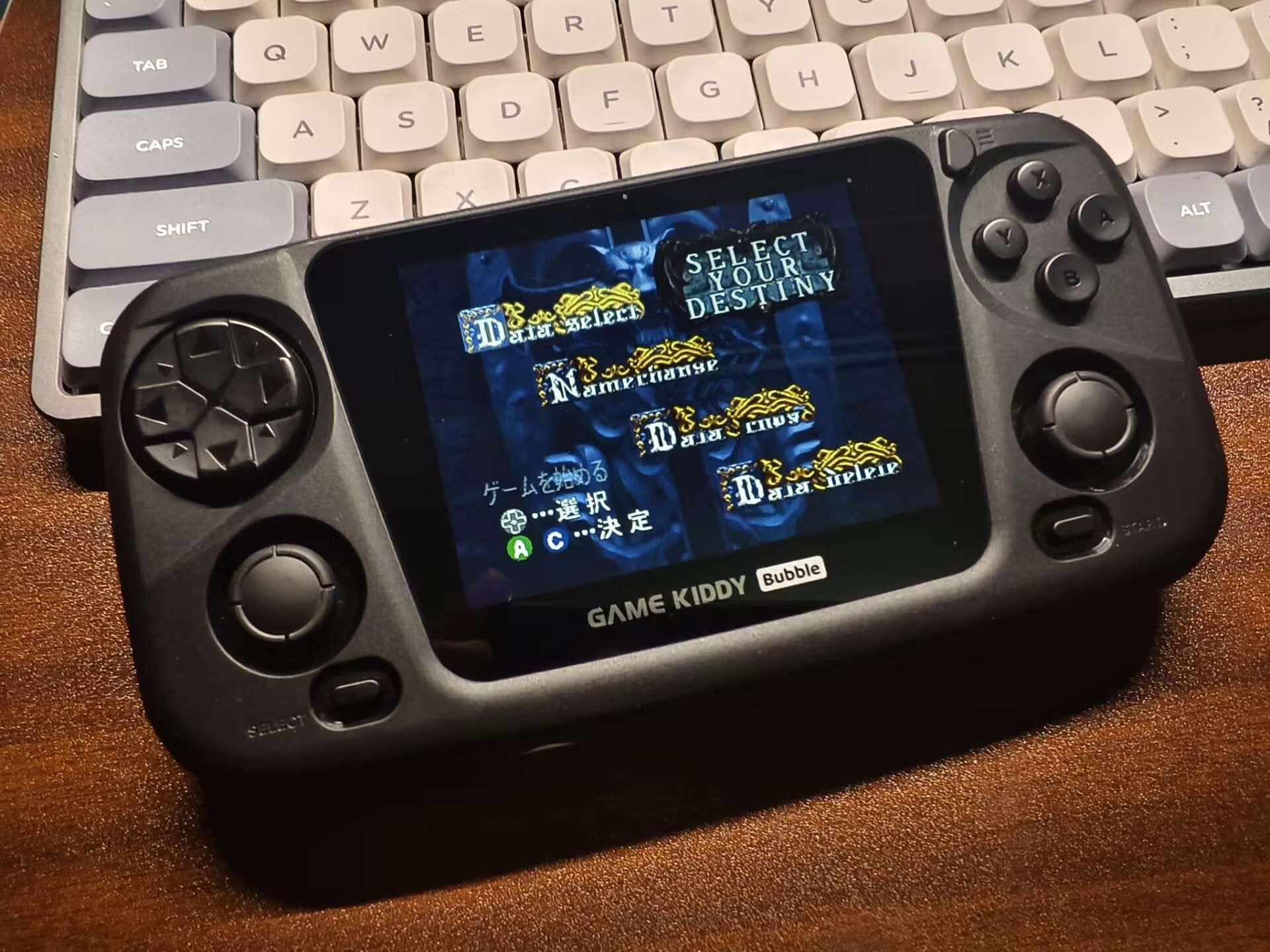
The Game Kiddy GKD Bubble is a Sega Game Gear cosplay in handheld form: a landscape RK3566 device that lifts the Game Gear’s black-and-red front, its circular d-pad placement, and the little power and charge LEDs sitting exactly where Sega’s logo used to be. It is noticeably smaller than the machine it references, measuring 165 x 83 x 25 mm and weighing 229 grams, and it runs the same Rockchip RK3566 that powers a dozen other budget handhelds. Nobody should mistake it for a performance leap. What you are buying is the styling plus a competent 8- and 16-bit machine, not a new tier of silicon.
Emulation performance, generation by generation
The RK3566 is four ARM Cortex-A55 cores at 1.8 GHz paired with a Mali-G52 MP2 GPU and, in the common configuration, 1GB of RAM. That combination is a thoroughly mapped quantity by now. Everything up to and including the fourth generation runs without drama: NES, Master System, Game Gear (naturally), Genesis, SNES, PC Engine and Game Boy through GBA all hit full speed with headroom to spare. PS1 is the comfortable ceiling, with most of the library holding full frame rate through a standalone core like DuckStation or PCSX ReARMed. Above that line, expect a lottery. N64 runs on Mupen with per-game tweaking and still stutters in the demanding titles; Dreamcast through Flycast handles 2D fighters and lighter 3D but chokes on the heavier games; PSP via PPSSPP manages simpler releases at reduced resolution but sheds frames the moment the action gets busy; Saturn is a maybe at best. Anyone shopping this device for N64 or PSP as a primary job should buy an RK3588 or Snapdragon handheld instead. The 1GB of RAM alone is a hard wall for the ambitious stuff.
Screen, build and controls
The panel is a 3.5-inch IPS running 640 x 480, a native 4:3 that fits everything from the fifth generation back with no letterbox math. Reviewers consistently mark it down for brightness: fine indoors, washed out in daylight, though colour and contrast hold up well. The chassis is plastic, light and pleasant at 229 grams, and the two-tone retro finish is frankly the whole reason to pick this over a plainer competitor. Controls are where it gets uneven. The circular Game Gear-style d-pad looks right but feels light and throws accidental diagonals, which stings on the exact 2D platformers and fighters this hardware is best at. Oddly for a Game Gear tribute, Game Kiddy fitted dual Switch-style analog sticks and four shoulder buttons, so PS1 and the occasional 3D game are at least physically covered. The sticks are not advertised as Hall effect, so budget for eventual drift. The shoulder buttons use a membrane with a louder clack than the face buttons. Two microSD slots, a 3.5mm headphone jack, Wi-Fi, Bluetooth and HDMI output round it out, and the 4000 mAh battery is good for roughly four to six hours depending on the system.
Software and setup
Out of the box it runs PlumOS, a stripped-down front end with a black background and a plain text system list, dressed up with a Game Gear-themed overlay when you launch Game Gear titles. That overlay is a nice touch and about as fancy as the stock experience gets. PlumOS is functional rather than polished, and the setup work is on you: load your ROMs onto the second card yourself. Because this is a standard RK3566 board, the wider custom-firmware ecosystem is the more interesting story. ROCKNIX, Knulli and Batocera all target RK3566 hardware, and any of them will hand you cleaner menus, proper scraping and far more per-emulator control than PlumOS offers. One honest caveat: I could not confirm an official, device-specific build tuned for the Bubble by name at the time of writing. RK3566 support is generalized, so you may be leaning on community images and some manual tinkering rather than a clean one-click flash. Treat custom firmware as likely but verify it for this exact unit before you buy on that basis. For the record, muOS and OnionOS are not options here; those target Allwinner chips, not this Rockchip.
Price, value and who it is for
Pricing swings hard by storefront. It runs roughly $70 on AliExpress and closer to $90 to $100 through Western resellers such as MechDIY. At the AliExpress end it is a fair ask for a styled RK3566; at $100 you are paying a nostalgia tax and could get more capable hardware for the money. Buy the Bubble if the Game Gear look is genuinely the point for you and your library lives in the 8-bit, 16-bit and PS1 range. Skip it if you want dependable N64, PSP or Dreamcast, if you need a competition-grade d-pad, or if Hall-effect sticks are a dealbreaker. It is a good-looking secondary handheld for retro purists, not a do-everything main driver, and it earns its place on charm and a sensible emulation target rather than on raw power.
📐 Size & Pocketability
⚖️ Weight vs Other Handhelds
🔋 Real-World Battery Estimator
⭐ Emulation Performance
📊 View How This Score is Calculated
The Hardware Power Score is an absolute metric. Perfect emulation of difficult, modern consoles awards significantly more points than standard retro consoles.
- 15× Multiplier: Modern PC
- 12× Multiplier: Switch, PS3, Xbox 360
- 10× Multiplier: Wii U
- 8× Multiplier: PS2, GameCube, Wii, Xbox
- 5× Multiplier: Saturn, Dreamcast, PSP
- 3× Multiplier: N64, PS1
- 1× Multiplier: SNES, GBA
Generation 6
Generation 5
Handhelds & Retro
⚡ Performance Benchmarks
Where Game Kiddy GKD Bubble ARM Mali-G52 MP2 (2EE) lands against the handhelds everyone knows. Every bar shares one scale, so longer genuinely means faster — add up to two rivals to compare.
CPU = Geekbench 6 multi-core · GPU = 3DMark Wild Life. Median real-world scores; every bar shares one scale — add up to two rivals to compare.
📋 Full Specifications
📺 Display
⚙️ Platform
💾 Memory
🕹️ Controls
📏 Body
🔋 Battery
⚖️ Verdict
✅ The Good
- Genuinely charming Game Gear tribute design with a light, comfortable 229 g plastic body
- Native 4:3 3.5-inch 640×480 IPS panel with good colour and contrast for 8/16-bit and PS1 libraries
- Flawless performance through PS1, plus dual analog sticks, four shoulder buttons and HDMI output for TV play
- Standard RK3566 board opens the door to ROCKNIX, Knulli and Batocera custom firmware
❌ The Bad
- Dim screen and a light circular d-pad that throws accidental diagonals on 2D games
- N64, PSP, Dreamcast and Saturn are inconsistent, and 1GB RAM caps ambitious emulation
- Non-Hall-effect sticks risk drift, and no confirmed device-specific CFW build means possible manual tinkering
📰 Latest News & Guides
The Ultimate Guide to ARMSX3: Android’s New PS3 Emulator, Competitor Comparisons, and Setup Tutorial
18/08/2026Pokémon Gold, Silver, and Crystal (Gen 2) Recomp Lands on Android
17/08/2026How to Play the Pokémon Red, Blue, or Yellow Recomp on Your Android, Windows, and Linux Devices
16/08/2026🔍 Similar Handhelds
Other handhelds that emulate up to PSP.