
🛒 Where to Buy
⚠️ Golden Rule of Retro Handhelds: Throw away the cheap MicroSD card that comes in the box — it will fail. And never use a high-wattage PD “Fast Charger” on these devices; it can damage the battery. Use a standard 5V/1.5A brick.
Device Overview: Sony PSP-1000
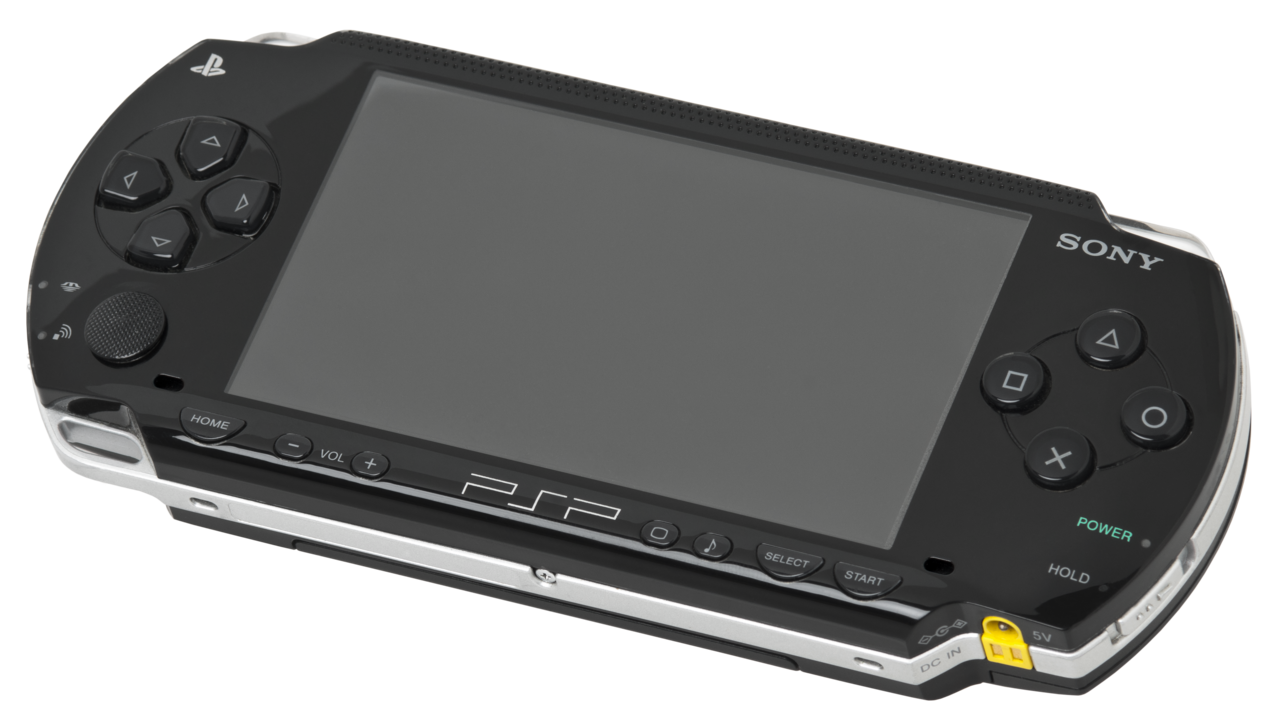
The PSP-1000 was Sony’s opening shot in a handheld war it had spent decades avoiding, launched in Japan on 12 December 2004 and in North America on 24 March 2005 at $249.99 as a Value Pack. Nintendo had owned portable gaming for fifteen years; the PSP-1000 answered with a 4.3-inch widescreen, a proprietary optical disc, and something close to PlayStation 2 visuals in your hands. Nothing else on a store shelf in 2005 looked or ran like it. Two decades on, the “Fat” model matters for a different reason: it is the most hackable PSP ever made, and that has kept it in circulation long after the UMD store went dark.
The hardware and its library
Inside sits a MIPS32 R4000-based CPU paired with a matching Media Engine, both scaling from 222 to 333 MHz. Sony firmware-locked launch units to 222 MHz to protect battery life and only unlocked the full 333 MHz in a later update; homebrew has run it flat-out for years. The 1000 carries 32 MB of system RAM plus 2 MB of dedicated video memory, half the RAM of every PSP that followed, which is the one spec that occasionally trips up newer homebrew. Games shipped on 1.8 GB UMDs, and a Memory Stick PRO Duo slot handled saves, music and downloads. Connectivity is 802.11b Wi-Fi with an IrDA infrared port, and this model has no video output.
The library is the reason to own one. This is where God of War: Chains of Olympus and Ghost of Sparta proved a handheld could stage a console-scale spectacle, where Monster Hunter Freedom Unite ate thousands of hours of commuter time, and where Metal Gear Solid: Peace Walker, Crisis Core: Final Fantasy VII, Persona 3 Portable, Grand Theft Auto: Liberty City Stories and the Wipeout Pure/Lumines/Patapon/LocoRoco run gave the platform its personality. It is a genuinely deep catalog that no modern re-release has ever fully reprinted.
Homebrew, custom firmware and emulation
The PSP-1000 is the modder’s chassis. Its earliest motherboards carry an unpatchable service-mode flaw, so a Pandora Battery and a Magic Memory Stick can install custom firmware or revive a bricked unit with no soldering and no external dongle, something no later revision matches. On current firmware you run 6.61 PRO-C or ME and make it permanent with Infinity 2.0 (on the 1000 that pairs with a cIPL flash). That unlocks ISO loading, plugins and region-free play.
As an emulator it is honest about its 2004 silicon. It runs NES, Game Boy/Color (RIN), Master System and Genesis (PicoDrive) at full speed, and handles SNES (Snes9x Euphoria/TYL) and Game Boy Advance (gpSP with its dynarec) at or near full speed with the odd frameskip. Neo Geo and PC Engine are comfortable. PlayStation 1 is the headline act: Sony’s own POPS emulator plays a large slice of the PS1 catalog cleanly, and this is arguably the best pocket way to play those games short of a Vita. Do not expect Nintendo 64, where DaedalusX64 exists but limps, and anything past the fifth generation is off the table.
Screen, build and revisions
The 4.3-inch TFT runs 480 by 272 at 24-bit color, sharp for its day but dimmer and more reflective than the panels Sony shipped later, and early units were notorious for stuck pixels and, on some Japanese launch consoles, a sticking square button. At 280 g with the 1800 mAh battery installed, the 1000 is the heaviest and chunkiest PSP, and the gloss-black shell scratches and smudges if you breathe on it. Controls are a d-pad, four face buttons, L and R shoulder triggers and a single sliding analog nub: no second stick, no clickable stick, no Hall-effect anything, which is simply what 2004 offered. The 1000 heads a family that got better in some ways and worse in others. The PSP-2000 halved the weight, doubled RAM to 64 MB and added video out; the 3000 brightened the screen but introduced visible scanline interlacing; the Go dropped the UMD drive entirely. None of them hack as cleanly as this one.
Collecting, price and who it is for
Loose PSP-1000s trade for roughly $40 to $80 depending on condition, with boxed Value Packs and special editions climbing higher. Buy with eyes open: check for dead pixels, test the analog nub, and confirm the battery still holds a charge, because the used market is full of tired units and swollen cells. If you want the lightest, brightest stock PSP, get a 2000 or 3000. But if your plan is custom firmware, emulation and a permanent, dongle-free modding platform, the 1000 is the model to hunt down; the open service-mode exploit and the removable battery make it the enthusiast’s pick. For a straight retro buyer who wants the PS1 and 8/16-bit libraries in a pocket with real buttons, it is still one of the best-value used handhelds going.
📐 Size & Pocketability
⚖️ Weight vs Other Handhelds
🔋 Real-World Battery Estimator
⭐ Emulation Performance
📊 View How This Score is Calculated
The Hardware Power Score is an absolute metric. Perfect emulation of difficult, modern consoles awards significantly more points than standard retro consoles.
- 15× Multiplier: Modern PC
- 12× Multiplier: Switch, PS3, Xbox 360
- 10× Multiplier: Wii U
- 8× Multiplier: PS2, GameCube, Wii, Xbox
- 5× Multiplier: Saturn, Dreamcast, PSP
- 3× Multiplier: N64, PS1
- 1× Multiplier: SNES, GBA
Gen 8 & PC
Generation 5
Handhelds & Retro
📋 Full Specifications
📺 Display
⚙️ Platform
💾 Memory
🕹️ Controls
📏 Body
🔋 Battery
⚖️ Verdict
✅ The Good
- Most hackable PSP ever made: an unpatchable service-mode exploit on early boards means solder-free, dongle-free custom firmware via a Pandora Battery and Magic Memory Stick.
- Deep first-party library (God of War, Monster Hunter, Peace Walker, Crisis Core) plus excellent PlayStation 1 emulation through Sony's own POPS.
- Removable 1800 mAh battery you can swap for a fresh cell, unlike sealed modern handhelds.
- Sharp 480×272 widescreen with real physical controls (d-pad, dual shoulder triggers, analog nub) for its era.
❌ The Bad
- Dimmer, more reflective screen than the PSP-2000/3000, and early units are prone to dead pixels and, on some Japanese launch consoles, a sticking square button.
- Heaviest PSP at 280 g, no video output, and only 32 MB of RAM (half of every later model).
- Single analog nub with no second stick and no Hall-effect components; Nintendo 64 and anything newer sit beyond its emulation ceiling.
📰 Latest News & Guides
The Ultimate Guide to ARMSX3: Android’s New PS3 Emulator, Competitor Comparisons, and Setup Tutorial
18/08/2026Pokémon Gold, Silver, and Crystal (Gen 2) Recomp Lands on Android
17/08/2026How to Play the Pokémon Red, Blue, or Yellow Recomp on Your Android, Windows, and Linux Devices
16/08/2026🔍 Similar Handhelds
Other handhelds that emulate up to PSP.