
🛒 Where to Buy
⚠️ Golden Rule of Retro Handhelds: Throw away the cheap MicroSD card that comes in the box — it will fail. And never use a high-wattage PD “Fast Charger” on these devices; it can damage the battery. Use a standard 5V/1.5A brick.
Device Overview: Nintendo DS
The Nintendo DS is the 2004 handheld that bet a console generation on two screens and a stylus, and won so decisively that it sold roughly 154 million units and became the best-selling Nintendo system ever made. It launched in North America on 21 November 2004 at $149.99, pitched by Nintendo as an experimental “third pillar” rather than a straight Game Boy Advance successor. That hedging aged badly, because the DS effectively buried the GBA within two years. Today it matters for two reasons: an enormous, frequently weird, genuinely inventive software library, and a flashcart hacking scene that was mature and cheap long before the 3DS or Vita were ever cracked.
The hardware and its library
Inside are two ARM cores: an ARM946E-S at 67 MHz for game logic and an ARM7TDMI at 33 MHz handling audio, Wi-Fi and GBA compatibility. Main memory is a mere 4 MB of PSRAM. Those are modest figures even for 2004, and the DS was never a horsepower story. What it had instead was a resistive touchscreen under the lower 256×192 TFT panel, a microphone, 802.11b Wi-Fi for local and later online play, and a Slot-2 cartridge port that ran Game Boy Advance games natively. A four-hour charge returned six to ten hours of play, and the Wi-Fi supported single-card Download Play and the online Nintendo Wi-Fi Connection, the latter shut down in 2014. The library is where the machine earns its reputation. Nintendogs and Brain Age pulled in people who had never owned a console, while Mario Kart DS, New Super Mario Bros. and the Pokemon entries from Diamond/Pearl through Black/White each sold in the tens of millions. The interesting material sits underneath: The World Ends With You, Elite Beat Agents, Castlevania: Dawn of Sorrow, the Ace Attorney and Professor Layton series, Chrono Trigger’s definitive port, and Dragon Quest IX. The dual-display gimmick produced genuinely novel design, not just menus dumped onto a second panel.
Homebrew, custom firmware and emulation
The DS has no “custom firmware” in the 3DS or Vita sense. Its scene is flashcart-driven: you buy a Slot-1 card such as an R4, Acekard or EZ-Flash, load a microSD, and boot ROMs and homebrew directly. The essential modern tool is TWiLight Menu++, which replaces the launcher and adds compatibility layers. Emulation on the base DS is honestly capped by that 67 MHz core and 4 MB of RAM. NES, Game Boy/Color, Sega Master System and Game Gear run well; Genesis/Mega Drive is passable; SNES is out of reach on a standard card. The exception was the SuperCard DSTWO, a flashcart with its own onboard CPU that offloaded SNES and GBA emulation to silicon on the cart itself. Note that GBA on the original DS and DS Lite is not emulation at all: Slot-2 devices like the EZ-Flash 3-in-1 run the real Game Boy Advance hardware built into the console. The DSi and DSi XL, which dropped that slot, later gained their own hacks (HiyaCFW, unlaunch) but lost native GBA in the process.
Screen, build and revisions
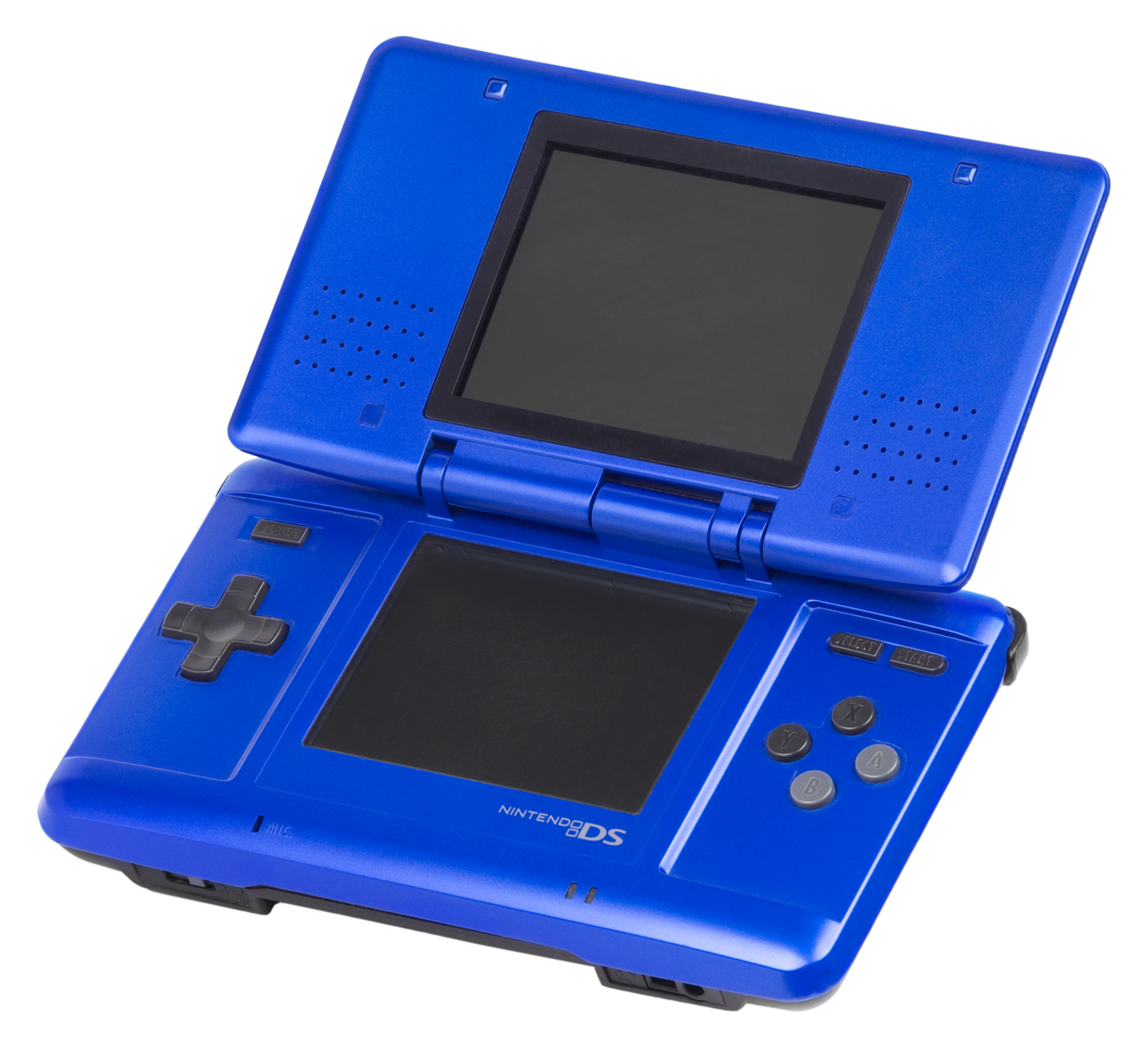
The original 2004 “phat” DS is a chunky grey-and-blue clamshell, 275 g and 148.7 x 84.7 x 28.9 mm, with two 3-inch screens whose backlight has a single brightness level. It feels like a prototype next to what followed, and the plastic hinge and glossy shell scuff easily. The DS Lite (2006) is the model most people should actually own: far slimmer at 218 g, with four adjustable brightness levels and much sharper-looking panels, while keeping the GBA slot. The DSi (2008) added two low-resolution cameras, an SD card slot, DSiWare downloads, more RAM and a 133 MHz clock, but removed Slot-2 and GBA support. The DSi XL (2009) stretched the panels to 4.2 inches, which are lower density and slightly soft but easy on the eyes. All four use the same 256×192 resistive touchscreen, so the drawing and tapping feel is consistent across the entire line.
Collecting, price and who it is for
Used prices are still low for the hardware itself. Original DS units turn up for around $30-50, DS Lites in good condition for $40-70, and the DSi and DSi XL a little higher. The real cost is software: complete Pokemon HeartGold/SoulSilver, plus cartridges like The World Ends With You or Ace Attorney, command serious money, and counterfeit Pokemon carts are rampant, so buy from sellers who know how to spot fakes. For a buyer today the calculus is simple. If you want the largest playable native library plus GBA passthrough, get a DS Lite and a flashcart. If you want cameras and DSiWare and do not care about GBA, the DSi XL is the most comfortable to stare at for hours. Skip the original phat model unless you specifically want the launch hardware; its dim, single-brightness screen is the weakest part of an otherwise remarkable machine.
📐 Size & Pocketability
⚖️ Weight vs Other Handhelds
🔋 Real-World Battery Estimator
⭐ Emulation Performance
📊 View How This Score is Calculated
The Hardware Power Score is an absolute metric. Perfect emulation of difficult, modern consoles awards significantly more points than standard retro consoles.
- 15× Multiplier: Modern PC
- 12× Multiplier: Switch, PS3, Xbox 360
- 10× Multiplier: Wii U
- 8× Multiplier: PS2, GameCube, Wii, Xbox
- 5× Multiplier: Saturn, Dreamcast, PSP
- 3× Multiplier: N64, PS1
- 1× Multiplier: SNES, GBA
Gen 8 & PC
Handhelds & Retro
📋 Full Specifications
📺 Display
⚙️ Platform
💾 Memory
🕹️ Controls
📏 Body
🔋 Battery
⚖️ Verdict
✅ The Good
- Best-selling handheld ever with a deep, genuinely inventive library; dual screens and touch enabled designs impossible on single-screen rivals
- Native Game Boy Advance backward compatibility on the DS and DS Lite via the Slot-2 port, running real GBA hardware rather than emulation
- Mature, cheap flashcart scene (R4, Acekard, SuperCard DSTWO, TWiLight Menu++) makes homebrew and 8-bit emulation trivial
- Hardware is abundant and inexpensive used, and the DS Lite and DSi XL offer bright, adjustable, comfortable screens
❌ The Bad
- Weak 67 MHz ARM core and 4 MB RAM cap emulation at 8-bit and early 16-bit; SNES needs the special onboard-CPU DSTWO cart
- Low 256×192 resolution overall, and the original phat model's single-brightness screen looks dated; the DSi dropped GBA support entirely
- Counterfeit Pokemon and RPG cartridges are widespread and desirable titles have become expensive on the collector market
📰 Latest News & Guides
The Ultimate Guide to ARMSX3: Android’s New PS3 Emulator, Competitor Comparisons, and Setup Tutorial
18/08/2026Pokémon Gold, Silver, and Crystal (Gen 2) Recomp Lands on Android
17/08/2026How to Play the Pokémon Red, Blue, or Yellow Recomp on Your Android, Windows, and Linux Devices
16/08/2026🔍 Similar Handhelds
Other handhelds that emulate up to DS.