
🛒 Where to Buy
⚠️ Golden Rule of Retro Handhelds: Throw away the cheap MicroSD card that comes in the box — it will fail. And never use a high-wattage PD “Fast Charger” on these devices; it can damage the battery. Use a standard 5V/1.5A brick.
Device Overview: Anbernic RG ARC-D
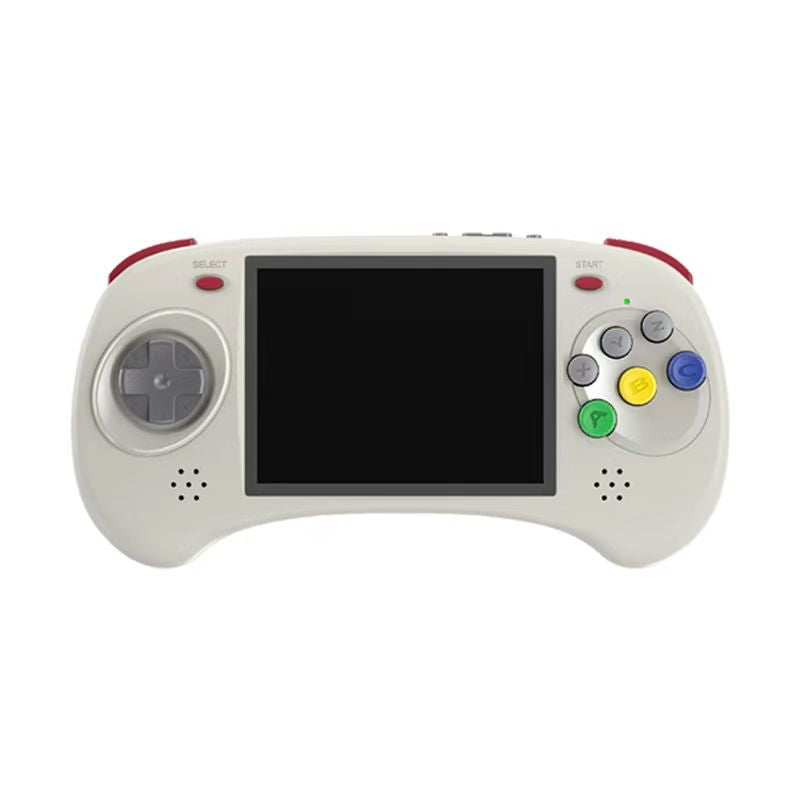
The RG ARC-D is Anbernic’s love letter to the Sega Saturn controller, shrunk into a 240-gram slab you hold in two hands. The face is the giveaway: six buttons in a 3×2 grid, labelled X Y Z across the top and A B C below, sitting beside a broad rocking D-pad. That layout exists for one reason, 2D fighting games and arcade brawlers, and on that narrow brief the ARC-D is one of the most satisfying things Anbernic makes. The catch is equally blunt: there is no analog stick anywhere on the device, on either the D or the S model, so anything built around a thumbstick is compromised before you start. This is the “D” variant, meaning it dual-boots Android 11 alongside a Linux emulation OS; the cheaper ARC-S drops Android and ships Linux only. Anbernic launched the pair in late 2023, and Android is the half that unlocks online fighting-game netplay, which is squarely the point of this shell.
Emulation performance, generation by generation
Inside is a Rockchip RK3566: a quad-core Cortex-A55 at 1.8GHz paired with a Mali-G52 2EE GPU and 2GB of LPDDR4. This is a modest, power-sipping ARM chip, the same silicon Anbernic used across the RG353 line, so calibrate expectations accordingly. Everything up to the 16-bit and Neo Geo era runs flawlessly: NES, SNES, Mega Drive, Game Boy Advance, and crucially the CPS1, CPS2 and CPS3 arcade boards through FinalBurn Neo all hit full speed, which is exactly what this shell was built for. PlayStation 1 via DuckStation and Nintendo DS via DraStic are comfortable. Nintendo 64 reaches roughly 85% on the friendlier titles through Mupen64Plus, but remember every N64 game was designed around an analog stick you do not have. Dreamcast on Flycast is genuinely title-dependent: Crazy Taxi and Capcom vs SNK 2 hold 60fps, while Virtua Fighter 3 sags to around 45fps with crackling audio. PSP through PPSSPP is the ceiling and it is a soft one; buy this device for PSP and you will be disappointed. Sega Saturn, ironically given the styling, is barely there, leaning on frame-skip and running well under full speed.
Screen, build and controls
The 4.0-inch IPS panel runs 640×480 in a 4:3 shape at about 200ppi, OCA-laminated so the image sits right under the glass, and it is multi-touch for the Android side. That 4:3 ratio is deliberate and correct for retro content that was never widescreen. The D-pad and buttons initially feel excellent, the rolling Saturn-style pad well suited to quarter-circle motions. Reliability is the asterisk: a number of owners, including long-term reviewers, report the D-pad periodically sticking in a direction after months of use, and some units show a faint bright patch in one screen corner from case pressure. The buttons are conductive silicone rather than microswitches, a vibration motor is fitted, and the shoulders stack L1/L2 and R1/R2 on each side. The chassis measures roughly 19.1 x 8 x 2.2cm, wide enough that your palms cradle it like a pad rather than a pocket toy. Connectivity covers dual-band 802.11ac Wi-Fi, Bluetooth 4.2, HDMI out and USB-C, with two microSD slots on top of the 32GB eMMC. The 3500mAh battery is rated near six hours, which holds up for 2D systems and drains faster once you push Dreamcast.
Software and setup
Out of the box the ARC-D dual-boots Android 11 and a stock Linux front-end. Android is the more flexible half, running RetroArch, standalone emulators, streaming apps and online fighting-game netplay, though it is the older, heavier option. The stock Linux OS is functional but plain. Because the RK3566 is a well-mapped chip, the real upgrade path is community custom firmware: ArkOS and ROCKNIX both support this platform and give you cleaner menus, better per-core defaults and far less bloat. Do not expect the Allwinner-focused projects here, so muOS, Knulli and OnionOS are not the right targets; Batocera support on RK3566 exists but is patchier. Whichever route you take, you supply your own games and a decent high-endurance microSD card.
Price, value and who it is for
The ARC-D sells for around $88, occasionally dipping toward its original roughly $70 launch pricing. At that money the value equation is unusually specific. If your library is Street Fighter, King of Fighters, Marvel vs Capcom, Metal Slug and 16-bit classics, nothing in this price bracket feels better in the hands, and the six-button Saturn face is the entire reason to choose it over a cheaper stick-equipped handheld. If you want N64, PSP or 3D-era games, the missing analog stick and the entry-level RK3566 both work against you, and you should look at a Unisoc T820-class device instead. Buy the ARC-D as a dedicated fighting-and-arcade machine that happens to play everything up to PS1 well, go in aware of the D-pad reliability reports, and it earns its keep. Treat it as an all-rounder and it will let you down.
📐 Size & Pocketability
⚖️ Weight vs Other Handhelds
🔋 Real-World Battery Estimator
⭐ Emulation Performance
📊 View How This Score is Calculated
The Hardware Power Score is an absolute metric. Perfect emulation of difficult, modern consoles awards significantly more points than standard retro consoles.
- 15× Multiplier: Modern PC
- 12× Multiplier: Switch, PS3, Xbox 360
- 10× Multiplier: Wii U
- 8× Multiplier: PS2, GameCube, Wii, Xbox
- 5× Multiplier: Saturn, Dreamcast, PSP
- 3× Multiplier: N64, PS1
- 1× Multiplier: SNES, GBA
Generation 6
Generation 5
Handhelds & Retro
⚡ Performance Benchmarks
Where Anbernic RG ARC-D ARM Mali-G52 MP2 (2EE) lands against the handhelds everyone knows. Every bar shares one scale, so longer genuinely means faster — add up to two rivals to compare.
CPU = Geekbench 6 multi-core · GPU = 3DMark Wild Life. Median real-world scores; every bar shares one scale — add up to two rivals to compare.
📋 Full Specifications
📺 Display
⚙️ Platform
💾 Memory
🕹️ Controls
📏 Body
🔋 Battery
⚖️ Verdict
✅ The Good
- Six-button Saturn-style face and rolling D-pad make it arguably the best portable for 2D fighters and CPS/Neo Geo arcade games, which run at full speed
- Sharp 4.0-inch 640×480 laminated IPS panel in native 4:3, so retro content fills the screen with no forced widescreen stretching
- Genuine dual-boot Android 11 plus Linux, with community ArkOS and ROCKNIX firmware support, HDMI out and Bluetooth/802.11ac Wi-Fi for netplay
- Inexpensive at around $88, with two microSD slots on top of 32GB eMMC for large libraries
❌ The Bad
- No analog stick on either model, which cripples N64, Dreamcast, PSP and virtually all 3D-era games that assume one
- Entry-level RK3566: PSP is a soft ceiling and Sega Saturn emulation limps along on frame-skip
- Reported D-pad sticking after months of use, occasional screen-corner light bleed, and conductive-silicone (non-microswitch) buttons
📰 Latest News & Guides
The Ultimate Guide to ARMSX3: Android’s New PS3 Emulator, Competitor Comparisons, and Setup Tutorial
18/08/2026Pokémon Gold, Silver, and Crystal (Gen 2) Recomp Lands on Android
17/08/2026How to Play the Pokémon Red, Blue, or Yellow Recomp on Your Android, Windows, and Linux Devices
16/08/2026🔍 Similar Handhelds
Other handhelds that emulate up to PSP.