
🛒 Where to Buy
⚠️ Golden Rule of Retro Handhelds: Throw away the cheap MicroSD card that comes in the box — it will fail. And never use a high-wattage PD “Fast Charger” on these devices; it can damage the battery. Use a standard 5V/1.5A brick.
Device Overview: SJGAM M18
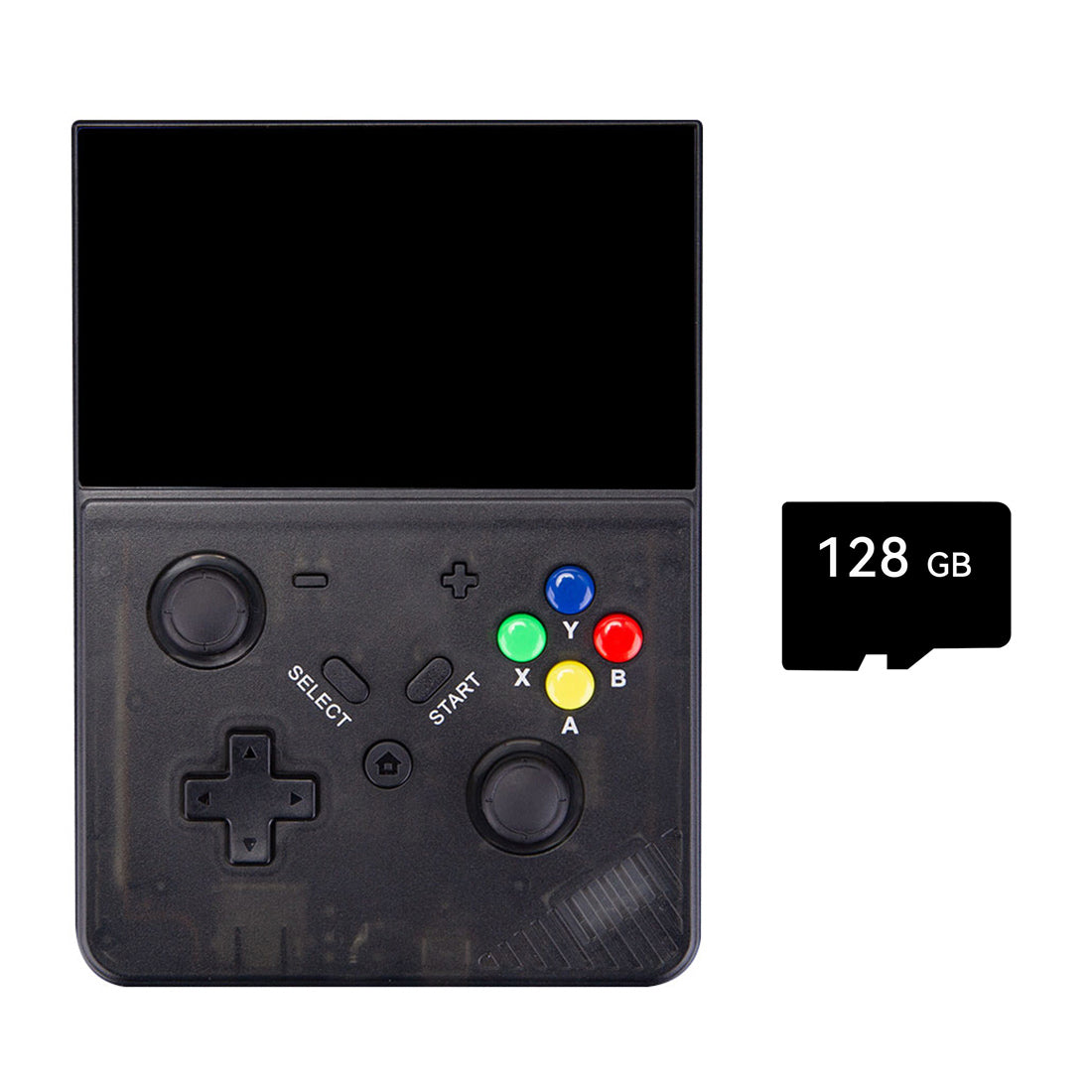
The SJGAM M18 is a budget Linux retro handheld built on the Rockchip RK3566, the same quad-core Cortex-A55 platform that powers the ubiquitous R36S and its many clones. What sets the M18 apart from that crowd is its body: a tall, vertical shell with two oversized rear grips and a 4.3-inch widescreen panel mounted up top, a layout closer to a chunky controller than the pocketable R36S. It also circulates under the names R43 Pro and Xiaobawang Q7, so if those ring a bell you are looking at the same hardware. This is emphatically an entry-level device, and its RK3566 silicon sets a hard ceiling that no amount of firmware tuning will lift.
Emulation performance, generation by generation
The RK3566 pairs four Cortex-A55 cores at 1.8 GHz with a modest Mali-G52 2EE GPU, and only 768 MB of DDR3 RAM to feed both. Everything up to and including the PlayStation 1 runs at full speed without drama: NES, SNES, Genesis, Game Boy Advance, TurboGrafx, and PS1 through PCSX ReARMed all behave, as do the CPS and Neo Geo arcade boards. Nintendo 64 is where reality bites. Super Mario 64 and Mario Kart 64 are fine on Mupen64Plus, but Conker, Majora’s Mask, and anything leaning on the expansion pak will chug. Dreamcast via Flycast is genuinely playable across much of the 2D-leaning library and lighter 3D titles, with demanding games dropping frames. PSP through PPSSPP is the headline stretch goal: 2D and 2.5D games run close to full speed, while 3D-heavy titles like God of War need frameskip and still sit below 60. One quirk works in your favor here, because the 480×272 panel is exactly PSP’s native resolution, so those games map one-to-one with no upscaling penalty. Nintendo DS runs on DraStic, though the single widescreen display makes the dual-screen layout awkward. Saturn is hit-or-miss and best avoided. PS2, GameCube, and Wii are simply out of reach; do not buy this expecting them.
Screen, build and controls
The 4.3-inch IPS display is the M18’s biggest gamble. Going 16:9 suits PSP, Dreamcast, and arcade content, but the resolution is only 480×272, around 128 pixels per inch, so 4:3 retro games look visibly chunky next to the 640×480 screen on a standard R36S. Whether that trade lands depends entirely on what you play. The build is all plastic and, at a claimed 450 grams, surprisingly heavy for its footprint; the large rear grips are the whole point, and they make long sessions comfortable in a way the flat R36S never manages. Controls cover the basics: an offset dual-analog-stick layout, a d-pad, four face buttons, and L1/R1/L2/R2 shoulders. The sticks are ordinary potentiometer units rather than Hall-effect, so expect eventual drift, and there is no L3/R3 click. A 3.5mm headphone jack sits alongside the USB-C charging port and the microSD slot on the bottom edge. The 4000 mAh cell handles the low-power SoC well enough for several hours of 8- and 16-bit play.
Software and setup
The M18 ships with EmuELEC, a mature Linux emulation distro, preloaded on the microSD card. That works out of the box, but the wider RK3566 scene has stronger options. ArkOS, ROCKNIX, Knulli, and Batocera all target this chip and generally deliver cleaner menus, better save-state handling, and more active updates. The honest caveat is that those firmwares are tuned first for the standard R36S body, so the M18’s larger screen and non-standard button map can mean an image needs community tweaks before resolution and controls map correctly. It is less plug-and-play than the R36S it resembles. The bigger setup wrinkle is connectivity: there is no WiFi and no Bluetooth, at all. That rules out wireless controllers, netplay, and on-device box-art scraping, so you populate ROMs and artwork by pulling the card and loading it from a PC. For many buyers that offline simplicity is fine; for anyone expecting to download and scrape from the couch, it is a dealbreaker.
Price, value and who it is for
The M18 launched in January 2024 at roughly $75 to $100 depending on storage and seller. At that price it fights the R36S, the RG35XX family, and a wall of near-identical RK3566 clones. Its case for existing is narrow but real: if you specifically want a widescreen panel and big ergonomic grips for PSP, Dreamcast, and arcade games, the M18 delivers that where most sub-$100 devices stay small and pocket-focused. If you mostly play 4:3 8- and 16-bit systems, the sharper 640×480 screen on a plain R36S is the smarter pick, and if you want WiFi or a machine that reaches past PSP you should spend more. Buy the M18 with clear eyes. It is a comfortable low-end emulator for everything through PS1 and a stretch machine for the fifth and sixth generations, sold under a brand with thin documentation. Match your expectations to the RK3566 and it will not let you down.
📐 Size & Pocketability
⚖️ Weight vs Other Handhelds
🔋 Real-World Battery Estimator
⭐ Emulation Performance
📊 View How This Score is Calculated
The Hardware Power Score is an absolute metric. Perfect emulation of difficult, modern consoles awards significantly more points than standard retro consoles.
- 15× Multiplier: Modern PC
- 12× Multiplier: Switch, PS3, Xbox 360
- 10× Multiplier: Wii U
- 8× Multiplier: PS2, GameCube, Wii, Xbox
- 5× Multiplier: Saturn, Dreamcast, PSP
- 3× Multiplier: N64, PS1
- 1× Multiplier: SNES, GBA
Generation 6
Generation 5
Handhelds & Retro
⚡ Performance Benchmarks
Where SJGAM M18 ARM Mali-G52 MP2 (2EE) lands against the handhelds everyone knows. Every bar shares one scale, so longer genuinely means faster — add up to two rivals to compare.
CPU = Geekbench 6 multi-core · GPU = 3DMark Wild Life. Median real-world scores; every bar shares one scale — add up to two rivals to compare.
📋 Full Specifications
📺 Display
⚙️ Platform
💾 Memory
🕹️ Controls
📏 Body
🔋 Battery
⚖️ Verdict
✅ The Good
- Widescreen 4.3-inch IPS panel whose 480×272 resolution matches PSP native and suits Dreamcast and arcade aspect ratios
- Large rear grips plus a 4000 mAh battery make for comfortable, multi-hour handheld sessions
- Runs everything through PS1 at full speed, with playable Dreamcast, lighter N64, and entry-level PSP on the RK3566
- Cheap at roughly $75 to $100 and backed by a broad RK3566 custom-firmware ecosystem (ArkOS, ROCKNIX, Knulli, Batocera)
❌ The Bad
- No WiFi and no Bluetooth whatsoever, so no wireless pads, netplay, or on-device scraping
- Low 480×272 resolution plus drift-prone potentiometer sticks (no Hall effect), and it is heavy at about 450 grams
- Obscure brand with thin documentation, and CFW is tuned for the R36S so the M18's screen and buttons may need community fixes
📰 Latest News & Guides
The Ultimate Guide to ARMSX3: Android’s New PS3 Emulator, Competitor Comparisons, and Setup Tutorial
18/08/2026Pokémon Gold, Silver, and Crystal (Gen 2) Recomp Lands on Android
17/08/2026How to Play the Pokémon Red, Blue, or Yellow Recomp on Your Android, Windows, and Linux Devices
16/08/2026🔍 Similar Handhelds
Other handhelds that emulate up to PSP.