
🛒 Where to Buy
⚠️ Golden Rule of Retro Handhelds: Throw away the cheap MicroSD card that comes in the box — it will fail. And never use a high-wattage PD “Fast Charger” on these devices; it can damage the battery. Use a standard 5V/1.5A brick.
Device Overview: Game Console R33S
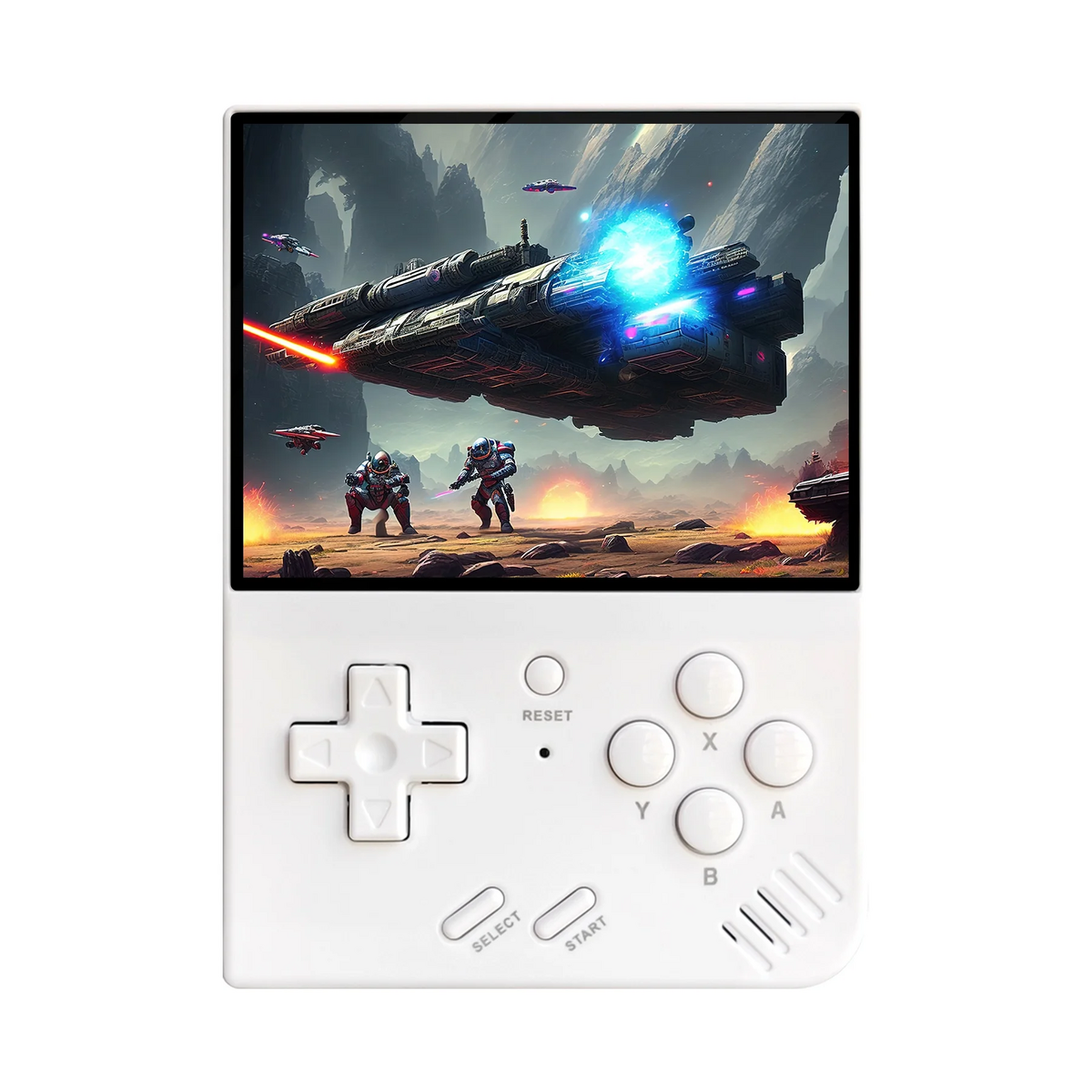
The Game Console R33S is one of the odder entries in the budget emulation-handheld flood: an unbranded OEM device (the manufacturer name genuinely is just “Game Console”) that takes the guts of the popular R35S/R36S and drops them into a vertical shell that is a near-exact copy of the Miyoo Mini Plus. That lineage tells you most of what you need up front. Inside is a Rockchip RK3326, the same aging chip that powers a dozen sub-$60 handhelds, and the R33S makes no attempt to push it further. What you are buying is a portrait-format, Game Boy-vertical retro player for 8-bit through PS1, sold cheaply and shipped with more open-source firmware support than most of its clone cousins. It arrived in January 2024 and immediately drew legal heat, which shapes its story as much as the spec sheet does.
Emulation performance, generation by generation
The RK3326 is a quad-core Cortex-A35 clocked around 1.3-1.5 GHz with a Mali-G31 MP2 GPU and just 1GB of DDR3L RAM. Treat it as a low-power ARM SoC, not a pocket PC. Everything from the 8- and 16-bit era runs at full speed with headroom to spare: NES, SNES, Genesis, Master System, PC Engine, Game Boy through GBA, Neo Geo, and the CPS1/CPS2 arcade libraries are all flawless under RetroArch cores like Snes9x and gpSP. PlayStation 1 is the device’s true ceiling and its sweet spot; DuckStation and PCSX ReARMed run the vast majority of the library at full speed, and the 4:3 panel suits PS1 well. Above that line, be honest with yourself. Nintendo 64 via Mupen64Plus is a per-game gamble: Mario 64 and Ocarina of Time are playable with frame-skip, but the moment a title leans hard on the RDP it drops frames. PSP through PPSSPP manages only lighter 2D-leaning games at reduced resolution; anything 3D-heavy stutters. Dreamcast on Flycast handles a few 2D fighters and little else, and Saturn is effectively off the table. Nintendo DS runs, but a two-screen system on a single vertical 4:3 panel is a compromise you feel constantly.
Screen, build and controls
The 3.5-inch IPS panel runs 640×480 at a 4:3 aspect, and for the systems this chip actually handles that ratio is a real advantage; SNES and PS1 fill the glass with none of the letterboxing a 16:9 handheld would force. Colours are punchy and viewing angles are fine. One warning inherited straight from the R36S: the R33S has shipped with several different panels over its production run, so custom-firmware setup includes a screen-identification step to load the correct driver, or you get washed-out or tinted output. The shell is ABS plastic, offered in transparent black, purple, white and beige, weighs roughly 162 grams, and measures about 108 x 78 x 22 mm in a portrait body that pockets easily. Controls are the weak point. The d-pad and face buttons are decent and responsive, but there are no analog sticks at all, which is fine for retro and limiting for N64 and PSP, and the rear L2/R2 triggers are widely panned as stiff and awkward to press. USB-C handles charging for the 3200mAh battery, good for roughly four to six hours.
Software and setup
Out of the box the R33S ships with ArkOS 2.0 fronted by EmulationStation, running from one of two microSD cards; there is no internal storage, and the second slot is meant for your ROM library. Stock boot and load times are sluggish, largely down to the cheap bundled card, so swapping in a decent A1-rated microSD is the first thing you should do. The real reason to pick this device over its siblings is firmware freedom: beyond stock ArkOS, the R33S is supported by ROCKNIX, and the wider RK3326 platform has a mature open-source scene, so you are not locked to whatever the seller flashed. Flashing is the usual routine: image a fresh card, boot, run the panel-ID tool, add BIOS and ROMs. There is no WiFi and no Bluetooth, which means no over-the-air anything; RetroAchievements, netplay and wireless file transfer are simply absent, and every ROM moves by pulling the card. PortMaster works for a selection of native PC ports where the chip can keep up.
Price, value and who it is for
The R33S was rumoured around $40 and street-priced closer to $48-50, but its life has been complicated. Miyoo’s design owners pursued it as a clone of the Mini Plus, it was pulled from AliExpress, and the units that surface on Amazon have sometimes carried inflated tags near $80 that make no sense against a genuine Miyoo Mini Plus or an R36S. That is the crux: at $45 it is a reasonable vertical RK3326 player with unusually open firmware; at $80 it is pointless. Buy it only if you specifically want a Mini Plus-style portrait handheld, you value ArkOS and ROCKNIX support, and you can find one at clone pricing. Anyone who wants sticks, wireless, or anything past PS1 should look elsewhere. Bear in mind too that as an unbranded OEM product its documentation and warranty are effectively nonexistent; the community, not the manufacturer, is your support desk.
📐 Size & Pocketability
⚖️ Weight vs Other Handhelds
🔋 Real-World Battery Estimator
⭐ Emulation Performance
📊 View How This Score is Calculated
The Hardware Power Score is an absolute metric. Perfect emulation of difficult, modern consoles awards significantly more points than standard retro consoles.
- 15× Multiplier: Modern PC
- 12× Multiplier: Switch, PS3, Xbox 360
- 10× Multiplier: Wii U
- 8× Multiplier: PS2, GameCube, Wii, Xbox
- 5× Multiplier: Saturn, Dreamcast, PSP
- 3× Multiplier: N64, PS1
- 1× Multiplier: SNES, GBA
Generation 6
Generation 5
Handhelds & Retro
⚡ Performance Benchmarks
Where Game Console R33S Mali-G31 MP2 lands against the handhelds everyone knows. Every bar shares one scale, so longer genuinely means faster — add up to two rivals to compare.
CPU = Geekbench 6 multi-core · GPU = 3DMark Wild Life. Median real-world scores; every bar shares one scale — add up to two rivals to compare.
📋 Full Specifications
📺 Display
⚙️ Platform
💾 Memory
🕹️ Controls
📏 Body
🔋 Battery
⚖️ Verdict
✅ The Good
- Sharp 3.5" 640×480 IPS panel at a native 4:3 aspect, which fills the screen with no letterboxing for 8-bit, 16-bit and PS1 games
- Unusually open firmware for a clone: ships with ArkOS 2.0 and is supported by ROCKNIX, on top of the mature RK3326 open-source ecosystem
- PlayStation 1 and everything below it runs flawlessly at full speed via DuckStation and PCSX ReARMed
- Genuinely pocketable at about 162g in a compact portrait shell, with USB-C charging and four to six hours from the 3200mAh battery
❌ The Bad
- No WiFi and no Bluetooth at all, so no RetroAchievements, netplay or wireless transfers, and every ROM has to move by SD card
- Stiff, awkward rear L2/R2 triggers and no analog sticks, which hobbles the N64 and PSP titles the chip could otherwise attempt
- Messy availability and provenance: an unbranded OEM clone pulled from AliExpress over Miyoo design complaints, sometimes overpriced near $80, with no official warranty or documentation
📰 Latest News & Guides
The Ultimate Guide to ARMSX3: Android’s New PS3 Emulator, Competitor Comparisons, and Setup Tutorial
18/08/2026Pokémon Gold, Silver, and Crystal (Gen 2) Recomp Lands on Android
17/08/2026How to Play the Pokémon Red, Blue, or Yellow Recomp on Your Android, Windows, and Linux Devices
16/08/2026🔍 Similar Handhelds
Other handhelds that emulate up to DS.