
🛒 Where to Buy
⚠️ Golden Rule of Retro Handhelds: Throw away the cheap MicroSD card that comes in the box — it will fail. And never use a high-wattage PD “Fast Charger” on these devices; it can damage the battery. Use a standard 5V/1.5A brick.
Device Overview: Retroid Pocket Mini
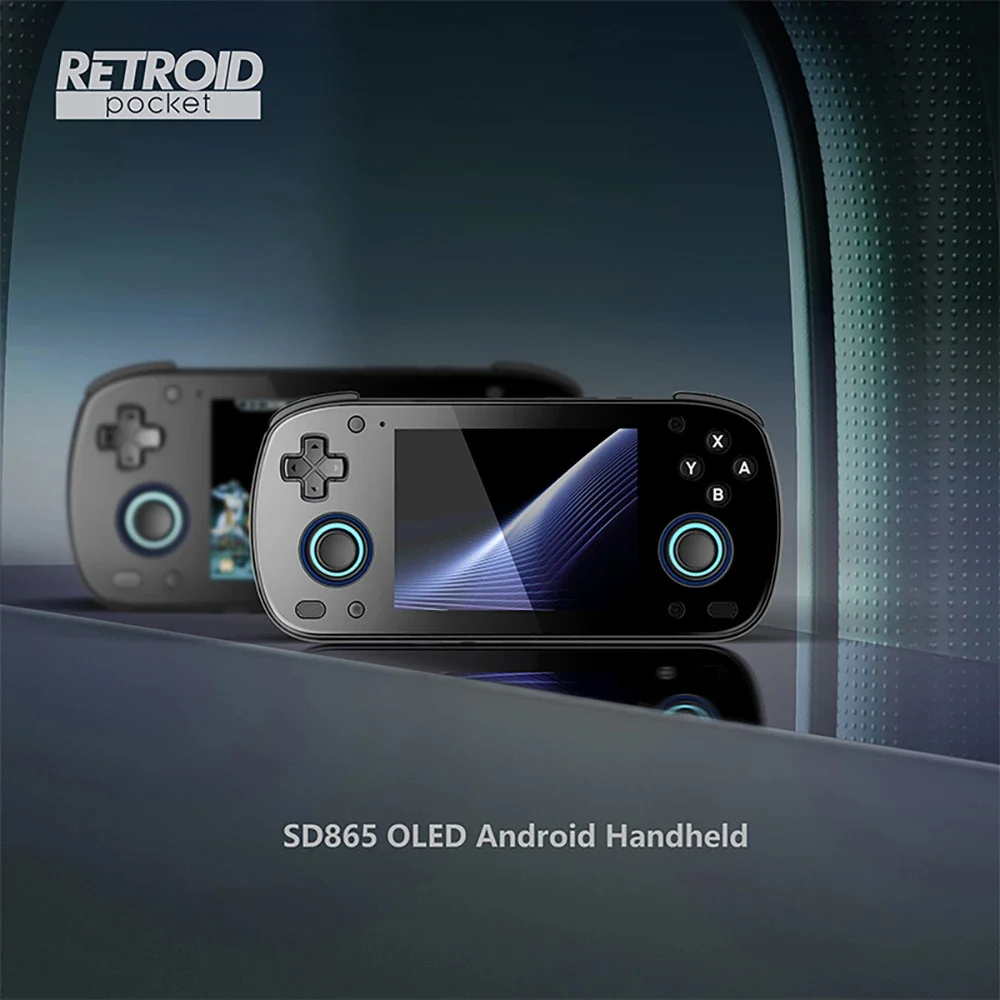
The Retroid Pocket Mini takes the exact silicon Retroid put in its full-size Pocket 5 (a Qualcomm Snapdragon 865 with the Adreno 650 GPU) and crams it behind a 3.7-inch AMOLED panel in a body small enough to forget in a jacket pocket. That is the whole pitch, and Retroid does not pretend otherwise. Where the Pocket 5 gives you a 5.5-inch 1080p screen and room to breathe, the Mini hands you the same 6GB of LPDDR4X, the same 128GB of UFS 3.1 storage, and the same active cooling fan, then shrinks the canvas. You lose screen real estate and gain a device that disappears into one hand.
Against a Miyoo Mini Plus or an Anbernic ARC-D, this is not a fair fight on raw power; those are sub-$100 Linux machines built for 16-bit and PS1, and the Mini’s 865 will run circles around them up into sixth-gen consoles. The honest comparison is the Pocket 5 (more screen, more battery, same chip, roughly $35-$50 more) and the older Pocket 3+ or 4 (weaker SoCs, LCD panels). The Mini’s reason to exist is that AMOLED-in-your-palm size, not a higher ceiling.
Emulation performance, generation by generation
The Snapdragon 865 is a known quantity, and the Mini behaves exactly as that chip should. Up through the fifth generation it is effortless: PS1 through DuckStation, N64, Saturn, and Dreamcast via Flycast all run at full speed with upscaling headroom to spare. PSP under PPSSPP is the sweet spot, most of the library runs at 3x or 4x internal resolution without breaking a sweat. PS2 is where the 865 starts to work for its money: NetherSX2 (the AetherSX2 fork most people install) handles the bulk of the catalog well, typically at 2x native, though the heavier 3D titles need per-game settings and a few never cooperate. GameCube and Wii through Dolphin are a real strength here; most games hold full speed at 2x, and reviewers consistently call this the standout. The 3DS via Azahar or Citra runs single-screen games beautifully, but the dual-screen layout fights the small 4:3 panel. Switch is the genuine ceiling and the honest hit-or-miss line: with the newer Yuzu forks (Citron, Eden) plus custom GPU drivers, lighter titles like a 2D Mario are playable, but this is not a Switch machine and you should not buy it as one. There is no PS3 and no Xbox 360 here, that wall belongs to the Snapdragon 8 Gen 2 devices, not the 865.
Screen, build and controls
The 3.7-inch 4:3 AMOLED is the reason to buy this thing, and one caveat keeps it honest. Retroid markets it at 1280×960, but community measurement found the true active area lands closer to 928p, a discrepancy that caused real friction at launch and an eventual V2 revision. That asterisk aside, the panel is gorgeous in hand: rated 500 nits, roughly 107% sRGB, with near-zero bezels under a seamless 2.5D glass cover. Inky AMOLED blacks make 4:3 retro content pop in a way no budget LCD touches. The flip side is purely physical, 3.7 inches is small. Anyone used to a 5-inch handheld will find text in 16:9 PSP games and dual-screen 3DS layouts cramped, and adult hands may find the grip tight on longer sessions. Controls are a high point: dual Hall-effect analog sticks that will not drift, analog Hall L2/R2 triggers, and stacked shoulder buttons. A 4000mAh battery is modest on paper but reasonable for the panel size, landing most users in the four-to-six-hour range depending on what they emulate.
Software and setup
Out of the box the Mini runs Android (13 at launch), which is the right call for this hardware: it is the only path to the current PS2, GameCube, and Switch emulators, plus frontends like Daijisho and ES-DE and storefronts for the odd native Android game. Plan to do setup work, sideloading emulators, installing the Mesa Turnip GPU drivers that Dolphin, Azahar and the Switch forks lean on, and mapping controls. It is not plug-and-play the way a Miyoo is. If you would rather skip Android entirely, the Mini is well supported by Linux CFW: ROCKNIX and GammaOS both run on it, trading Android’s emulator breadth for a leaner, console-style boot-to-games experience. Retroid also ships incremental OTA updates, so the firmware is not frozen at whatever shipped in the box.
Price, value and who it’s for
At roughly $169 to $185 depending on configuration and sales, the Mini is not a budget handheld and is not trying to be. You are paying a premium specifically for an AMOLED screen attached to a sixth-gen-capable SoC in the smallest body Retroid could manage. That is a narrow want, and if it is your want, nothing else matches it. If you mostly play 8- and 16-bit and PS1, a Miyoo at a third the price will satisfy you and the Mini is overkill. If you want the most comfortable way to emulate GameCube and PS2, the Pocket 5’s larger screen and bigger battery make it the better buy for marginally more money. The Mini is for the person who already knows they want that combination of pocketable size, an OLED panel, and enough horsepower to reach the PS2/GameCube/Wii tier, and who is willing to do a little Android tinkering and live with a small screen and a launch-day resolution asterisk to get it.
📐 Size & Pocketability
⚖️ Weight vs Other Handhelds
🔋 Real-World Battery Estimator
⭐ Emulation Performance
📊 View How This Score is Calculated
The Hardware Power Score is an absolute metric. Perfect emulation of difficult, modern consoles awards significantly more points than standard retro consoles.
- 15× Multiplier: Modern PC
- 12× Multiplier: Switch, PS3, Xbox 360
- 10× Multiplier: Wii U
- 8× Multiplier: PS2, GameCube, Wii, Xbox
- 5× Multiplier: Saturn, Dreamcast, PSP
- 3× Multiplier: N64, PS1
- 1× Multiplier: SNES, GBA
Gen 8 & PC
Generation 7
Generation 6
Generation 5
Handhelds & Retro
⚡ Performance Benchmarks
Where Retroid Pocket Mini Adreno 650 lands against the handhelds everyone knows. Every bar shares one scale, so longer genuinely means faster — add up to two rivals to compare.
CPU = Geekbench 6 multi-core · GPU = 3DMark Wild Life. Median real-world scores; every bar shares one scale — add up to two rivals to compare.
📋 Full Specifications
📺 Display
⚙️ Platform
💾 Memory
🕹️ Controls
📏 Body
🔋 Battery
⚖️ Verdict
✅ The Good
- Snapdragon 865 comfortably runs PS1, PSP, Saturn, Dreamcast, GameCube/Wii and most PS2 at full speed
- Genuinely pocketable 3.7-inch 4:3 AMOLED with deep blacks, ~500 nits and near-zero bezels
- Dual Hall-effect analog sticks plus analog Hall L2/R2 triggers mean no stick drift and precise input
- Flexible software: full Android 13 for the broadest emulator support, or ROCKNIX / GammaOS Linux CFW, with OTA updates
❌ The Bad
- Advertised 1280×960 panel actually renders closer to 928p, a launch controversy that led to a V2 revision
- 3.7-inch screen feels cramped for 16:9 PSP and dual-screen 3DS, and tight for larger hands on long sessions
- Switch emulation is hit-or-miss and there is no PS3 or Xbox 360 capability; setup needs manual emulator and GPU-driver work
📰 Latest News & Guides
The Ultimate Guide to ARMSX3: Android’s New PS3 Emulator, Competitor Comparisons, and Setup Tutorial
18/08/2026Pokémon Gold, Silver, and Crystal (Gen 2) Recomp Lands on Android
17/08/2026How to Play the Pokémon Red, Blue, or Yellow Recomp on Your Android, Windows, and Linux Devices
16/08/2026🔍 Similar Handhelds
Other handhelds that emulate up to Switch.