
🛒 Where to Buy
⚠️ Golden Rule of Retro Handhelds: Throw away the cheap MicroSD card that comes in the box — it will fail. And never use a high-wattage PD “Fast Charger” on these devices; it can damage the battery. Use a standard 5V/1.5A brick.
Device Overview: AYANEO Next Lite
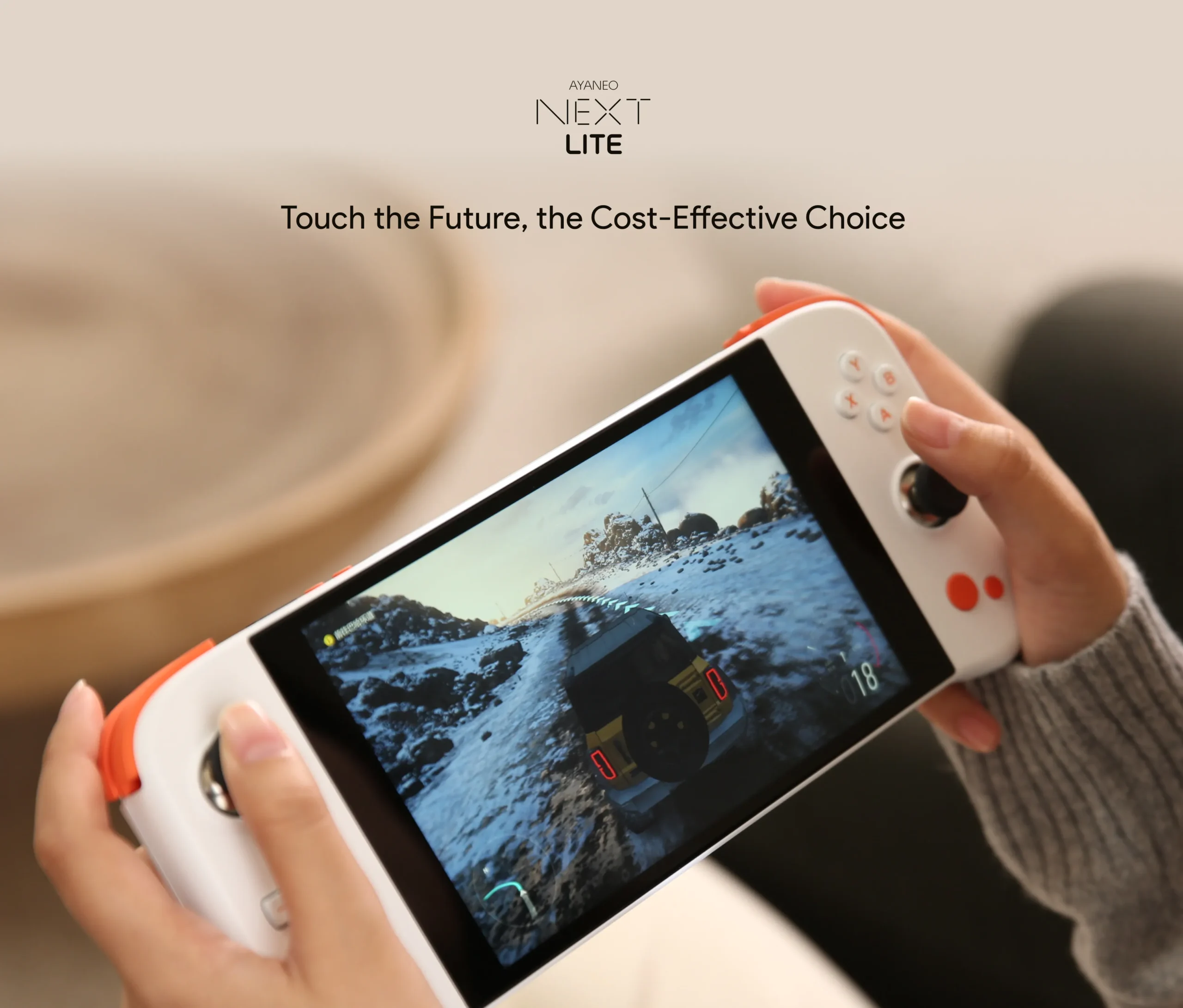
The AYANEO Next Lite is the odd one out in AYANEO’s catalog: a full x86 handheld PC that the company priced like a mid-range ARM emulation box. It launched in early 2024 at $299 for the base configuration, undercutting almost everything else AYANEO makes, and it does that by reaching back to silicon AMD shipped in 2020. Inside is a Renoir-U APU, either a six-core Ryzen 5 4500U with Radeon Vega 6 graphics, or, in the $399 model, an eight-core Ryzen 7 4800U with Vega 8. Both are Zen 2 parts, which means this is a real desktop-class x86 machine, not a Rockchip or Snapdragon running Linux. That single fact shapes everything about how it emulates and what you should expect from it.
Emulation performance, generation by generation
Because it runs the same architecture as a laptop, the Next Lite uses the full desktop emulator stack rather than the cut-down ARM ports. Everything up to the sixth console generation is trivial: NES, SNES, Genesis, PS1 through DuckStation, N64, Dreamcast and PSP all run at full speed with headroom to spare. PlayStation 2 through PCSX2 and GameCube/Wii through Dolphin are comfortable at 2x to 3x internal resolution on both APUs. The interesting line sits higher up. Wii U games under Cemu are largely playable. PlayStation 3 via RPCS3 is where the two chips diverge: the 4800U’s sixteen threads make lighter PS3 titles genuinely playable, while the 4500U’s six threads with no SMT choke on the same games. Switch emulation, now handled by Yuzu and Ryujinx forks such as Sudachi and Citron after the originals were shut down, runs many titles at 720p on the 4800U with occasional dips; the 4500U is a rougher ride. Xbox 360 through Xenia stays experimental here, as it is everywhere. The real ceiling is the Vega iGPU, which is weaker than the Steam Deck’s RDNA 2 part and caps how hard you can push resolution.
Screen, build and controls
The 7-inch IPS panel is 1280×800, 16:10, 60Hz, OCA-laminated and touch-enabled, sharp enough for a 720p-native library but ordinary next to the OLED screens AYANEO fits on its pricier handhelds. The chassis is large: 267mm wide and 720g, closer to a Steam Deck than to a pocketable retro unit. What genuinely stands out at this price are the controls. You get Hall-effect joysticks and Hall-effect analog triggers, so stick drift is a non-issue and the triggers have real travel, plus a six-axis gyro and an X-axis linear motor for rumble. Storage is a full-size M.2 2280 PCIe 3.0 slot, so the 128GB base model is cheap to upgrade yourself. The 16GB of LPDDR4x-4266 is soldered. Connectivity is WiFi 6, Bluetooth 5.2 and USB-C with 60W PD charging feeding a 47Wh battery, decent capacity, though the aging 7nm APU drains it faster than newer chips would.
Software and setup
AYANEO originally promised the Next Lite would ship with HoloISO, a community SteamOS rebuild, then reversed course and shipped Windows 11 Home instead, offering the Linux image only as a separate download. That image was rough at launch: AYANEO’s face buttons and TDP controls did not work under it, so out of the box most owners run Windows. The upside of an x86 device is that you are not locked to any vendor firmware. You can wipe it and install Bazzite, ChimeraOS or Batocera, and EmuDeck sets up the entire emulator front-end on either Windows or a SteamOS-style install in a few clicks. None of the ARM custom firmwares, muOS, Knulli, ArkOS, ROCKNIX or OnionOS, apply here; this is a PC, and it takes PC operating systems.
Price, value and who it is for
The awkward part is the math. At $299 to $399 the Next Lite runs straight into the LCD Steam Deck, which costs the same, has a similar 800p screen, a stronger RDNA 2 GPU, and a polished SteamOS with working TDP and button mapping. Valve’s device is the better buy for most people, and reviewers said so bluntly. The Next Lite earns its place only in narrow cases: you specifically want Hall triggers and a user-upgradeable SSD, you value the slightly stronger CPU for thread-heavy emulation, or you find one discounted below Deck pricing. As a pure emulation machine it clears PS2, GameCube and Wii with ease and reaches into PS3 and Switch on the 4800U, but you are paying x86 handheld money for four-year-old silicon, and the competition is fierce.
📐 Size & Pocketability
⚖️ Weight vs Other Handhelds
🔋 Real-World Battery Estimator
⭐ Emulation Performance
📊 View How This Score is Calculated
The Hardware Power Score is an absolute metric. Perfect emulation of difficult, modern consoles awards significantly more points than standard retro consoles.
- 15× Multiplier: Modern PC
- 12× Multiplier: Switch, PS3, Xbox 360
- 10× Multiplier: Wii U
- 8× Multiplier: PS2, GameCube, Wii, Xbox
- 5× Multiplier: Saturn, Dreamcast, PSP
- 3× Multiplier: N64, PS1
- 1× Multiplier: SNES, GBA
Gen 8 & PC
Generation 7
Generation 6
Generation 5
Handhelds & Retro
📋 Full Specifications
📺 Display
⚙️ Platform
💾 Memory
🕹️ Controls
📏 Body
🔋 Battery
⚖️ Verdict
✅ The Good
- Full x86 PC internals run the complete desktop emulator stack (PCSX2, Dolphin, RPCS3, Cemu), not cut-down ARM ports
- Hall-effect joysticks and Hall-effect analog triggers from a $299 starting price, so stick drift is a non-issue
- User-accessible full-size M.2 2280 PCIe slot makes the cheap 128GB base model easy to upgrade yourself
- Not locked to vendor firmware: it installs Windows, Bazzite, ChimeraOS or Batocera and works with EmuDeck
❌ The Bad
- Built on 2020-era Zen 2 Renoir silicon with a weak Vega iGPU the same-priced Steam Deck's RDNA 2 outperforms
- Ships with Windows 11 rather than the promised SteamOS, and the downloadable Linux image launched with broken buttons and TDP control
- Large and heavy at 720g with an ordinary 60Hz IPS screen, so it is neither pocketable nor premium-feeling
📰 Latest News & Guides
The Ultimate Guide to ARMSX3: Android’s New PS3 Emulator, Competitor Comparisons, and Setup Tutorial
18/08/2026Pokémon Gold, Silver, and Crystal (Gen 2) Recomp Lands on Android
17/08/2026How to Play the Pokémon Red, Blue, or Yellow Recomp on Your Android, Windows, and Linux Devices
16/08/2026🔍 Similar Handhelds
Other handhelds that emulate up to Switch.