
🛒 Where to Buy
⚠️ Golden Rule of Retro Handhelds: Throw away the cheap MicroSD card that comes in the box — it will fail. And never use a high-wattage PD “Fast Charger” on these devices; it can damage the battery. Use a standard 5V/1.5A brick.
Device Overview: AYANEO Pocket Micro
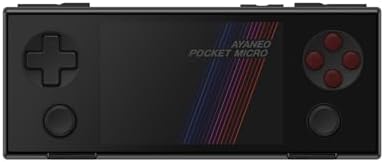
The AYANEO Pocket Micro answers a very specific itch: what if the Game Boy Micro had been rebuilt in 2024 with real analog controls and an Android brain? It is a 233-gram slab of CNC aluminium measuring 156 x 63 x 18 mm, small enough to disappear into a jacket pocket, and it is organised entirely around a 3.5-inch, 960×640 IPS panel. That resolution is not arbitrary. It is exactly four times the Game Boy Advance’s 240×160, so GBA games scale to the pixel with no shimmer. A MediaTek Helio G99 does the computing. This is a mid-range Android phone chip, not a gaming-PC part, and almost everything below follows from that single fact.
Emulation performance, generation by generation
The Helio G99 pairs two Cortex-A76 cores at 2.2 GHz with six A55 cores and a Mali-G57 MC2 GPU. In practice that means 8- and 16-bit systems – NES, SNES, Genesis, PC Engine, Game Boy through GBA – run at full speed with headroom left over for shaders and run-ahead, whether you use RetroArch cores or standalone apps. PS1 through DuckStation is effortless, upscaling included. The interesting middle sits at N64, DS and PSP: Mupen64Plus FZ, MelonDS and PPSSPP clear the bulk of each library, though the heaviest N64 and PSP titles want per-game tuning. Dreamcast on Flycast is comfortable, and DS via MelonDS benefits from the tall panel, which stacks both screens without wasting glass. Above that line the chip runs out of room. Saturn is hit or miss. PS2 on NetherSX2 boots, and a handful of lighter 2D or simple 3D games reach a playable state, but most of the catalogue stutters and is not worth forcing. GameCube on Dolphin tells the same story of occasional wins and frequent slideshows. Treat Wii and 3DS as out of scope. Buy this expecting anything past the sixth generation and you bought the wrong handheld; its honest ceiling is the PS1/PSP/DS band, and it owns that band.
Screen, build and controls
The 3:2 aspect ratio is the whole point. It is taller than the 16:9 panels on most Android handhelds, and it flatters retro content that was mostly authored at 4:3 or squarer. Colour coverage is a full 100% sRGB and the borderless glass looks the part. The aluminium unibody feels genuinely dense in the hand rather than hollow. AYANEO fits two clickable Hall-effect thumbsticks, a cross d-pad, ABXY buttons, and four shoulder keys (L1/L2, R1/R2), plus a fingerprint power button, a six-axis gyro and a linear rumble motor. The catch is stick placement: both analog sticks sit high, above the face controls, so anything demanding constant right-stick camera work feels cramped. Two omissions sting. There is no 3.5mm headphone jack, so wired audio means a USB-C dongle, and the battery is only 2600mAh. Six hours is the optimistic figure; heavy PSP or PS1 sessions drain it faster, and for a 2024 device that cell is undersized.
Software and setup
The Pocket Micro ships with Android 13 under AYANEO’s AYAHome and AYASpace launchers. That distinction matters if you are coming from Anbernic or Miyoo hardware: this is not a Linux retro box, so muOS, Knulli, ROCKNIX, ArkOS and Batocera simply do not apply here. Those distributions target Rockchip and Allwinner silicon, not a MediaTek Android platform. Your “custom firmware” on this device is really front-end software. Most owners ignore the stock launcher and install Daijisho or ES-DE (EmulationStation DE) to organise ROMs and box art, then point RetroArch and the standalone emulators at a microSD card. It is a five-minute job if you have done Android emulation before and a mild learning curve if you have not. Storage comes as 128GB or 256GB of UFS 2.2, expandable by a single microSD slot, and connectivity is Wi-Fi 5 and Bluetooth 5.2 over a USB-C 2.0 port. Because it is open Android, you also keep the Play Store, so streaming, native Android games and cloud gaming all run – flexibility the Linux handhelds cannot match.
Price, value and who it is for
The Pocket Micro launched in late 2024 at roughly $219 for the 6GB/128GB model and $249 for 8GB/256GB, with a Retro Gray limited edition near $279; on the used market it trades a little below those figures. That is real money next to a $70-110 Anbernic RG35XX-class handheld that emulates the same PS1-and-below libraries. You pay the premium for the aluminium build, the Hall sticks, the excellent 3:2 screen and Android’s app ecosystem. If you mainly want GBA and 16-bit games in the most pocketable premium package going, and you value a pixel-exact GBA panel, it is easy to recommend. If you are chasing GameCube or PS2, or you just want the cheapest competent emulator, look elsewhere. The tiny battery and the missing headphone jack are the two things most likely to annoy you a week in.
📐 Size & Pocketability
⚖️ Weight vs Other Handhelds
🔋 Real-World Battery Estimator
⭐ Emulation Performance
📊 View How This Score is Calculated
The Hardware Power Score is an absolute metric. Perfect emulation of difficult, modern consoles awards significantly more points than standard retro consoles.
- 15× Multiplier: Modern PC
- 12× Multiplier: Switch, PS3, Xbox 360
- 10× Multiplier: Wii U
- 8× Multiplier: PS2, GameCube, Wii, Xbox
- 5× Multiplier: Saturn, Dreamcast, PSP
- 3× Multiplier: N64, PS1
- 1× Multiplier: SNES, GBA
Generation 7
Generation 6
Generation 5
Handhelds & Retro
⚡ Performance Benchmarks
Where AYANEO Pocket Micro Arm Mali-G57 MC2 lands against the handhelds everyone knows. Every bar shares one scale, so longer genuinely means faster — add up to two rivals to compare.
CPU = Geekbench 6 multi-core · GPU = 3DMark Wild Life. Median real-world scores; every bar shares one scale — add up to two rivals to compare.
📋 Full Specifications
📺 Display
⚙️ Platform
💾 Memory
🕹️ Controls
📏 Body
🔋 Battery
⚖️ Verdict
✅ The Good
- Pixel-perfect GBA and 16-bit emulation on a 3.5-inch 960×640 3:2 IPS panel (exactly 4x GBA resolution) with full sRGB coverage
- Premium 233g CNC aluminium unibody with clickable Hall-effect thumbsticks, gyro and a linear rumble motor
- Open Android 13 with Play Store access, so streaming and cloud-gaming apps run alongside RetroArch, Daijisho and ES-DE
- Genuinely pocketable at 156 x 63 x 18mm – the closest modern equivalent to a Game Boy Micro but with real analog sticks
❌ The Bad
- Small 2600mAh battery – around six hours at best, and heavy PS1/PSP sessions drain it faster
- No 3.5mm headphone jack, so wired audio needs a USB-C dongle
- Helio G99 hits a hard wall at PS2 and GameCube (most titles stutter); it is strictly a PS1/PSP/DS-and-below machine, no leap over far cheaper handhelds for those libraries
📰 Latest News & Guides
The Ultimate Guide to ARMSX3: Android’s New PS3 Emulator, Competitor Comparisons, and Setup Tutorial
18/08/2026Pokémon Gold, Silver, and Crystal (Gen 2) Recomp Lands on Android
17/08/2026How to Play the Pokémon Red, Blue, or Yellow Recomp on Your Android, Windows, and Linux Devices
16/08/2026🔍 Similar Handhelds
Other handhelds that emulate up to 3DS.