
🛒 Where to Buy
⚠️ Golden Rule of Retro Handhelds: Throw away the cheap MicroSD card that comes in the box — it will fail. And never use a high-wattage PD “Fast Charger” on these devices; it can damage the battery. Use a standard 5V/1.5A brick.
Device Overview: AYN Loki Mini Pro
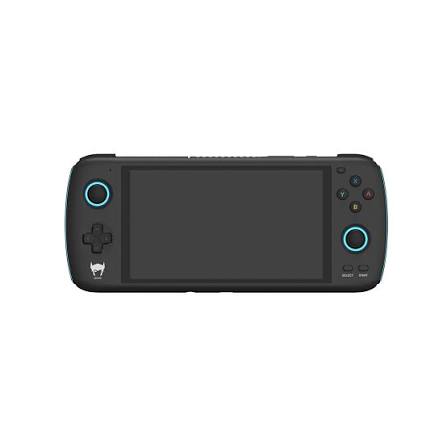
The AYN Loki Mini Pro is the budget entry in AYN’s 2023 Loki line, and unlike most handhelds near its price it is a genuine x86 machine rather than an ARM emulation box. It ships with Windows 11 on an AMD “Mendocino” Ryzen 3 7320U, which puts a real desktop instruction set and the entire Steam and Windows-emulator ecosystem within reach for a launch price of about $299. That framing matters. You are not buying a locked-down Linux front end here; you are buying the slowest, cheapest route AYN could ship into PC handheld gaming. It sits well beneath the Ryzen 7 6800U Loki Max, and the performance gap between the two is enormous.
Emulation performance, generation by generation
The chip is a four-core, eight-thread Zen 2 part clocked from 2.4 GHz to 4.1 GHz, paired with a Radeon 610M that carries just two RDNA 2 compute units at up to 1.9 GHz. The CPU is respectable; the GPU is the bottleneck in nearly every demanding scenario. Everything through the sixth console generation runs without drama. PlayStation 1 (DuckStation), Nintendo 64, Dreamcast (Flycast), Saturn, and PSP (PPSSPP) all hold full speed, usually with headroom to upscale. GameCube and Wii through Dolphin are largely playable at native resolution, though the anemic GPU means you rarely get to push internal resolution the way a Steam Deck can. PlayStation 2 in PCSX2 is a mixed bag: lighter and mid-tier games run well, but the heavy hitters stutter, and again it is the 610M that gives out first. Beyond that, be realistic. Wii U via Cemu manages lighter titles inconsistently. PlayStation 3 in RPCS3 is mostly out of reach on two compute units, with only simpler 2D-leaning games cooperating. Switch emulation was always marginal on this hardware, and with yuzu and Ryujinx shut down in 2024 it is not a use case to plan around. One practical note: results swing hard with the configurable TDP, and the little Mendocino part rewards patient per-emulator wattage tuning rather than one global setting. Treat this as a strong retro machine and a competent GameCube and PS2 box, not a current-gen emulator.
Screen, build and controls
The display is a 6.0-inch 1920×1080 IPS panel, 16:9, 60 Hz, touch-enabled and protected by OCA-laminated tempered glass at roughly 367 ppi. It is sharp and colour-accurate for the money, though 1080p is arguably more resolution than the 610M wants to drive in native PC games. There is no AMOLED here; that is the Loki Max’s party trick. Controls are the highlight: asymmetric, clickable Hall-effect analog sticks that will not develop drift, a proper d-pad, four face buttons, analog L2/R2 triggers and stacked shoulder buttons, plus gyro and rumble. The chassis measures 248 x 98 x 23.7 mm, which is squarely Steam Deck-sized real estate rather than anything genuinely “mini” — the name marks its place in the range, not its footprint. Connectivity covers Wi-Fi 6E, Bluetooth 5.2, a single USB-C port, a microSD slot and a 3.5 mm headphone jack. A roughly 12,000 mAh (about 46 Wh) battery keeps it alive, though the x86 silicon drains it faster than the ARM handhelds it visually resembles, so demanding emulation is a two-hour affair rather than an all-day one.
Software and setup
Out of the box it runs Windows 11 on 8 GB of LPDDR5 and a 128 GB M.2 2230 NVMe SSD, both of which are the real constraints. 8 GB shared between system and GPU is tight for modern PC titles, and 128 GB fills fast, so the microSD slot is not optional. Because this is x86, none of the ARM custom-firmware projects apply: muOS, Knulli, ArkOS, ROCKNIX and OnionOS target Rockchip and Allwinner boards, not this device. What does work is the PC-handheld stack. Many owners wipe Windows for a Linux gaming OS such as Bazzite, ChimeraOS, SteamOS or Batocera to reclaim RAM and cut overhead, and EmuDeck installs cleanly on either Windows or SteamOS to configure every emulator above in one pass. Expect to spend an afternoon tuning TDP and per-game settings — this is a PC, with a PC’s freedom and a PC’s homework.
Price, value and who it is for
At its roughly $299 launch price the Loki Mini Pro undercut almost every other x86 handheld, and that is the whole pitch. It is now discontinued, so it lives on the used market, where it makes sense only if you specifically want Windows or SteamOS flexibility on a tight budget and accept the GPU ceiling. If your library stops at GameCube and PS2, and you value Hall-effect sticks and a laminated 1080p screen, it is a sensible buy. If you are chasing PS3, Wii U or Switch, or any recent PC release at playable frame rates, spend more on a Steam Deck or a Ryzen 6800U handheld — the Mendocino chip will frustrate you. Buy it for what it is: the cheapest honest entry into x86 handheld gaming, not a do-everything machine.
📐 Size & Pocketability
🔋 Real-World Battery Estimator
⭐ Emulation Performance
📊 View How This Score is Calculated
The Hardware Power Score is an absolute metric. Perfect emulation of difficult, modern consoles awards significantly more points than standard retro consoles.
- 15× Multiplier: Modern PC
- 12× Multiplier: Switch, PS3, Xbox 360
- 10× Multiplier: Wii U
- 8× Multiplier: PS2, GameCube, Wii, Xbox
- 5× Multiplier: Saturn, Dreamcast, PSP
- 3× Multiplier: N64, PS1
- 1× Multiplier: SNES, GBA
Gen 8 & PC
Generation 7
Generation 6
Generation 5
Handhelds & Retro
⚡ Performance Benchmarks
Where AYN Loki Mini Pro AMD Radeon 610M lands against the handhelds everyone knows. Every bar shares one scale, so longer genuinely means faster — add up to two rivals to compare.
CPU = Geekbench 6 multi-core · GPU = 3DMark Wild Life. Median real-world scores; every bar shares one scale — add up to two rivals to compare.
📋 Full Specifications
📺 Display
⚙️ Platform
💾 Memory
🕹️ Controls
📏 Body
🔋 Battery
⚖️ Verdict
✅ The Good
- Genuine x86 Windows 11 machine at a roughly $299 launch price, opening the full Steam and PC-emulator library instead of an ARM walled garden
- Clickable Hall-effect analog sticks that resist drift, plus analog L2/R2 triggers, gyro and rumble
- Sharp 6-inch 1080p IPS touchscreen with OCA lamination and tempered glass
- Runs Linux gaming OSes (Bazzite, ChimeraOS, SteamOS, Batocera) and EmuDeck, so you can strip Windows overhead
❌ The Bad
- The Radeon 610M's two RDNA 2 compute units cap it well below a Steam Deck; PS3, Wii U and demanding PS2 or PC titles struggle
- 8 GB of shared RAM and a 128 GB SSD are tight, making the microSD slot mandatory and modern PC games cramped
- Discontinued with thin official documentation (AYN never published a consistent weight figure), so support and spares now depend on the community
📰 Latest News & Guides
The Ultimate Guide to ARMSX3: Android’s New PS3 Emulator, Competitor Comparisons, and Setup Tutorial
18/08/2026Pokémon Gold, Silver, and Crystal (Gen 2) Recomp Lands on Android
17/08/2026How to Play the Pokémon Red, Blue, or Yellow Recomp on Your Android, Windows, and Linux Devices
16/08/2026🔍 Similar Handhelds
Other handhelds that emulate up to Switch.