
🛒 Where to Buy
⚠️ Golden Rule of Retro Handhelds: Throw away the cheap MicroSD card that comes in the box — it will fail. And never use a high-wattage PD “Fast Charger” on these devices; it can damage the battery. Use a standard 5V/1.5A brick.
Device Overview: Retroid Pocket Mini V2
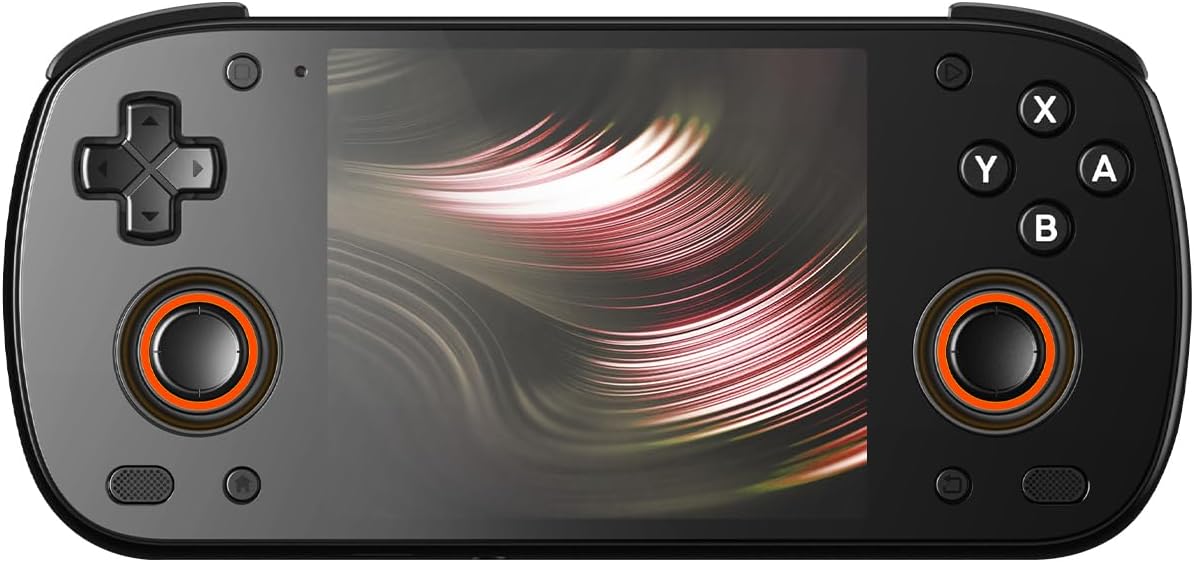
The Retroid Pocket Mini V2 answers a specific request: shrink a capable Android emulation handheld down to something that actually rides in a jacket pocket, without gutting the internals to do it. It keeps the Qualcomm Snapdragon 865 that powers Retroid’s full-size units, wraps it in a 165 mm-wide shell that weighs 215 grams, and puts a near-square 3.92-inch AMOLED up front. At $199 it slots against Anbernic’s larger Android handhelds and Retroid’s own Pocket Classic, and its pitch is refreshingly honest about the trade-off: you give up screen size and battery, and in return you get a device that disappears into a pocket while still playing GameCube.
Emulation performance, generation by generation
Do not read “Snapdragon 865” as a gaming PC. This is a 2020 phone chip: one Cortex-A77 core at 2.84 GHz, three more at 2.42 GHz, four A55 efficiency cores, and an Adreno 650 GPU. What makes it punch above that age is the open-source Adreno Turnip Vulkan driver, which lets Dolphin and PPSSPP lean on the GPU far harder than the stock blob allows. Everything through the fifth generation is trivial. PS1 in DuckStation, N64 in Mupen64Plus FZ, PSP in PPSSPP, and Dreamcast in Flycast or Redream all run full speed with upscaling headroom to spare, and Saturn via Yaba Sanshiro is largely solid. The interesting line is GameCube: Dolphin handles the bulk of the library at a locked 30, and lighter games such as Wind Waker or Mario Sunshine push toward 60 with the right settings. Wii is genuinely hit-or-miss and depends on the title. PS2 through NetherSX2 is the true ceiling here, so many games run full speed at native resolution, but demanding 3D titles want careful per-game tuning and will not always cooperate. Nintendo 3DS in the Citra-derived emulators such as Azahar is comfortable. Be skeptical of any claim that this chip does Switch, Wii U, or PS3 well; those are not realistic on ARM hardware of this class, and you should buy the Mini V2 for a ceiling that ends cleanly at GameCube and mid-tier PS2.
Screen, build and controls
The headline fix over the V1 is the panel. The V2 adopts a 3.92-inch AMOLED at 1240×1080, an unusual roughly 31:27 near-square ratio that suits 4:3 retro content beautifully, running at 419 PPI and 60 Hz. It is bright and contrasty, and the black artificial bezel that cropped the first Mini’s display is gone, so you see more of the actual screen. The controls are the other pleasant surprise. Both analog sticks are Hall-effect, offset below the D-pad and face buttons, and despite the tiny footprint they are usable rather than token. Triggers are true analog L2/R2 in a stacked four-shoulder arrangement, with L3/R3, a gyroscope, and a touchscreen rounding things out. The body is plastic, contoured from 16.5 mm at the screen to 29.3 mm at the grips, and the 4000 mAh battery is the honest cost of the small size: expect four to six hours of real emulation and top-ups over the 27 W USB-C port, which also carries video out for TV play.
Software and setup
Out of the box it runs stock Android 13, the path of least resistance: install RetroArch or standalone emulators, drop your ROMs on a microSD, and point a frontend such as Daijisho or ES-DE at them. Retroid’s stock launcher is serviceable, but most owners replace it. The more interesting route is Linux, since the Mini V2 dual-boots ROCKNIX, which strips away Android overhead and boots straight into a console-like, RetroArch-centric experience. GammaOS Next is the other community favourite, a debloated Android build tuned for these Snapdragon Retroids. None of this requires soldering or risky flashing; it is SD-card and bootloader territory, well documented by the community. Do not expect muOS, Knulli, or OnionOS here, as those belong to the cheaper Linux-only handhelds; this is Android-first hardware with a genuine Linux option bolted on.
Price, value and who it is for
At $199, launched in May 2025 in black only, the Mini V2 is not the cheapest way into emulation and is not trying to be. It is for the person who already knows they want pocketability and a genuinely good OLED, and who will pay a premium and accept shorter battery life to get both in one hand. If your ceiling is PS1, PSP, and Dreamcast, cheaper Linux handhelds do that for a third of the money. If you want the Mini V2’s real value, which is clean GameCube, competent PS2, a gorgeous near-square AMOLED, Hall sticks, and Android flexibility in something you forget is in your pocket, this is one of the few devices that delivers it at this size. The single-colour launch is the one nag, hinting at a modest production run rather than a long-supported flagship.
📐 Size & Pocketability
⚖️ Weight vs Other Handhelds
🔋 Real-World Battery Estimator
⭐ Emulation Performance
📊 View How This Score is Calculated
The Hardware Power Score is an absolute metric. Perfect emulation of difficult, modern consoles awards significantly more points than standard retro consoles.
- 15× Multiplier: Modern PC
- 12× Multiplier: Switch, PS3, Xbox 360
- 10× Multiplier: Wii U
- 8× Multiplier: PS2, GameCube, Wii, Xbox
- 5× Multiplier: Saturn, Dreamcast, PSP
- 3× Multiplier: N64, PS1
- 1× Multiplier: SNES, GBA
Gen 8 & PC
Generation 7
Generation 6
Generation 5
Handhelds & Retro
⚡ Performance Benchmarks
Where Retroid Pocket Mini V2 Adreno 650 lands against the handhelds everyone knows. Every bar shares one scale, so longer genuinely means faster — add up to two rivals to compare.
CPU = Geekbench 6 multi-core · GPU = 3DMark Wild Life. Median real-world scores; every bar shares one scale — add up to two rivals to compare.
📋 Full Specifications
📺 Display
⚙️ Platform
💾 Memory
🕹️ Controls
📏 Body
🔋 Battery
⚖️ Verdict
✅ The Good
- Genuinely pocketable at 165 mm and 215 g yet still fast enough for clean GameCube and competent PS2 emulation.
- Excellent 3.92-inch 1240×1080 AMOLED whose near-square 31:27 ratio frames 4:3 retro systems with no wasted letterboxing.
- Hall-effect analog sticks and true analog L2/R2 triggers, so no stick drift and genuinely usable inputs despite the small chassis.
- Flexible software: stock Android 13 plus a real dual-boot ROCKNIX Linux and active GammaOS Next community support.
❌ The Bad
- The 4000 mAh battery only lasts about four to six hours of emulation, the direct price of the small shell.
- The 2020-era Snapdragon 865 puts Switch, Wii U and PS3 out of reach, and heavy PS2 and Wii titles need per-game tuning.
- Launched in black only with a modest production run, raising questions about long-term availability and support.
📰 Latest News & Guides
The Ultimate Guide to ARMSX3: Android’s New PS3 Emulator, Competitor Comparisons, and Setup Tutorial
18/08/2026Pokémon Gold, Silver, and Crystal (Gen 2) Recomp Lands on Android
17/08/2026How to Play the Pokémon Red, Blue, or Yellow Recomp on Your Android, Windows, and Linux Devices
16/08/2026🔍 Similar Handhelds
Other handhelds that emulate up to PS2.