
🛒 Where to Buy
⚠️ Golden Rule of Retro Handhelds: Throw away the cheap MicroSD card that comes in the box — it will fail. And never use a high-wattage PD “Fast Charger” on these devices; it can damage the battery. Use a standard 5V/1.5A brick.
Device Overview: AYANEO 3
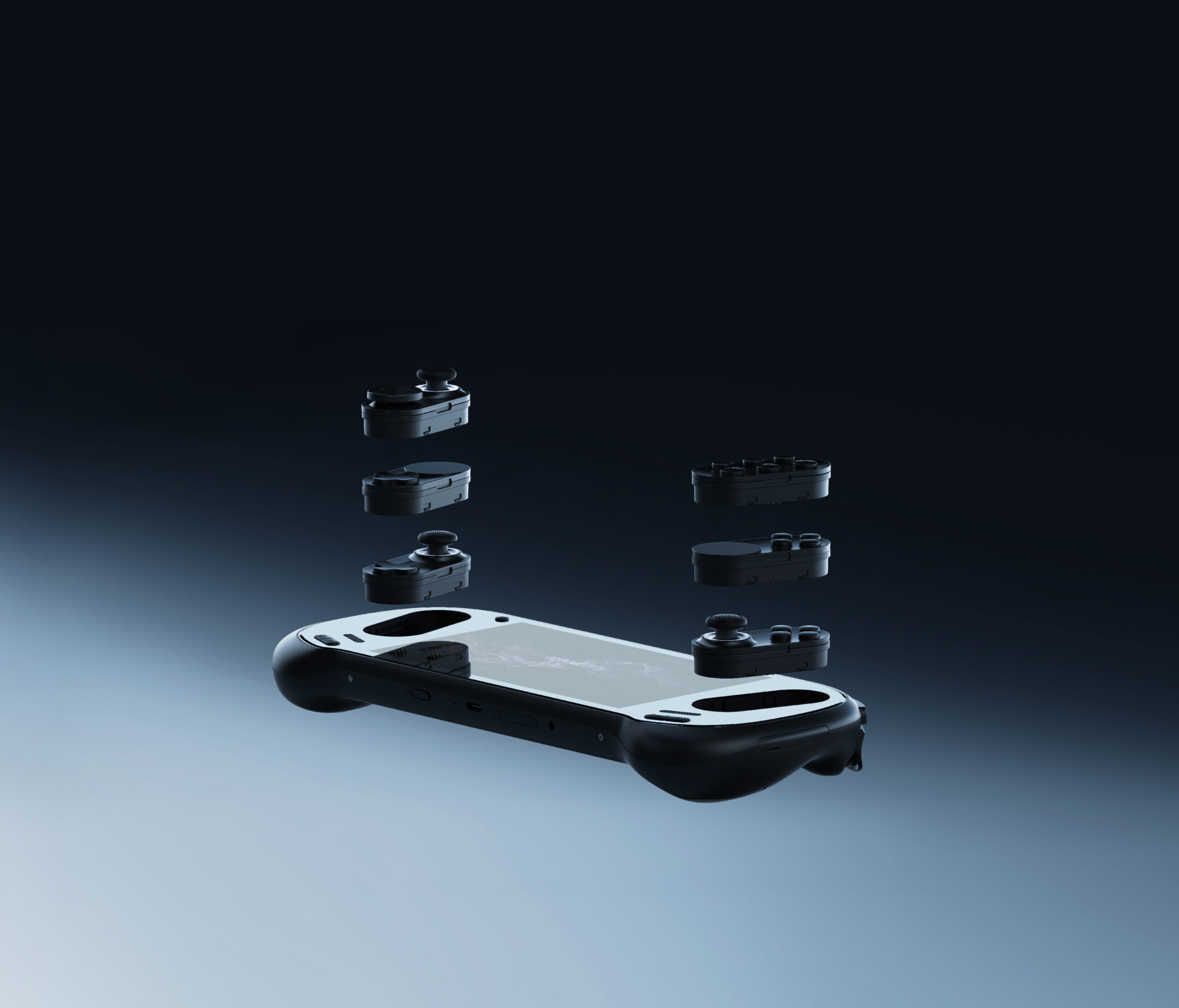
The AYANEO 3 is a Windows 11 x86 handheld, and specifically the one where AYANEO’s engineers decided the gimmick would be modularity. Its headline trick is the Magic Module system: the analogue sticks and face-button clusters pop off magnetically so you can swap in a touchpad block for FPS aiming or a six-button fighting-stick layout, with the company claiming 56 possible arrangements. Underneath the novelty sits genuinely fast silicon. The top SKU runs AMD’s Ryzen AI 9 HX 370, a 12-core Zen 5 chip (four full Zen 5 cores plus eight Zen 5c) with a Radeon 890M iGPU, while the entry model drops to the older Ryzen 7 8840U and its Radeon 780M. This is not a cheap retro emulator box; it is a premium gaming PC that happens to fold into your hands, and it is priced accordingly.
Emulation performance, generation by generation
Because this is a full x86 Windows machine, it runs the same desktop emulators you would use on a gaming laptop, not the ARM-limited ports. Everything up to the sixth generation is trivial: DuckStation (PS1), Dolphin (GameCube and Wii), PCSX2 (PS2) and Flycast all run at native resolution with upscaling headroom to spare. Seventh-gen is where the HX 370 earns its keep. PPSSPP handles PSP at 4x, Cemu drives Wii U cleanly, and RPCS3 finally becomes practical for a large slice of the PS3 library, though heavier titles still hitch. Nintendo Switch emulation via Ryujinx forks and yuzu’s successors is strong here, with many first-party games holding 30 to 60 fps at TDPs the chip can sustain. Xbox 360 through Xenia remains the usual coin-flip, entirely dependent on the specific game’s compatibility rather than raw power. The weaker 8840U model does all of this too, just with less overhead for the PS3 and Switch edge cases. The honest ceiling is set by thermals and battery, not the CPU.
Screen, build and controls
The 7-inch panel is a 1920×1080 display at 315 PPI, offered in two flavours. The OLED version pushes 800 nits, 144Hz and wide gamut (150% sRGB, 110% DCI-P3); the LCD alternative is 500 nits, 120Hz, with FreeSync VRR and a 7ms response. Both look sharp, and 1080p is a sensible native resolution for emulation upscaling. The chassis is large: 289.8 x 115 x 22.4mm and 690g with modules fitted, heavier than a Steam Deck and noticeably so over a long session. The Hall-effect sticks are drift-resistant and RGB-lit, the triggers are Hall-based with a two-stage 3mm/7.5mm switch, and the magnetic modules genuinely do snap on and off in seconds. Whether you will ever carry spare button clusters around is another question, but the sticks staying drift-free for years is the part that actually matters.
Software and setup
It ships with Windows 11 Home and AYANEO’s AYASpace 3.0 launcher, which handles TDP profiles, fan curves and a controller-friendly front end. Windows on a handheld is still Windows, so expect the usual friction: driver updates, a taskbar sized for a mouse, and games that occasionally ignore the controller until you alt-tab. The ARM-world custom firmwares (muOS, Knulli, ArkOS, ROCKNIX, OnionOS) are irrelevant to this class of device. The real alternatives are x86: EmuDeck installs and configures the whole emulator stack on the stock Windows install in one pass, and if you dislike Windows you can wipe it for Bazzite (a SteamOS-like Linux with gaming-mode) or Batocera for a console-style emulation front end. Third-party tools like Handheld Companion add gyro mapping and finer power control. Out of the box, though, most buyers will stay on Windows and lean on Steam plus EmuDeck.
Price, value and who it is for
This is the AYANEO 3’s weak point. The 8840U base model started around $699 as an early-bird price and roughly $899 at retail, and the fully specced HX 370 with 64GB and 4TB climbed past $1,799 early-bird toward $1,949 or more retail. The 49Wh battery and 65W PD charging are fine on paper, but a Zen 5 APU pushed to playable framerates will drain it in well under two hours on AAA titles, so this is a couch-and-desk machine that tolerates travel rather than a true grab-and-go. Against a Steam Deck OLED it wins on raw performance, screen and build in almost every measurable way, and loses badly on price and value. Buy it if you specifically want the fastest Windows handheld with a swappable-control party trick and have the budget to ignore the Deck. If you mainly want a great emulation box up to PS3 and Switch, cheaper HX 370 handhelds from ASUS or Lenovo do the same silicon for less, and the modularity is the only reason to pay AYANEO’s premium.
📐 Size & Pocketability
⚖️ Weight vs Other Handhelds
🔋 Real-World Battery Estimator
⭐ Emulation Performance
📊 View How This Score is Calculated
The Hardware Power Score is an absolute metric. Perfect emulation of difficult, modern consoles awards significantly more points than standard retro consoles.
- 15× Multiplier: Modern PC
- 12× Multiplier: Switch, PS3, Xbox 360
- 10× Multiplier: Wii U
- 8× Multiplier: PS2, GameCube, Wii, Xbox
- 5× Multiplier: Saturn, Dreamcast, PSP
- 3× Multiplier: N64, PS1
- 1× Multiplier: SNES, GBA
Gen 8 & PC
Generation 7
Generation 6
Generation 5
Handhelds & Retro
⚡ Performance Benchmarks
Where AYANEO 3 AMD Radeon 890M lands against the handhelds everyone knows. Every bar shares one scale, so longer genuinely means faster — add up to two rivals to compare.
CPU = Geekbench 6 multi-core · GPU = 3DMark Wild Life. Median real-world scores; every bar shares one scale — add up to two rivals to compare.
📋 Full Specifications
📺 Display
⚙️ Platform
💾 Memory
🕹️ Controls
📏 Body
🔋 Battery
⚖️ Verdict
✅ The Good
- Top-tier Ryzen AI 9 HX 370 (Zen 5) with Radeon 890M makes PS3, Switch and Wii U emulation genuinely practical
- Swappable Magic Modules (touchpad, fighting-stick, joystick blocks) are a real, working feature, not vaporware
- Excellent 7-inch 1080p panel, with an 800-nit 144Hz OLED option and drift-free Hall-effect sticks
- Full x86 Windows PC, so it runs desktop-grade emulators (RPCS3, Cemu, Ryujinx forks) plus EmuDeck, Bazzite or Batocera
❌ The Bad
- Very expensive, climbing past $1,799 for the top HX 370 config while a Steam Deck OLED costs a fraction
- Heavy at 690g and large, with a 49Wh battery that lasts under two hours in demanding AAA games
- Ships with Windows 11, inheriting its handheld friction (driver updates, mouse-sized UI, controller quirks)
📰 Latest News & Guides
The Ultimate Guide to ARMSX3: Android’s New PS3 Emulator, Competitor Comparisons, and Setup Tutorial
18/08/2026Pokémon Gold, Silver, and Crystal (Gen 2) Recomp Lands on Android
17/08/2026How to Play the Pokémon Red, Blue, or Yellow Recomp on Your Android, Windows, and Linux Devices
16/08/2026🔍 Similar Handhelds
Other handhelds that emulate up to CURRENTGEN.